

SPCX closed Thursday at $154.81, back above its $135 IPO price. The bounce is not the story. Investors are repricing SpaceX as vertically integrated AI infrastructure whose rocket exists to deploy its own network and compute, with Starship Flight 14 as the first operational test of that machine.
SPCX closed Thursday at $154.81, up about 2.6% after a 5.2% Wednesday gain — back above the $135 IPO after a collapse from above $225. The tape looks like a recovery. The books look like a second IPO without another share.
The June company sold rockets plus Starlink. The September company sells a stack.
The original public model was linear: launches feed Starlink satellites, satellites feed subscribers, subscribers feed connectivity revenue. SpaceX now reports itself as Space, Connectivity, and AI — wording from its own results, not from a sell-side overlay.
Last week CFO Bret Johnsen told Goldman Sachs’ Communacopia conference that SpaceX had closed another terrestrial hosting deal worth about $1.11 billion a month starting Dec. 1 — roughly $13 billion of annualized recurring revenue toward a $100 billion ARR target by year-end 2026.
That is an AI-infrastructure operator that still owns a launch vehicle. In the same session Johnsen said SpaceX is investing in Starship “because it enables our other businesses,” and in terrestrial compute because it funds the rest and trains the company for orbital racks. The CFO is describing the rocket as capital equipment.
Launch is already the small print
SpaceX reported $7.8 billion of second-quarter revenue. Connectivity, including Starlink, contributed $4.3 billion. The Space segment — launch services plus launch-and-development — was $962 million, about 12% of the total. Launch services inside that line were $648 million.
Markets already saw this inversion in August, when the first public quarter doubled sales on Starlink and wholesale compute while AI capex rattled the stock. The Colossus leases and power fights that followed made the same point: the scarce input is deployable capacity, not another Falcon slot.
Amazon does not live on selling racks; AWS monetizes what sits on them. Starship’s job is to lower the cost of putting SpaceX’s own higher-margin assets into orbit. A delayed flight is therefore not mainly lost launch revenue. It delays Starlink V3 capacity, direct-to-device service, future orbital compute, and whatever else becomes economic once payload cost collapses. Reuse has the opposite sign across businesses the public still files under “space.”
Terrestrial AI still collides with who pays for the grid. Orbit is the proposed exit from other people’s substations.
Flight 14 is when the science project has to carry inventory
SpaceX’s Flight 14 page still lists a Sept. 22 window pending regulatory approval. Subsequent reporting has pointed to a Sept. 28 target. The date is less important than the payload.
The mission is supposed to be Starship’s first true orbital flight and the first deployment of 26 operational Starlink V3 satellites. SpaceX says each adds about 1 terabit per second — 26 Tbps on this flight, roughly ten times a Falcon 9 launch of V2 Mini spacecraft. The buses are sized for Starship. Falcon 9 is not the growth vehicle for this generation.
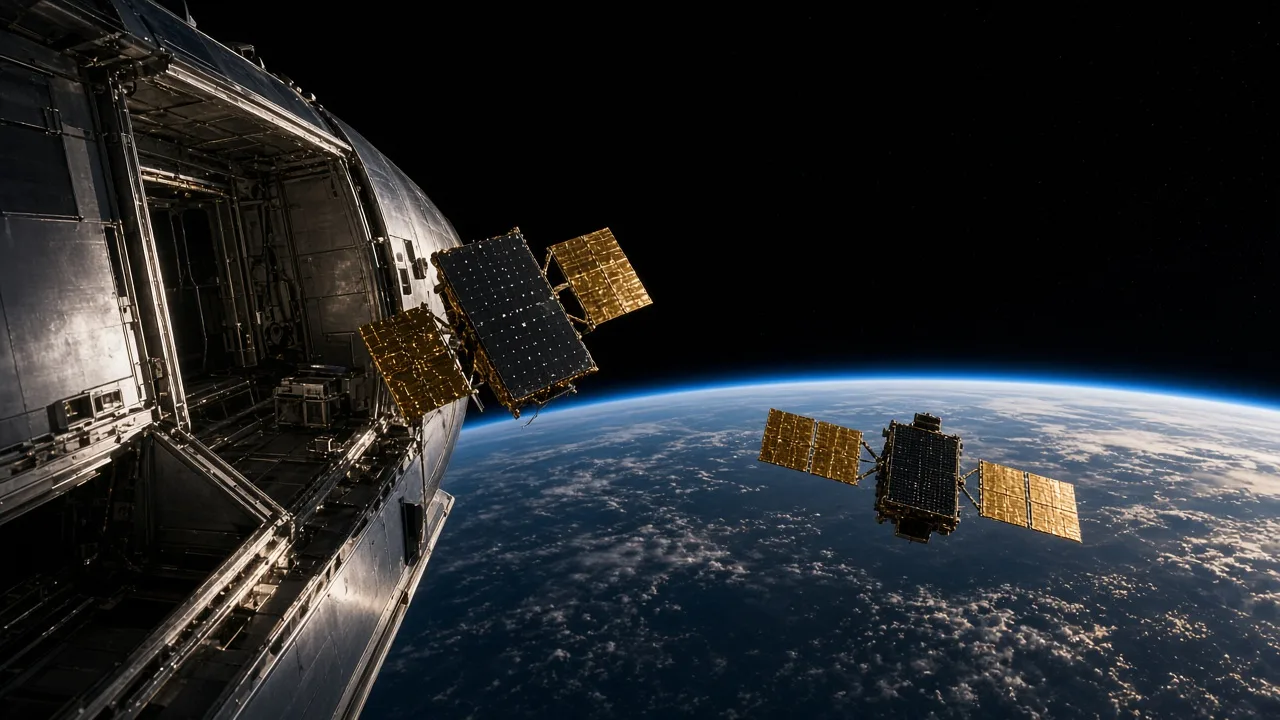
Flight 14 is therefore not a binary orbit test. It is whether SpaceX can turn its most expensive hardware into productive capital — the machine that scales the network Nvidia and SpaceX have already sketched as compute that leaves the terrestrial watt queue.
If share count has not changed much since a $1.75 trillion IPO at $135, $155 implies a capitalization near $2 trillion against revenue still in the low tens of billions. The market is not paying for the SpaceX that exists. It is paying for several future markets compressed into one owner of launch, constellation, network, and compute. The rally around $155 is that rewrite, and Flight 14 is the first date on which it has to fly.
More in AI & Compute


Sources
SpaceX Flight 14 mission page; Goldman Sachs Communacopia remarks by CFO Bret Johnsen; SpaceX Q2 2026 results; market close data for SPCX on Sept. 16–17.
