

AI's scarce input keeps migrating downward: models, then GPUs, then racks, then transformers, then turbines. SpaceX is now preparing to cast nickel- superalloy blades and vanes itself. Musk says that could pull gas turbines online up to eighteen months sooner. GE Aerospace just wrote an $11.75 billion cheque for the same casting layer.
The old tech-company stack was chips → servers → software. The interesting revision is not merely that tech companies are “moving into energy.” It is that the scarce resource setting the pace of AI deployment keeps migrating downward into progressively more primitive layers of the economy: models → GPUs → racks → cooling → transformers → transmission → turbines → nickel superalloys and castings. Capital can still buy Nvidia allocations. It cannot repurchase a vacuum-furnace calendar.
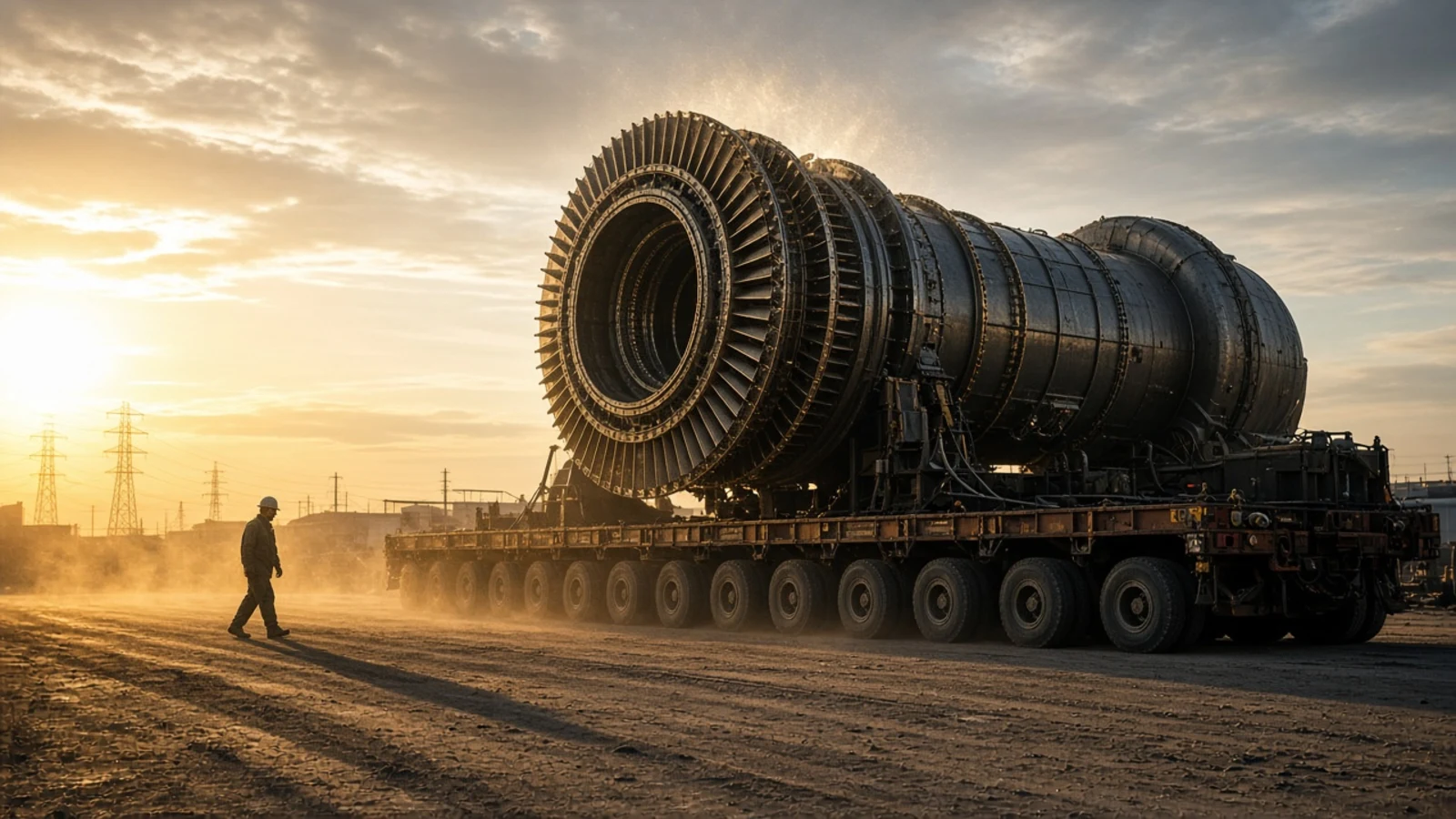
SpaceX is the clearest signal that vertical integration now follows that downward migration. The Information reported the company laying groundwork for a blades-and-vanes foundry in Bastrop, Texas — investment casting for large gas-turbine hot-section parts. Job listings for the site name what the metal actually is: nickel-superalloy equiaxed, directionally solidified, and single-crystal components; VIM furnaces; ceramic cores through wax, shell, and cast. On August 30, Elon Musk confirmed the basic story on X and said in-house casting could bring natural-gas turbines online up to eighteen months sooner. That eighteen-month figure is Musk’s estimate, not an independently demonstrated lead-time reduction. Treat it as a claim. The foundry program itself is not.
The turbine shortage is measurable before the foundry is romantic
GE Vernova ended the second quarter of 2026 with 116 GW of gas-turbine equipment under contract or paid slot reservation, up from 83 GW at the end of 2025. CEO Scott Strazik said the company is already taking reservations for 2031, with typical lead times directionally around three years. Roughly a fifth of that book is explicitly data-center support; the rest is traditional power customers racing the same industrial clock. Siemens Energy is largely booked through fiscal 2028, with later years filling fast. Customers — including data-center buyers — have been paying reservation fees on the order of 10–15 percent of turbine price to hold manufacturing slots, because time-to-power now has economic value that can outweigh peak thermal efficiency. Speed is the premium product.
Hot-section blades and vanes are not mundane widgets in that queue. They run in combustion environments that would melt their own alloys without internal cooling passages, thermal-barrier coatings, and casting methods that suppress the grain boundaries ordinary metal would crack along. A handful of specialized foundries do this at industrial scale. SpaceX already owns unusually deep metallurgy and casting expertise from rocket engines. That adjacency makes the Bastrop move plausible in a way that Meta deciding to stamp transformer cores would not be. It still does not prove the eighteen-month acceleration. It proves the company believes the casting layer, not the GPU allocation, is where months are being lost.
Then GE wrote almost twelve billion dollars for the same idea
On September 8, GE Aerospace agreed to pay $11.75 billion for Consolidated Precision Products, a major maker of highly engineered turbine castings. CEO Larry Culp called the capacity mission-critical. Reuters framed the deal as a bet on the “black art” of casting while engine supply remains tight; CPP had supplied GE for more than fifteen years. One of the world’s largest turbine and engine manufacturers just internalized more of the same constrained layer SpaceX is trying to grow in Bastrop. You are no longer taking Musk’s word that castings suddenly matter. You are watching industrial capital price the same bottleneck with a cheque large enough to clear a board.
The sequence inside the Musk orbit makes the industrial story sharper still. Earlier in 2026, SpaceX acquired APR Energy — a mobile gas and diesel generation fleet of more than 1 GW — in a deal that cleared FTC early termination in May and implied roughly $1 billion from minority-stake proceeds. Read it as a chain, not a stunt: AI chips → power shortage → acquire mobile generation → hit the turbine-component queue → build casting capacity. Hyperscalers elsewhere are making a quieter version of the same move by chasing behind-the-meter generation because utility interconnection can idle GPUs that have already been paid for. Transformer queues already showed capital cannot buy back industrial years. Castings are the next downward step.
Vertical integration follows the bottleneck. The bottleneck has left the clean room for the foundry floor.
What markets still misprice is the boundary of a “technology” company. Once electricity rather than computing is the limiting reagent, the logical firm expands: chips → servers → cooling → substations → generation → eventually the metallurgy inside the turbine. The companies racing to build intelligence are acquiring competencies that look increasingly like GE’s industrial playbook rather than Silicon Valley’s. Power and cooling already capped campus scale; the casting layer is where that cap becomes a materials-science problem with a multi-year apprenticeship.
The hunting heuristic for the next cycle is simple. Watch where hyperscalers and their orbit start manufacturing something that, five years ago, no sane person would have put inside the boundaries of a software company. Those boundary crossings are usually where the real shortages are hiding — and where atoms, not models, set the clock.
Continue reading


Sources
The Information / TechCrunch on SpaceX Bastrop blades-and-vanes foundry; Musk X post Aug. 30 on in-house casting and up-to-18-month acceleration claim; SpaceX Greenhouse job listings for SX/DS/EQ Ni-superalloy casting; GE Vernova Q2 2026: 116 GW under contract/reservation (from 83 GW end-2025), 2031 reservations, ~3-year lead times (Strazik); Siemens Energy booked into fiscal 2028 with reservation fees ~10–15% and Bruch on speed-to-power; GE Aerospace Sept. 8 deal for CPP at $11.75bn; FTC early termination / Duos filing on APR Energy (~$1bn+, >1 GW mobile fleet); Culled transformer queue and time-to-power coverage


