

AI is driving the first major U.S. electricity-demand supercycle in decades. The scarce assets are increasingly the machines, labor, and pipes that turn energy into reliable data-center power now. Commodity gas prices may stay mediocre; turbine slots, switchgear, and interconnection clocks will not.
The tempting shortcut is tidy: AI needs electricity, electricity needs natural gas, therefore buy gas producers. The cleaner thesis is broader and more mechanical. AI is creating the first major U.S. electricity-demand supercycle in decades, and the scarce assets are increasingly the things required to turn energy into reliable data-center power on a usable clock. The commodity producer may not capture as much value as the company that owns the bottleneck between molecule and megawatt.
EIA’s September Short-Term Energy Outlook makes the macro unusually explicit. It expects U.S. electricity sales of 4,135 billion kilowatthours in 2026 and 4,211 in 2027 — records in both years — and attributes much of the incremental demand to data centers and manufacturing. Natural gas still supplies roughly 40% of U.S. generation in the forecast. S&P Global separately reports proposed U.S. natural-gas generation capacity in interconnection queues jumping 68% year over year after a 159% surge the prior year, with AI and data-center load named as a driver. The investment response is already visible in the queue, not only in the spot price.
The Stack Rations Itself Upstream of the Rack
More compute still means more campuses. Campuses still mean massive incremental load. The grid still cannot expand on software schedules. That forces a familiar cascade: reliable generation now, then turbines and generators, pipelines, transmission and substations, transformers and switchgear, cooling and onsite power, and only then a live data center. Culled’s earlier map of power and cooling as the binding campus constraint stops at energization. The next question is commercial: where does demand exceed supply the most?
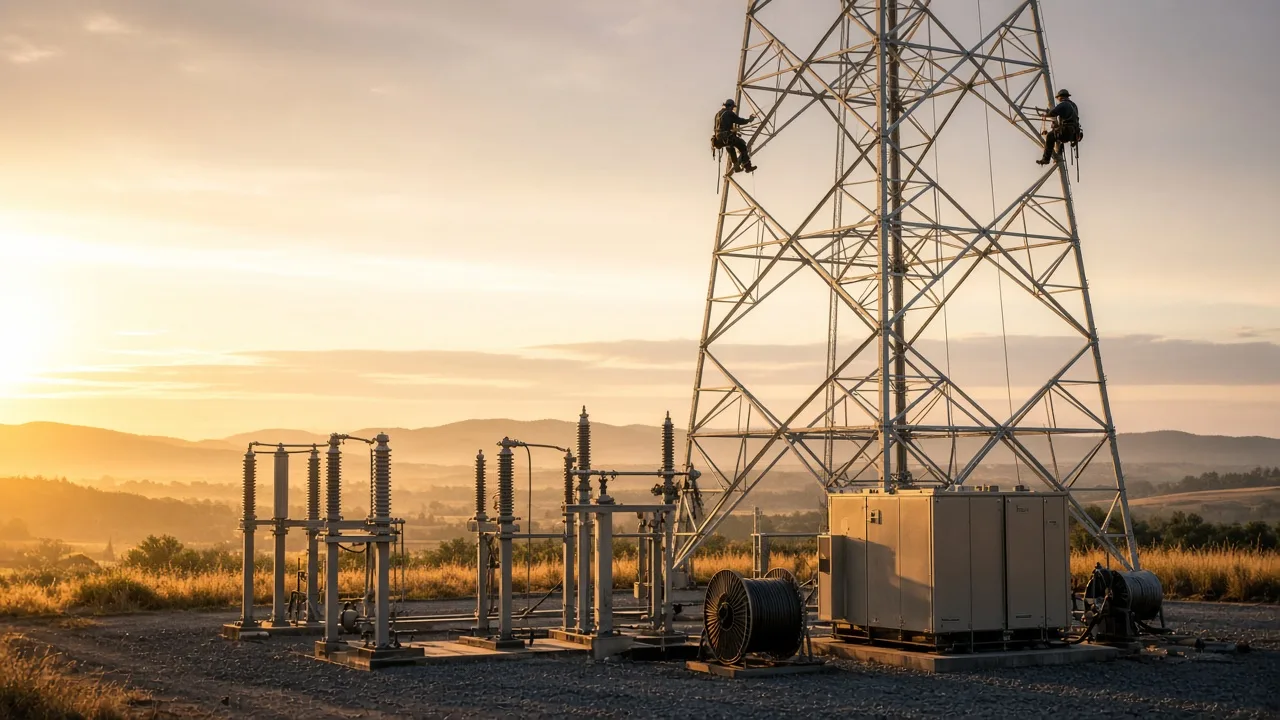
Five layers keep recurring. Gas turbines (GE Vernova). Electrical equipment — switchgear, breakers, busways, enclosures (Eaton). Grid construction — transmission, substations, distribution labor (Quanta Services). Gas transport into growing power corridors (Williams). Data-center power density and behind-the-meter systems (Vertiv). The hierarchy is not a stock tip sheet. It is a scarcity map. SoftBank’s DigitalBridge purchase already treated physical constraint as the asset. The electricity supercycle simply widens that claim from campus real estate to the industrial stack that feeds it.
Why Turbine Slots Beat Henry Hub
GE Vernova is the cleanest expression of the distinction. It is not a pure natural-gas bet. It sells turbines, grid equipment, electrification kit, power conversion, and renewables exposure — several layers between generation and the server hall. In Q2 2026 it said gas equipment under contract should reach at least 125 GW by year-end, with annual turbine output climbing from roughly 20 GW now toward 30 GW by 2030. Data-center-related Electrification orders already exceeded $5 billion year-to-date — more than twice all of 2025 — inside a $176 billion backlog. Utilities and hyperscalers can order gigawatts; only a short list of firms can manufacture high-efficiency heavy-duty turbines at scale. That is textbook bottleneck pricing, whether Henry Hub prints $3 or $5.
Eaton sits one step closer to the meter: switchgear, breakers, busways, UPS, customized electrical enclosures. Its latest manufacturing expansion — more than $240 million to double enclosure capacity for data centers and utilities — is the dull product becoming strategic. Quanta Services sells the labor: transmission lines, substations, distribution, pipeline and utility build. Whether the electrons come from gas, solar, wind, or nuclear, someone still has to string the path from generation to campus. Williams sits further upstream still. If new gas-fired plants get built, molecules must reach them; capacity reservation and transport fees can monetize throughput without requiring a commodity-price blowout. EIA still sees Henry Hub around the mid-$3s through 2027 even as power demand rises. That is the tell. The trade is not “gas becomes expensive.” It is “enormous capital must be spent to move and convert cheap gas into electricity on time.”
The scarce commodity is electricity available at the right location, at enormous scale, right now.
Time to Power, and the Third-Order Capex Cascade
Imagine the hall finished: GPUs racked, networking live, cooling commissioned — and the utility says interconnection arrives in 2031. The facility is economically idle until watts arrive. Vertiv’s roughly $1.45 billion upfront deal for UtilityInnovation Group — microgrids, onsite generation, behind-the-meter architecture — is explicit about the product being sold: accelerating “time to power” for AI data centers. That phrase may outlast the cycle’s slogans.
The first-order AI trade was Nvidia selling accelerators. The second-order trade was cooling and campus electricity, the same constraint that made Wall Street shrug at a clean Nvidia quarter. The third-order cascade is longer: AI capex → electrical load → utility capex → generation and transmission capex → pipeline and industrial manufacturing capex. Each hyperscaler dollar can trigger several layers of spend elsewhere. That is why the investable universe is larger than a GPU ticker — and why whether apps ever clear the bill is a different question from whether the arms race still pays the equipment vendors.
The structural advantage is blunt. Meta can spend tens of billions and later discover monetization was weaker than hoped. The firms that sold turbines, transformers, switchgear, pipeline capacity, and cooling still got paid. That is classic infrastructure economics: monetize the race, not the eventual winner. The major danger is equally blunt. GEV, VRT, ETN, and PWR are no longer secret AI beneficiaries. A great theme is not automatically a great stock at today’s multiple. The useful next step is quantitative: score a small AI-physical-infrastructure set on backlog growth, pricing power, capacity constraints, free-cash-flow trajectory, leverage, valuation, and how much incremental AI demand consensus has already baked in. The residual question is not whether electricity demand is rising. It is which name offers the most exposure to the supercycle per dollar of price — and that answer may sit further down the stack than the market’s loudest AI labels.
Continue reading


Sources
EIA September 2026 Short-Term Energy Outlook electricity sales and Henry Hub forecasts; GE Vernova Q2 2026 results on gas backlog and electrification orders; Vertiv UtilityInnovation Group acquisition announcement; S&P Global reporting on gas-generation interconnection queues; Culled prior coverage of power-cooling bottlenecks and AI infrastructure capital


