

AI campuses are no longer rationed mainly by accelerators. Multi-year interconnection queues, transformer lead times measured in years, and rack-density heat that forces liquid cooling mean the scarce inputs are watts and thermal headroom. Silicon still matters; energization schedules now decide who ships models on time.
For most of the AI boom, the scarce noun was silicon. CoWoS packaging queues, HBM allocations, and merchant GPU lead times set the tempo — and markets priced that scarcity with theatrical precision. That story is incomplete now. The binding constraint has migrated upstream of the white space, into the dull machinery that makes a rack useful: transformers, medium-voltage switchgear, utility interconnection, and the liquid loops that keep hundred-kilowatt cabinets from cooking themselves.
Dell’Oro’s framing is blunt. Liquid cooling grows fast and looks modern; it is rarely what delays a campus. You can stand up a cold-plate loop on a construction calendar. Energizing a substation lives on a different clock — often measured in years, not quarters. The industry learned to buy GPUs. It is still learning to buy watts on schedule. Facility teams already know the vernacular shift: “speed to power” now sits beside “time to train” on every serious build spreadsheet.
The Queue in Front of the Queue
Interconnection is the first rationing mechanism. In Northern Virginia, Dublin, parts of the Netherlands, and much of PJM territory, waiting for a firm grid tie can stretch five to ten years. Queues that once cleared in under two years now hold multi-thousand-gigawatt backlogs of generation and load studies. Hyperscalers iterate models in months. Transmission planners still think in decades. That maturity mismatch is not a footnote; it is the project plan.
Transformers tighten the same noose. Large power units that once shipped in weeks now quote lead times north of two years — sometimes four or five for specialized high-voltage gear. Every 200-to-500-megawatt AI campus needs step-downs at the tie, pad-mounts inside the fence, and distribution iron for cooling plants and UPS halls. A turbine slot without matched transformer slots is a press release, not capacity. Inside the building, conventional 48-volt distribution is bumping its physical limits as rack density climbs, which is why operators talk about higher-voltage DC paths that cut copper and loss — another platform rewrite forced by watts, not by marketing.
Capital notices the delay even when it does not name it. When Wall Street shrugged at Nvidia’s cleanest quarter, the selloff was partly a utility question: will the buildout pay for itself? Culled’s utility-gap argument asked whether apps can clear the bill. Power and cooling ask a prior question: can the bill even be delivered to the meter on time?
Cooling Is Mandatory — and Still Not the Delay
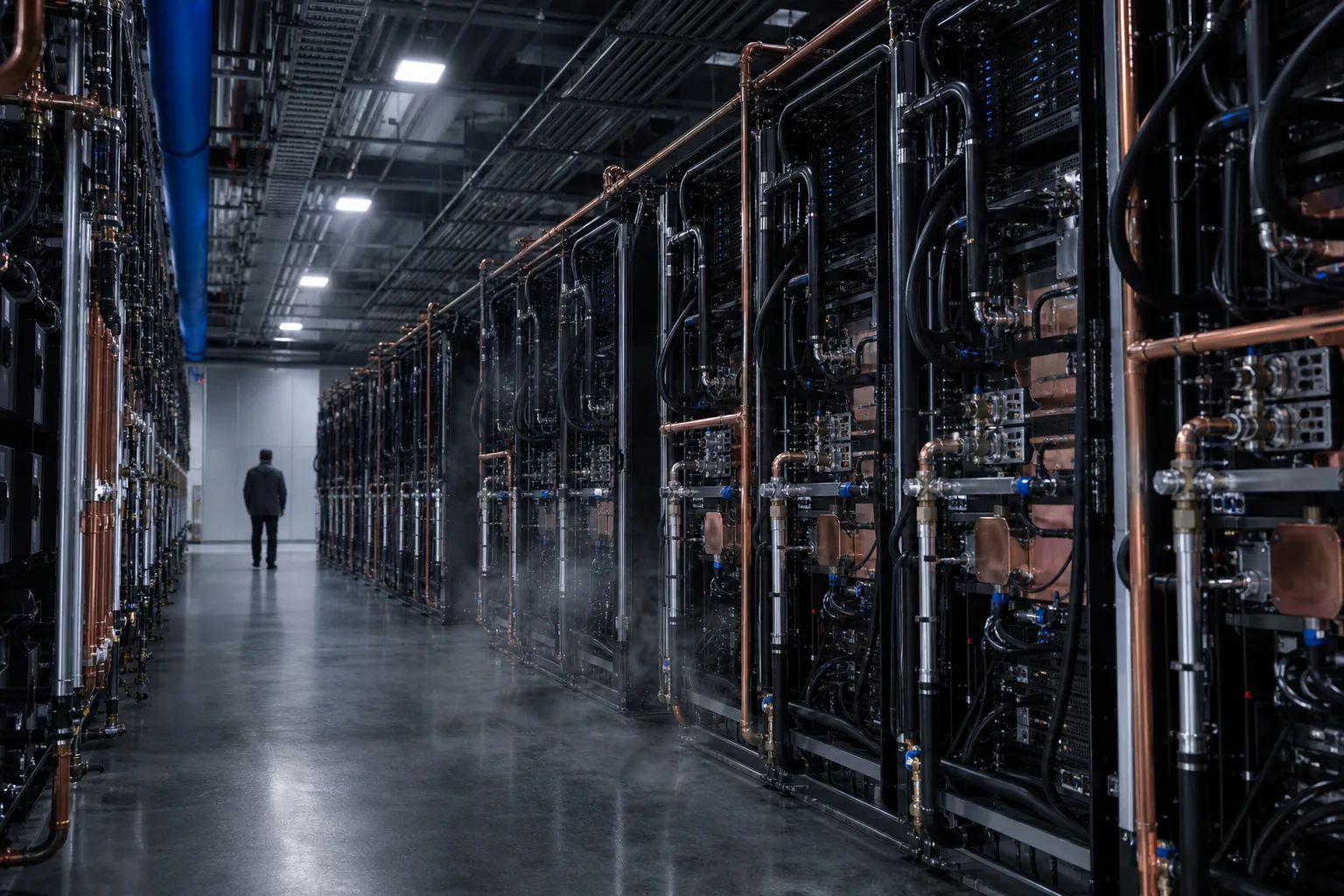
None of this makes thermal design optional. Direct-to-chip and immersion architectures are the price of admission for modern AI densities. Air cannot keep pace once racks push toward 100 kW and beyond; heat has to leave the die in liquid, then reject outdoors through dry coolers or closed loops that spare municipal water. PUE targets of 1.1–1.2 are not branding. They are survival math when cooling can eat a third of facility electricity. The industry’s thermal segment is growing nearly fifty percent year over year for a reason — density left air behind.
The strategic point is sequencing. Cooling is a solvable engineering problem once power exists. Power is a political-industrial problem: permits, utility cooperation, long-lead electrical equipment, and occasionally behind-the-meter generation when the queue will not move. Temporary gas turbines buy months — and invite the community and regulatory backlash already visible around gigawatt campuses. Speed to energization has become a location strategy. Markets with headroom and flexible-load deals win; saturated nodes lose deals they thought they owned. The same map explains why some operators now treat on-site generation as primary product, not backup: own the megawatts, own the schedule.
That is why custom silicon and merchant GPUs still matter without deciding the schedule. Broadcom’s quiet custom-silicon push and the merchant stack both assume a powered, cooled floor. Without it, architecture choice is theater. The dot-com echo warned that AI is not a simple fiber replay; the power layer is where the replay rhyme gets loudest — capital arrives faster than physical plant.
China’s AI-first five-year bet and Western intelligence warnings about near-term AI cyber risk only raise the stakes: whoever can energize dense compute first compounds model, defense, and industrial advantage. Kinetic fragility already showed that cloud regions are soft targets when war hit the cloud. Power yards and cooling plants are part of that attack surface — and part of the capacity map.
Price the Watt, Not Just the Chip
The actionable principle is simple. Treat interconnection queue position, transformer reservations, and cooling architecture as first-class capacity — as scarce as a GB300 allocation. Behind-the-meter generation, cooperative utilities, and closed-loop thermal design are not facilities polish. They are the platform layer that decides whether silicon ever leaves the crate.
AI scale-up does not stop at the rack door. It stops at the substation fence — until someone moves the fence.
Continue reading


Sources
Dell'Oro commentary on power-delivery bottlenecks versus liquid cooling; IEA Energy and AI demand framing; Lawrence Berkeley Queued Up interconnection backlog; industry reporting on transformer lead times and PJM/Northern Virginia grid congestion; Culled prior coverage of utility gap, CoWoS packaging, and custom silicon


