

Crusoe closed a $3.9 billion Series F on Thursday at a $30.9 billion valuation. Part of that capital funds Spark: factory-built, container-scale AI halls that go on a truck to spare power. The round is a check. The product changes the sequence.
Crusoe said Thursday it raised $3.9 billion in Series F capital at a $30.9 billion post-money valuation, co-led by Atreides Management, Mubadala Capital, and Valor Equity Partners, with Founders Fund, GIC, Nvidia, QIA, Radical Ventures, and TPG in the file. Ten months earlier it was a $10 billion company. Reuters repeated the book: more than $140 billion of total contracted value and over 6 GW contracted, 1 GW operational. That is the wire.
The residual is what some of the new money is for. Crusoe is still pouring Abilene — the Texas campus OpenAI used, now a multi-building, gigawatt-class site that also serves Microsoft after Oracle and OpenAI took other developers for later phases. In parallel it is manufacturing Spark: prefabricated, container-scale modules that put power, cooling, fire suppression, monitoring, and GPU-ready racks in a unit that fits a truck. CEO Chase Lochmiller told the Journal the Denver-area plant is meant, eventually, to turn out as much as 1 GW of Spark capacity a year. Units already run in Reno on solar and repurposed EV batteries from Redwood Materials.
The sequence, not the round
Until now the default AI question has been: where can we entitle a giant hall, then obtain the electrons? Spark inverts it: where are electrons already stranded — flared gas (Crusoe’s 2018 origin), remote solar, an underused substation, a battery pile — and can a factory-built hall arrive before a 100 MW tariff fight does?
Congress just told states to consider making hyperscale loads pay for upgrades. A container does not repeal PURPA or a queue. It can refuse the queue. Crusoe quotes field delivery in as little as three months; the Journal’s version is construction shrinking from years toward weeks. Neither number is a 20-year campus interconnect. Inference, Lochmiller said, does not need an Abilene. He expects most of Crusoe Cloud’s inference to run out of the smaller boxes.
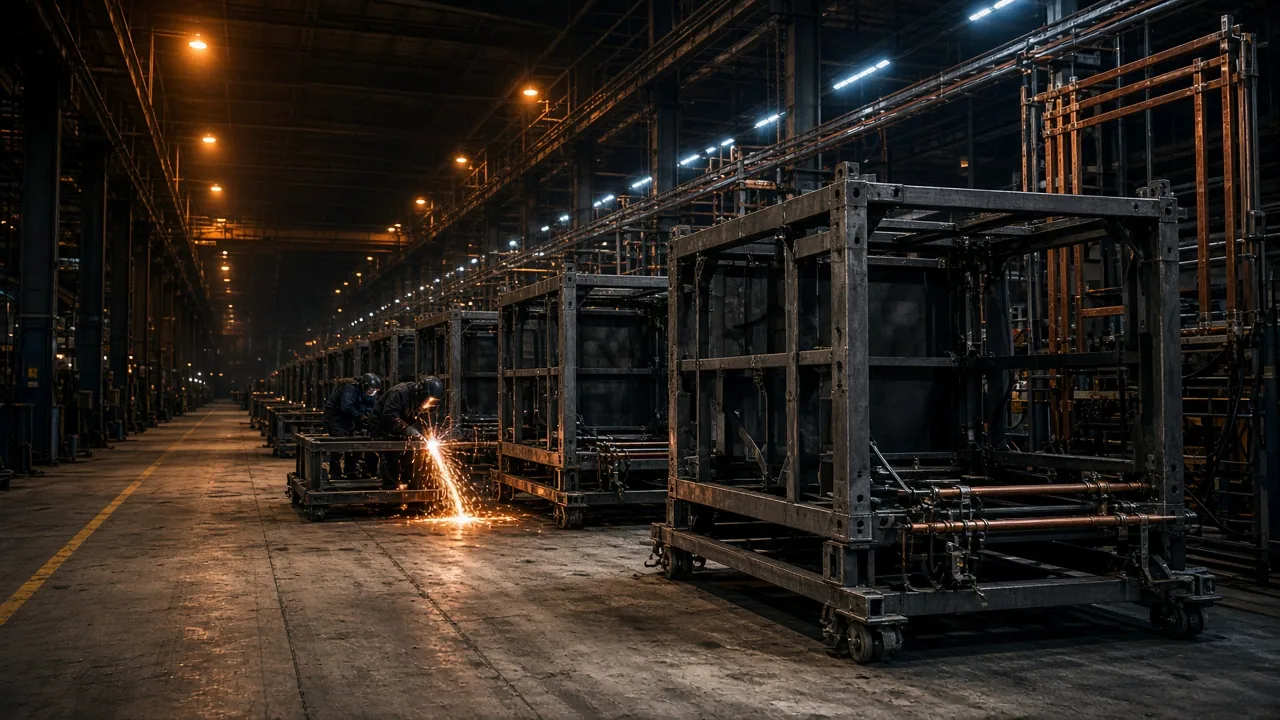
Stranded power becomes a token site
If the module works, sites that could never host a $20 billion campus become monetizable compute: industrial yards, behind-the-meter solar, gas that used to be wasted. Crusoe’s slogan is the stack from electrons to tokens. TPG’s note is that Spark is supposed to feed Crusoe Cloud’s pace, not replace the gigawatt campuses. The $140 billion TCV and 6 GW book are not a Spark-only ledger. Treating the round as “portable AI won” misreads the mix.
Limits sit in the same steel. Cooling, fire code, and fiber still exist at the pad. A truck does not create a transformer. Local backlash that kills a hyperscale hall can still kill a container farm if the farm is large enough to see. Satellite networking is a separate Crusoe bet with Starcloud in orbit, not a Spark spec sheet. Amazon is buying generators as an asset class for the same reason: time-to-power. Spark is the other escape — move the load to the watt.
The campus asks the grid to come to the GPUs. The container asks the GPUs to come to idle watts.
What still mis-prices is a $30.9 billion multiple as proof that Abilene-style buildout is obsolete, or as proof that it is safe. Ghost racks are still a demand risk. The test is factory throughput and pad count: Brighton’s first modules were slated for this quarter; watch how many Spark sites energize off-queue in 2027 versus how much of the 6 GW remains a conventional campus with a take-or-pay tariff. If inference really lives in containers, stranded megawatts start to look like inventory.
Continue reading


Sources
Crusoe/TPG Series F 17 Sept 2026 ($3.9B at $30.9B post-money); Reuters TCV and 6 GW contracted / 1 GW operational; Crusoe Spark and Brighton factory notices; WSJ/TNW on trucked units, Reno solar-plus-EV-battery, Denver 1 GW annual capacity.


