

A data center in Secaucus, New Jersey, discharged an estimated 5,000 gallons of diesel from a storage tank, sending cleanup crews to Anderson Creek. The accident is small beside AI's electricity appetite, but it exposes another physical dependency of cloud computing: large inventories of fuel kept on site for grid failure.
The cloud is designed to feel weightless. Its emergency plan is not. When an Equinix facility in Secaucus spilled thousands of gallons of diesel, a supposedly digital service acquired the unmistakable footprint of heavy industry.
The cloud’s emergency reserve is liquid fuel
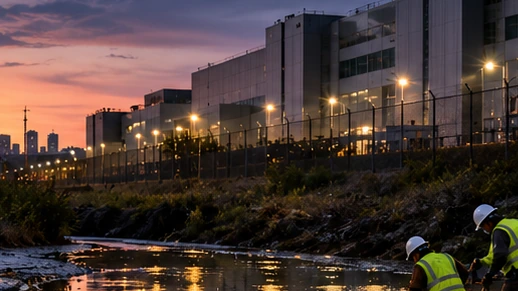
The spill began with a storage tank, not a server rack. New Jersey environmental officials said an estimated 5,000 gallons of diesel discharged Friday from an Equinix data center in Secaucus. Contractors were still removing oil from Anderson Creek, a tributary of the Hackensack River, when CBS New York reported the incident Monday evening. The state said the release had been contained, although it was still unclear how much fuel reached the creek.
Five thousand gallons is not large by refinery standards. That is precisely what makes the episode useful. A data center presents itself economically as software infrastructure, yet its reliability depends on equipment that would look familiar at a hospital, refinery or military base: switchgear, batteries, generators and fuel tanks waiting for the grid to fail.
The AI cloud is acquiring the accident profile of heavy industry.
Hyperscale operators design for uptime because a power interruption can strand enormous amounts of expensive compute. Batteries can bridge short disturbances, but sustained outages still push many facilities toward diesel or other on-site generation. The more concentrated the computing load becomes, the more consequential that backup layer becomes.
The Secaucus leak made an invisible part of that architecture visible.
Reliability creates its own industrial footprint
The popular accounting of AI infrastructure begins with electricity and cooling. We have already seen Texas turn water disclosure into an enforcement issue in its data-center crackdown, while new power architectures are emerging because conventional electrical equipment cannot keep pace with the buildout, as we reported in AI’s transformer redesign.
Backup fuel belongs in the same stack.
A large campus may need enough standby generation to carry critical loads while grid service is restored. That means not merely engines but fuel delivery, storage, containment, inspections and environmental controls. Each addition improves resilience against one failure while creating another category of operational risk.
This is an old industrial bargain. Refineries store hydrocarbons because they process hydrocarbons. Airports store jet fuel because aircraft require it. Data centers store diesel because software has become too economically important to tolerate darkness.
The novelty is cultural rather than mechanical. We still talk about cloud infrastructure as if its physical externalities stop at the utility meter.
AI is becoming an industrial land use
Secaucus sits inside one of America’s densest networks of fiber, finance and data-center capacity. The location makes digital sense: close to New York, connected to networks, valuable to customers that measure latency in milliseconds.
But physical density compounds too. Facilities that concentrate computing also concentrate cooling equipment, electrical gear, backup power and stored energy near roads, waterways and neighborhoods. Once those systems reach sufficient scale, ordinary industrial questions follow: What is in the tanks? Who inspects them? Where does a spill go? Who pays when containment fails?
The New Jersey incident does not establish that data centers are uniquely dangerous. It establishes something less dramatic and more important: they are no longer meaningfully separate from the industrial economy.
The cloud may still arrive through glass fiber. Its contingency plan arrives by fuel truck.
More in AI & Compute


Sources
New Jersey Department of Environmental Protection statements reported by CBS New York, plus Equinix infrastructure context.
