

Apple Inc. said Monday it is aware of an issue affecting the inner display on a small number of iPhone Duo foldable handsets and told affected customers to contact AppleCare for a replacement, after launch-week social posts showed cracks and bright lines along the central hinge on the device that began shipping Friday, October 23, 2026, with UK pricing from £1,999.
Monday, October 26 — Apple moved from launch applause to warranty arithmetic in seventy-two hours.
The company’s first foldable iPhone Duo hit retail on Friday, October 23, after online queues drained in minutes. By the weekend, Reddit, X, and repair forums lit up with nearly identical failure modes: a tightening hinge, sometimes a crunch on unfold, then bright lines or a crack along the inner panel’s center crease. On Monday, Apple told Reuters, BBC, 9to5Mac, and The Verge that it knows of an inner-display problem on a “small number” of units and that owners should call AppleCare for a replacement — without requiring AppleCare+.
The full statement, identical across outlets, paired reassurance with a narrow remedy:
The response to iPhone Duo from early users has been incredibly positive, and we are seeing exciting things from developers who are rapidly updating their apps to take advantage of its unique form factor. We are aware of an issue impacting the inner display on a small number of iPhone Duo units. If users experience issues with their iPhone Duo display, they should contact AppleCare for a replacement.
Apple spokespeople added that most phones should be fine and that defects tend to show up quickly after first use — language aimed at containing a gen-one recall narrative before it touches AAPL’s hardware margin story.
What owners report — and what is still uncounted
User posts cluster around the book-style hinge: damage radiating from the fold, occasionally a white patch on the right side of the inner screen. BBC and Bloomberg documented owners who received on-the-spot store swaps; Reuters noted tight inventory and long lead times on new orders, which could complicate replacements if service stock runs thin.
| What Apple said | What Apple did not say |
|---|---|
| Small-number inner display issue | Root cause or failure rate |
| Contact AppleCare for replacement | Whether a formal repair program or serial-range recall follows |
| Problem surfaces quickly when present | How many units are in the field vs. affected |
IDC analyst Francisco Jeronimo told BBC that some viral images may be AI-generated, so the internet’s denominator is unreliable even when the numerator is real. 9to5Mac made the same distinction: legitimate owner photos sit beside obvious fakes. AppleInsider said it contacted staff at 20 U.S. Genius Bar locations and counted four confirmed screen failures replaced from service inventory — a floor, not a prevalence estimate.
For PLATFORM power, the binding move is Apple’s control of the narrative channel: acknowledge, replace, decline to diagnose publicly.
iFixit’s hinge theory — and the Samsung precedent
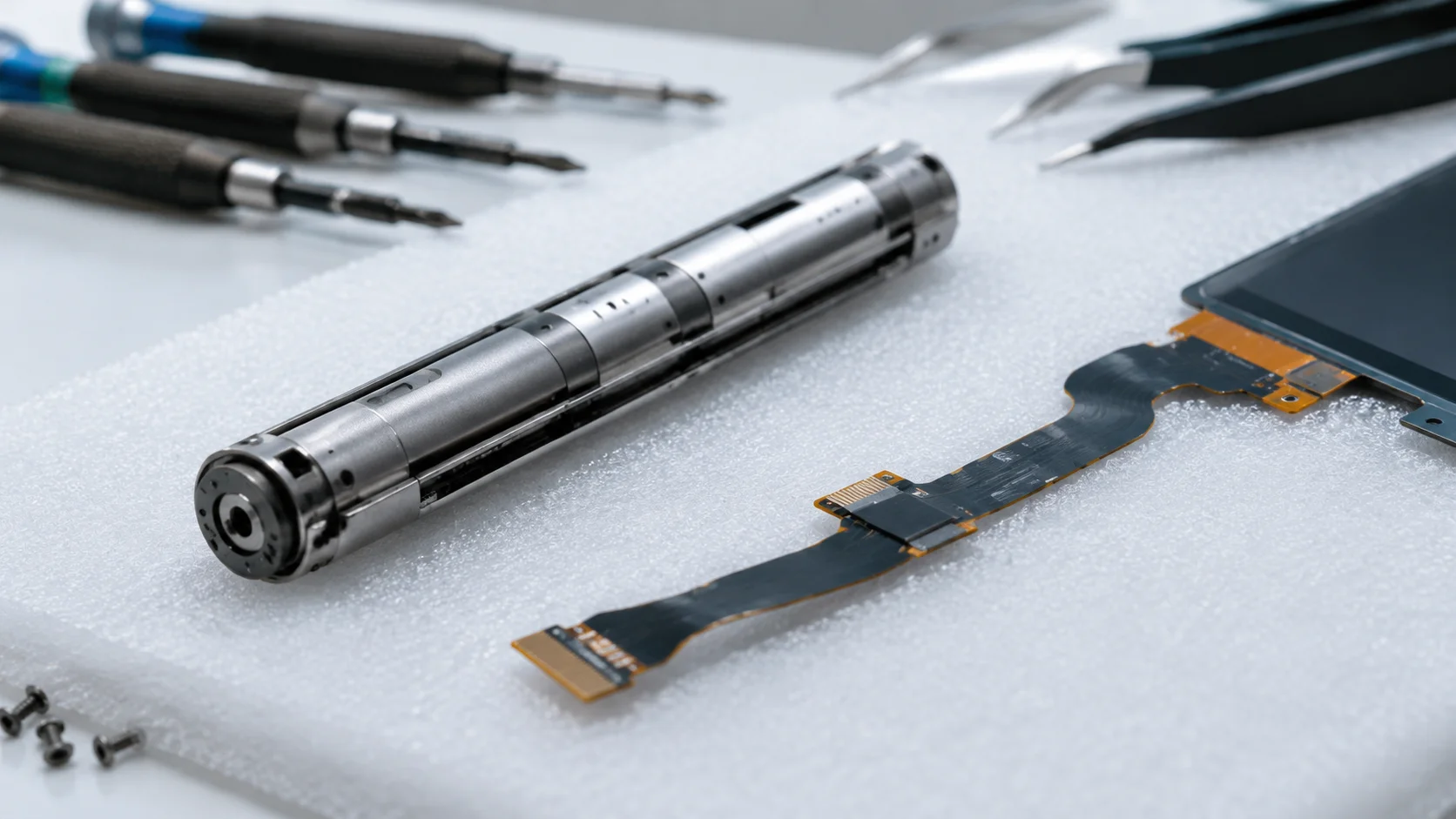
Apple offered no engineering explanation. iFixit, which published a teardown and awarded the Duo its highest foldable repairability score to date, ran CT-backed simulations and said reported breaks cluster near a display cable path under a central support bar. Its working theory: a component may fail to clear the panel during folding, creating a stress hotspot at the crease — the same mechanical class of flaw that haunted early Galaxy Fold units years before Apple entered the category.
That does not prove a design defect across the run. It does explain why first-batch foldables often fail in identical patterns: when a hinge tolerance is wrong, social media looks like a quality-control dashboard.
Separately, scattered reports of warranty denials for drop damage remain anecdotal; Apple’s Monday statement did not address them. Forbes and trade press have flagged the risk that accidental damage disputes get expensive on a $1,999 device with costly inner-screen repairs outside warranty.
Why this matters beyond Crackgate memes
Apple spent years insisting it would ship a foldable only when the mechanism was ready. The iPhone Duo is still a demand success — lines, scalpers, and analyst notes about 30 percent production uplift requests — but CAPITAL will price two risks now:
- Yield and rework if hinge batches need replacement mid-ramp.
- Trust tax on gen-one hardware, the force that kept many buyers on Samsung foldables until generation three.
Apple’s free replacement pledge is the standard platform play: absorb early-unit pain, keep reviewers and App Store partners focused on the 7.6-inch canvas. Whether that holds depends on numbers Apple has not published — and on whether Crackgate stays a small-number story once international units scale in January, when Bank of America analysts have flagged extended ship dates.
What to watch
- Service-stock availability versus retail sellouts — replacement speed is the reputational variable.
- Any serial-number or build-week pattern if repair networks leak batch data.
- iFixit and patent readers mapping the central support bar against Apple’s hinge patents.
- Q1 FY2027 commentary on Duo returns and manufacturing yields — the line item Apple will not name on Monday’s statement.
Apple did not cancel the foldable era it just opened. It did confirm, in the blandest possible corporate tense, that the era still belongs to the hinge — and to whoever controls the replacement queue.
Continue reading


Sources
Apple statement via 9to5Mac, The Verge, and Reuters (Oct. 26, 2026); BBC and Bloomberg reporting; iFixit teardown and simulation (Oct. 25–26, 2026); AppleInsider Genius Bar sampling.


