

HD Construction Equipment completed a new engine and battery-pack factory in Gunsan, South Korea, on October 28, targeting high-output power-generation engines for AI data centers alongside defense and commercial battery lines. The plant can build 1,250 generators rated at 1–3 megawatts annually, with mass production of the 1.3 MW DX37 engine slated for the first half of 2027. AI capex is now creating demand in heavy equipment markets investors once filed under construction and defense.
Gunsan, Oct. 28 — HD Construction Equipment opened a 116.8 billion won (US$87 million) engine and battery-pack plant at its Gunsan campus Wednesday, explicitly targeting high-output generators for AI data centers alongside defense and commercial battery production. The Korea Times and Korea Herald reported the completion ceremony, attended by HD Hyundai Vice Chairman Cho Young-cheul and regional officials.
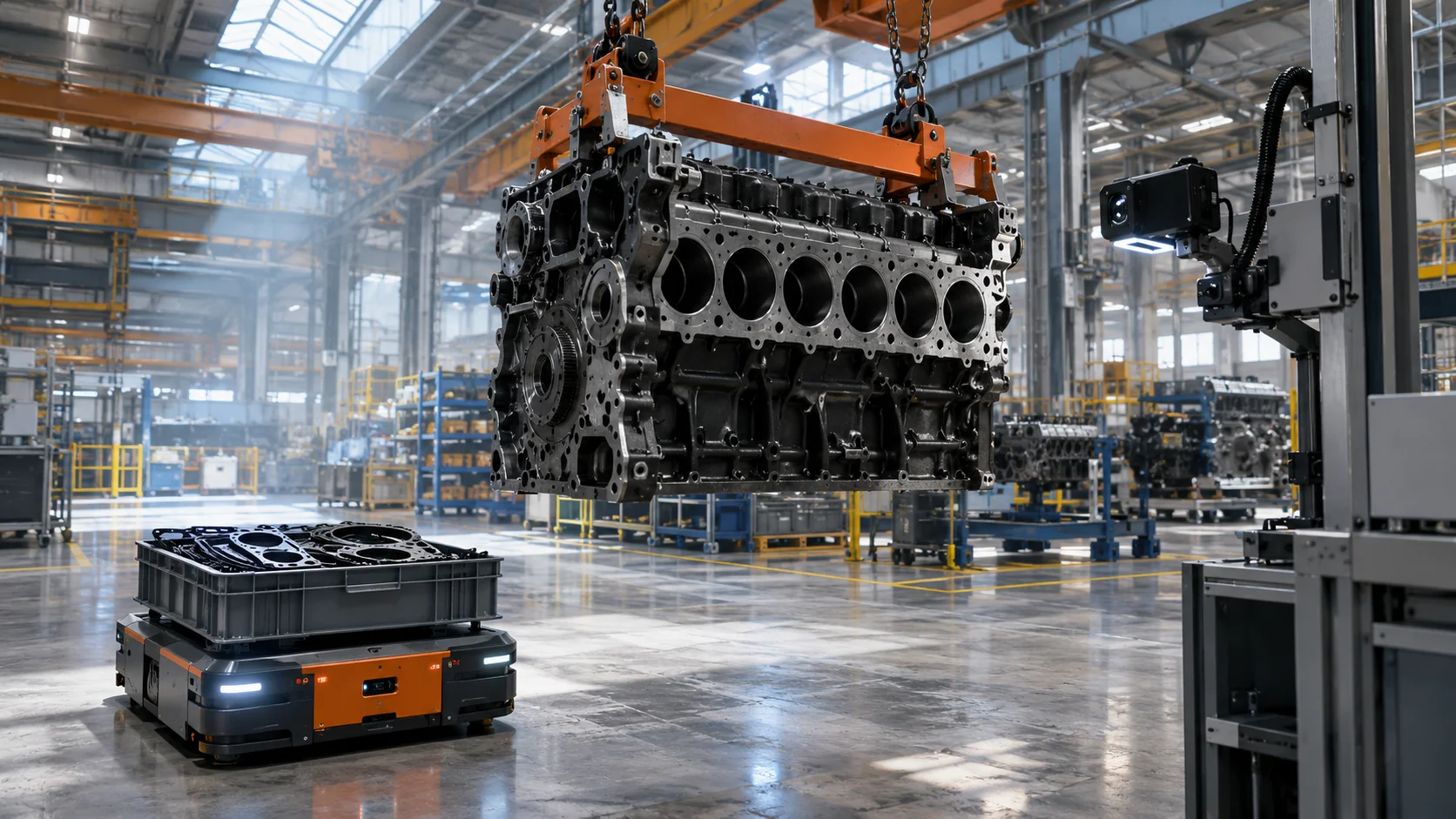
Built over roughly two years on a 62,700-square-meter site in the Gunsan National Industrial Complex, the facility adds automated assembly, autonomous mobile robots, pre-shipment defect detection, and a centralized control tower. Annual nameplate capacity includes 1,250 power-generation engines in the 1–3 megawatt electric range, 120 tank engines, and up to 1,460 megawatt-hours of battery packs — enough for roughly 9,400 electric buses if dedicated to that use case, the company said.
Power as a BOM Line Item
AI clusters do not run on silicon alone. On-site multi-megawatt generation — gas and diesel blocks, battery buffers, and grid interconnect — is becoming as strategic as HBM allocation for sites that cannot wait on utility timelines. HD Construction Equipment renamed its engine division Power Solutions at the opening, unveiling the 37-liter DX37 rated at 1.3 MW with mass production targeted for the first half of 2027. A 77-liter, 3 MW model is scheduled for 2028 and a 50-liter, 2 MW unit for 2029.
That cadence mirrors how hyperscalers phase power before accelerators: land, generation, cooling, then racks. Culled has tracked the same stack from modular data-center pods to fuel and duration bets tied to AI load growth. HD’s Gunsan investment pushes the story into heavy industry — a sector investors historically grouped with construction cycles and defense budgets, not Nvidia supply chains.
The company aims to lift engine-business revenue from 1.3 trillion won in 2025 to 2.5 trillion won by 2030, according to Korean press accounts of the ceremony. Earlier in October, reporting tied HD Construction Equipment to a roughly 390 billion won contract to supply gas generator engine components to U.S. power provider Enchanted Rock for 2027–2028 — one concrete U.S. data-center-adjacent order, though not necessarily fulfilled from every Gunsan line on day one.
Orders Versus Ambition
Plant openings are cheap signals; backlog quality is the constraint. HD Construction Equipment’s pitch combines AI data-center demand with steady tank-engine output and battery packs for commercial vehicles and construction machinery — a diversified load that reduces pure-play AI risk but also blurs how much capacity truly serves hyperscale generators.
Competition spans Caterpillar and Cummins-class OEMs, U.S. distributed-generation specialists, and the same on-site storage narratives battery vendors market to data-center operators. Korean industrial policy also matters: provincial officials at the ceremony underline that jobs and export content ride on whether DX37 shipments convert to repeat orders, not one-off ribbon photos.
A new fab line for memory is sold out through 2029; a new engine hall is empty until purchase orders match megawatt roadmaps. Watch Enchanted Rock component flows and the first DX37 delivery letters.
What Would Change the Verdict
Disclosed megawatt orders tied to named AI campuses — beyond component supply agreements — would confirm that Gunsan output is constrained by customer pull, not marketing. Delays in DX37 mass production or utility interconnect bottlenecks would show power equipment is still downstream of permitting, not just manufacturing. Competing OEM wins on U.S. data-center generation tenders would test HD’s 2030 revenue target.
For now, the Gunsan opening is evidence that AI infrastructure spending is widening the investable map — from SK hynix memory sold out for years to diesel blocks on skids in North Jeolla, waiting for the same electrons GPUs consume.
Continue reading


Sources
Korea Times; Korea Herald; JoongAng Daily; Seoul Economic Daily (Oct 28, 2026); HD Construction Equipment opening ceremony materials; prior Enchanted Rock component contract reporting; Culled AI power and data-center coverage.


