

At GTC Berlin on October 21, Nvidia introduced DSX POD, a partner-built modular reference design for Vera Rubin AI factories that the company says can cut deployment at an already prepared site from about six months to as little as 14 days. On October 22, Micron workers in Taiwan began strike action over profit sharing — a labor signal at the upstream end of the same supply chain, not yet evidence of lost memory output.
Berlin, Oct. 22 — PLATFORM economics in AI infrastructure used to look like a construction project: pour concrete, stage cranes, pull fiber, commission cooling, then rack servers one aisle at a time. On October 21, Nvidia introduced DSX POD, a reference design for complete Vera Rubin AI factories that partners build inside modular containers, integrate and validate at the factory, and ship ready to tie into power, cooling, and networking at the customer site. Nvidia says that final hookup at a prepared site can fall from about six months to as little as 14 days — a company projection for partner deliveries targeted in early 2027, not an independently audited deployment result.
The product story is not “chips in a box.” It is the relocation of integration labor — rack-to-rack cabling, liquid lines, power distribution, functional test — from a dusty data-hall floor to a manufacturing line. Jensen Huang framed the payoff as time to first production token: revenue begins when inference and training workloads run, not when the building permit clears. Nvidia’s FAQ is explicit that site preparation — foundations, grid power, facility water, network readiness — remains a separate schedule. The fourteen-day clock starts when the yard is ready to receive a pod, not when a board approves capex.
Who Captures the Faster Assembly?
DSX POD is a reference design, not a single-vendor SKU. Nvidia named a long partner list — Dell, HPE, Lenovo, Foxconn (Ingrasys), Quanta, Schneider Electric, Vertiv, Crusoe, and others — to manufacture and deliver modular factories worldwide. Each occupies a different margin pool: compute integration, power and cooling skids, logistics, and the CAPITAL that finances years of idle wait between interconnection queue and first token.
Faster assembly does not automatically mean cheaper silicon or more electrons. Helix-style coordination already showed that the scarce asset is synchronizing power, cooling, and shell — Nvidia is now standardizing the compute-and-mechanical bundle that drops into that shell. Vertiv and Schneider capture infrastructure rent whether the rack arrives by container or by flatbed. Hyperscalers still pay for HBM, advanced packaging, and transformers on industrial-time calendars that modular containers do not compress.
The Upstream Clock on October 22
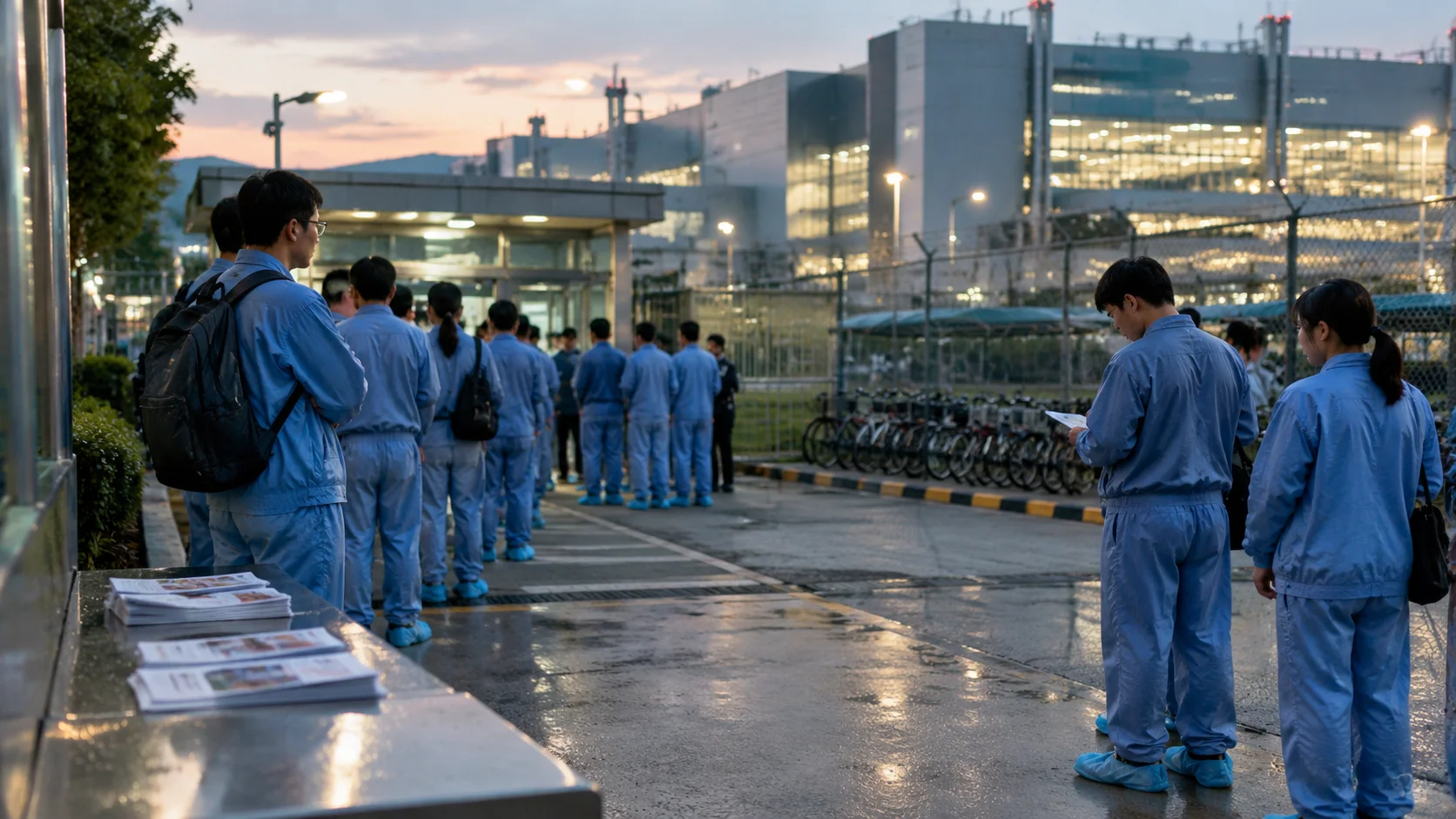
The contrast arrived the next morning in Taiwan. AFP reported that Micron workers began strike action over profit sharing — the first such move reported at a major Taiwanese semiconductor plant in years, though participation at one site involved only a handful of workers while a larger Taichung union had already reached an agreement. That profile matches a labor-relations warning, not a confirmed memory shortage. Culled’s earlier Micron coverage mapped the Taoyuan warning strike and mediation calendar; Thursday’s wire adds live friction at the layer where DRAM and HBM are etched, stacked, and tested — upstream of any containerized AI factory.
Micron’s dispute does not need to become a crisis to matter analytically. AI demand has made memory fabs politically visible and bonus formulas comparable across Samsung and SK hynix. A modular DSX POD can shorten onsite integration, but it cannot negotiate Taiwanese profit pools or expand HBM capacity on fourteen-day cycles.
Nvidia is shipping integration speed. The semiconductor ecosystem still ships on fab yield, packaging throughput, and shop-floor stability.
What Would Prove the Thesis
Three developments would upgrade this from an industrial-design announcement to measured economics.
Documented customer deployments hitting the fourteen-day prepared-site window with public uptime data — not keynote slides — would validate the deployment claim.
Site-ready metrics from operators (months from land to interconnection, not months from container arrival) would show whether the bottleneck simply moved upstream to grid and civil work, as containerized power bets already illustrate for storage.
Confirmed Micron output loss — missed shifts, allocation letters, HBM slip — would turn Thursday’s strike from signal to supply-chain fact. Until then, the synthesis stands: AI computing’s last mile is being manufactured faster than the foundry-and-memory economy that fills those racks can be duplicated or pacified.
Nvidia is not rewiring where chips are made. It is rewiring how finished AI capacity is assembled, transported, and switched on — while LABOR, STATE grid policy, and CAPITAL queues at the fab gate still set the pace for everything inside the container doors.
Continue reading


Sources
Nvidia Newsroom Oct. 21, 2026 (DSX POD reference design, 14-day prepared-site deployment claim, early 2027 partner deliveries, ecosystem partners); NVIDIA technical blog on factory integration; AFP Oct. 22, 2026 on Micron Taiwan strike participation; prior Culled Micron labor and Helix infrastructure coverage


