

Samsung and five affiliates have committed $1 billion to KKR’s Helix Digital Infrastructure. The strategic asset is not data-center real estate alone: Helix is assembling capital, generation, grid infrastructure, cooling, storage and construction capacity into one coordinated offer for hyperscalers.
Samsung and five affiliates have committed $1 billion to Helix Digital Infrastructure, the AI-infrastructure company KKR launched in June with the Kuwait Investment Authority, Nvidia and Vistra. The money raises a more useful question than whether another investor believes in data centers: what exactly is Helix buying that a conventional developer cannot?
The answer is coordination. Helix already had more than $10 billion of long-duration capital committed to a strategy spanning hyperscale facilities, power generation, transmission, distribution and fiber. Samsung adds a group whose subsidiaries can finance, design, cool, build, operate and back up the same campus. The scarce asset is no longer the data-center shell. It is the ability to make all the constrained parts arrive together.
The capital is buying a system, not a building
Helix calls itself a single coordination point for hyperscalers’ data-center, power and connectivity needs. That language can sound like investor-deck vocabulary. The corporate roster gives it operational content.
Samsung Electronics contributes $500 million of the commitment and brings cooling capabilities through FläktGroup, its HVAC subsidiary. Samsung C&T is an engineering, procurement and construction contractor for data centers and power-generation projects. Samsung SDS designs, builds and operates data centers. Samsung SDI supplies uninterruptible power systems and battery backup units. Samsung Life Insurance and Samsung Fire & Marine Insurance supply the remaining capital alongside those operating businesses.
Vistra, meanwhile, is Helix’s power partner. Nvidia is positioned around DSX AI-factory infrastructure and tokens per watt. KKR and KIA provide patient capital. No ordinary data-center landlord can recreate that stack simply by acquiring land near a substation.
The new moat is the ability to reserve power, deploy cooling and storage, build the facility and finance the delay as one transaction.
Power is what makes the integration valuable
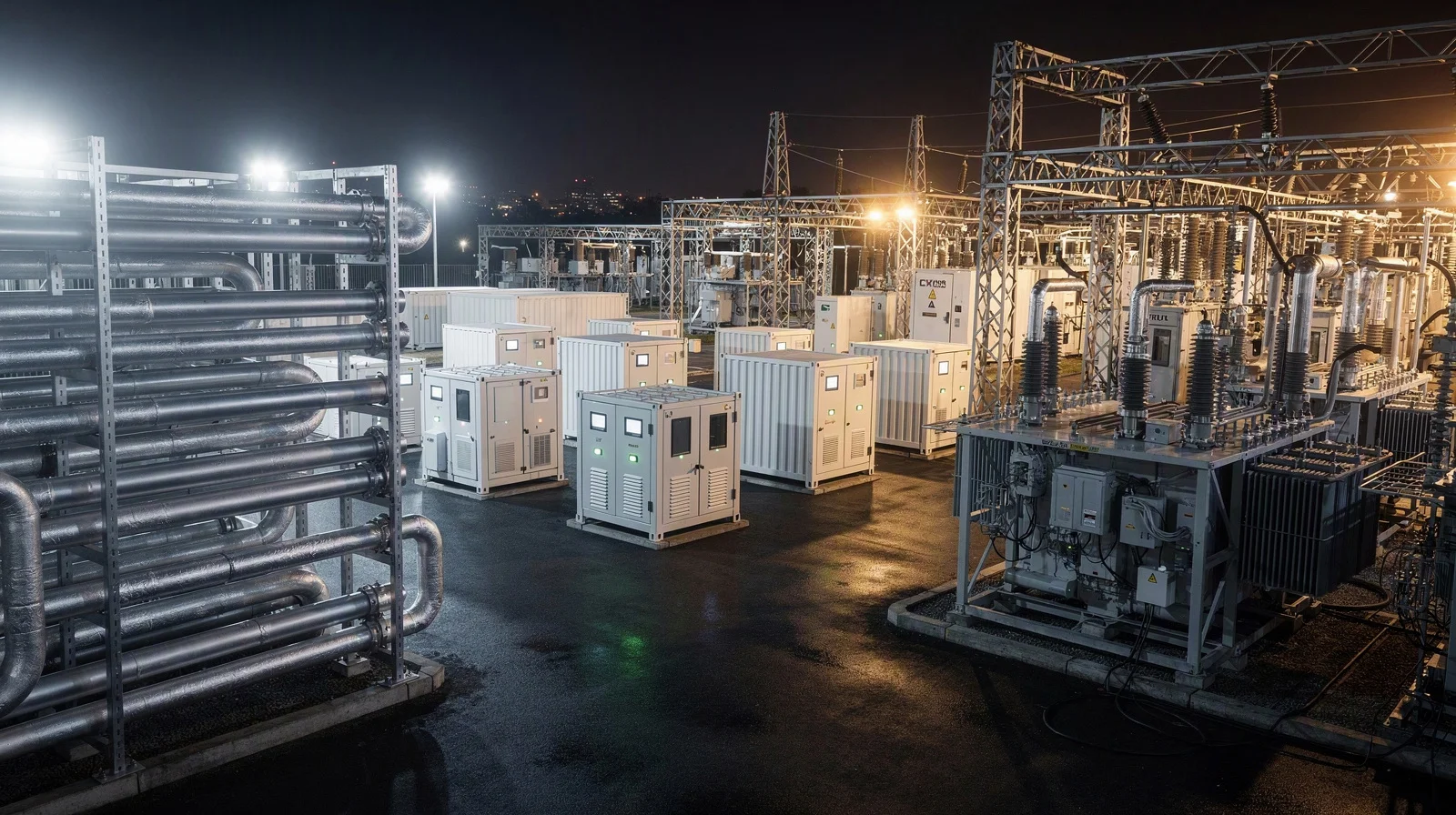
AI campuses compete for grid connections, dispatchable generation, transformers, switchgear, cooling equipment and skilled construction capacity. A developer that controls only the building is exposed to each external queue. A platform that can bundle generation, transmission and the physical campus can offer a hyperscaler a narrower execution risk.
That does not eliminate the bottleneck. It reallocates it. The transformer queue has become industrial time: a capital commitment cannot manufacture a transformer or obtain a grid interconnection on demand. But it can secure equipment earlier, align construction with power delivery and absorb the capital burden while both wait.
The cooling layer has become equally material. High-density AI clusters increasingly require liquid cooling, coolant-distribution units and heat-rejection infrastructure that are designed with electrical and mechanical systems rather than bolted on after the servers arrive. Samsung’s FläktGroup capability is therefore more than an affiliate cross-sell. It gives Helix access to a component of the campus whose design choices determine usable compute density.
Samsung is becoming an infrastructure principal
Samsung’s own announcement frames the move as an expansion from component supply to “system- and infrastructure-level influence.” The phrasing is candid. A semiconductor vendor earns on units shipped. An infrastructure principal can influence the specification, procurement sequence and lifetime expansion of the campus that consumes those units.
The company is not acquiring that influence through a single equipment contract. It is becoming an equity investor in the vehicle that selects projects and coordinates the supply chain. The $1 billion thus resembles a commercial option as much as a financial allocation: Samsung affiliates receive a closer route into potential cooling, EPC, data-center-operations and energy-storage work, while Helix receives aligned suppliers and capital.
The first Asian site is not yet a fact
The story should not outrun the announcement. Helix has not publicly disclosed a first Asian greenfield development, a specific campus location or a named hyperscale offtake. Its global mandate and Samsung’s Korean industrial base make Asia an obvious territory to watch, but they are not evidence of a signed Asian project.
That restraint matters because the market is already crowded with data-center claims. KKR has existing Asia exposure through STT GDC and other infrastructure platforms; Helix is a new global vehicle with a different promise. Its distinction is not regional presence. It is the attempt to package power, connectivity and compute-site delivery into one capital structure.
The next disclosure has to be physical
The thesis now needs a test. A named campus with a secured interconnection or dedicated generation source would demonstrate that Helix can turn its architecture into capacity. A hyperscaler offtake would show that buyers value coordinated delivery enough to commit. A cooling, battery or EPC award to Samsung affiliates would show the capital-and-supply loop operating commercially rather than rhetorically.
Until then, Helix is a well-financed design for removing execution risk from AI infrastructure. The wider constraint has already migrated into turbines, grids and other physical systems. Samsung’s investment says the suppliers of those systems no longer want to wait outside the project gate.
Continue reading


Sources
Samsung Global Newsroom announcement of the $1bn Helix commitment; KKR and Helix launch announcement; Reuters reporting on the transaction.


