

We are used to treating capital as a summon for physical assets. Increasingly it cannot. Money can reserve a large power transformer. It cannot repurchase the two-to-four years required to build one. In the AI grid buildout, industrial time itself has become the binding scarce input.
Large power transformers that could be obtained in roughly a year in 2021 are now being quoted at roughly 128 to 160 weeks, Inside the Datacenter and industry surveys report, with the largest units sometimes approaching four years. Generator step-up machines that tie new plants to the grid sit in a similar multi-year band. The hot commodity is no longer abstract “power infrastructure.” It is a reserved place in a winding bay — a manufacturing slot that capital can bid for but cannot accelerate past metallurgy, copper, and certification clocks.
That is a different kind of scarcity from a GPU shortfall. Chip fabs still respond to money with capacity expansions on known roadmaps. A transformer factory responds with a queue. Culled’s map of power and cooling as the campus bottleneck already treated energization as the hard gate. The residual underneath is uglier: even when a utility interconnection study clears and the shell rises, the iron that steps voltage down to useful buses may still be years from the pad.
One Mill, Many Queues
Industry analysis keeps returning to a material fact U.S. buyers cannot wish away. Transformer cores require grain-oriented electrical steel — GOES — a specialty product whose crystal structure is engineered so magnetic fields pass with minimal loss. Only one domestic mill system, operated by Cleveland-Cliffs after consolidating legacy electrical-steel plants, supplies that specialized steel for U.S. cores at meaningful scale. Every domestic builder drawing on local GOES draws from that franchise. Imports fill much of the finished-transformer market, but they do not erase the calendar; they only redistribute who owns the wait. You can finance a second winding plant. You cannot improvise high-permeability GOES on a software release cycle. New electrical-steel capacity takes years of capital, qualification, and process control — roughly the same horizon as the lead times it is supposed to relieve.
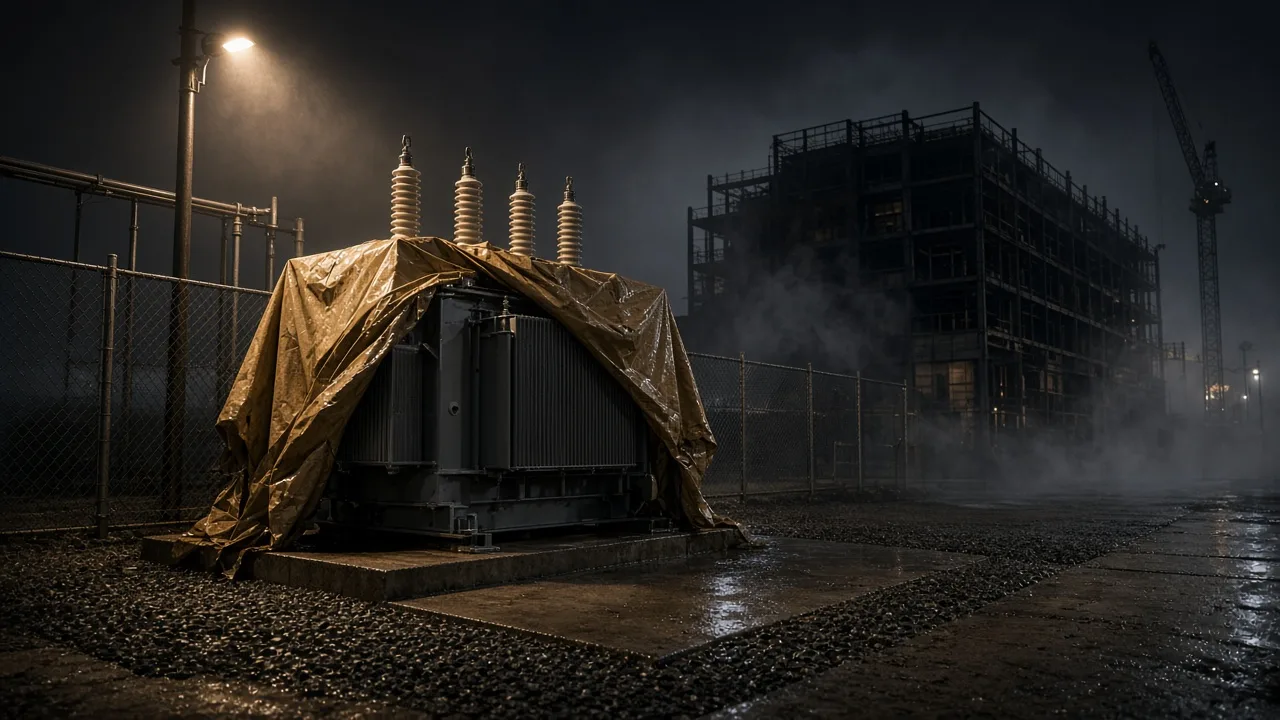
Industrial Time Versus Financial Time
We are accustomed to thinking capital can summon physical assets. Increasingly it cannot. Money can buy a transformer order. It cannot buy back the three years required to make one. That is the same logic as Verizon booking eighty million miles of Corning fiber years ahead and as turbine and switchgear bottlenecks in the electricity supercycle: offtake and slots beat spot cash. SoftBank’s DigitalBridge purchase claimed campus constraint. The transformer queue claims schedule constraint — delayed revenue for whoever already spent on GPUs, land, and cooling while the core steel is still laminating.
Financial time compounds. Industrial time queues. Markets that price the former as if it could compress the latter keep discovering empty pads: the campus lit, the racks staged, the interconnection story told — and the step-down iron still wrapped on a truck somewhere, or not yet wound. Prices for large units have shown roughly doubled-class inflation since the late 2010s in several surveys; that is delay selling itself as metal. Demand for generator step-up and substation gear has multiplied since 2019 while domestic GOES and winding capacity moved on steelmaker clocks, not hyperscaler ones.
Money can buy a transformer. It cannot buy back the years required to make one.
Hyperscalers have already learned to treat procurement as first-order planning, not a facilities footnote. Walk away from a gigawatt of planned load and you are often walking away from an equipment calendar, not a land deal. The actionable principle is simple. In any AI or grid project model, ask whether the critical path is capital, permits, or industrial time. If the answer is a factory queue measured in hundreds of weeks, the scarce asset is the slot — and the return accrues to whoever reserved it early enough that the pad is not waiting empty under sodium lights.
Continue reading


Sources
Inside the Datacenter and Wood Mackenzie-cited industry surveys on 128–160 week / multi-year large power transformer lead times; sole U.S. GOES producer concentration (Cleveland-Cliffs); Culled coverage of time-to-power, power-cooling bottlenecks, and manufacturing capacity reservation


