

China's AI story is increasingly told in tokens: metered word-pieces of inference, not crypto vouchers. Banks, carriers, cafes, and secondhand sellers now package them like data plans. The markets are real. Whether trillion-call headlines prove frontier progress is a separate, harder claim.
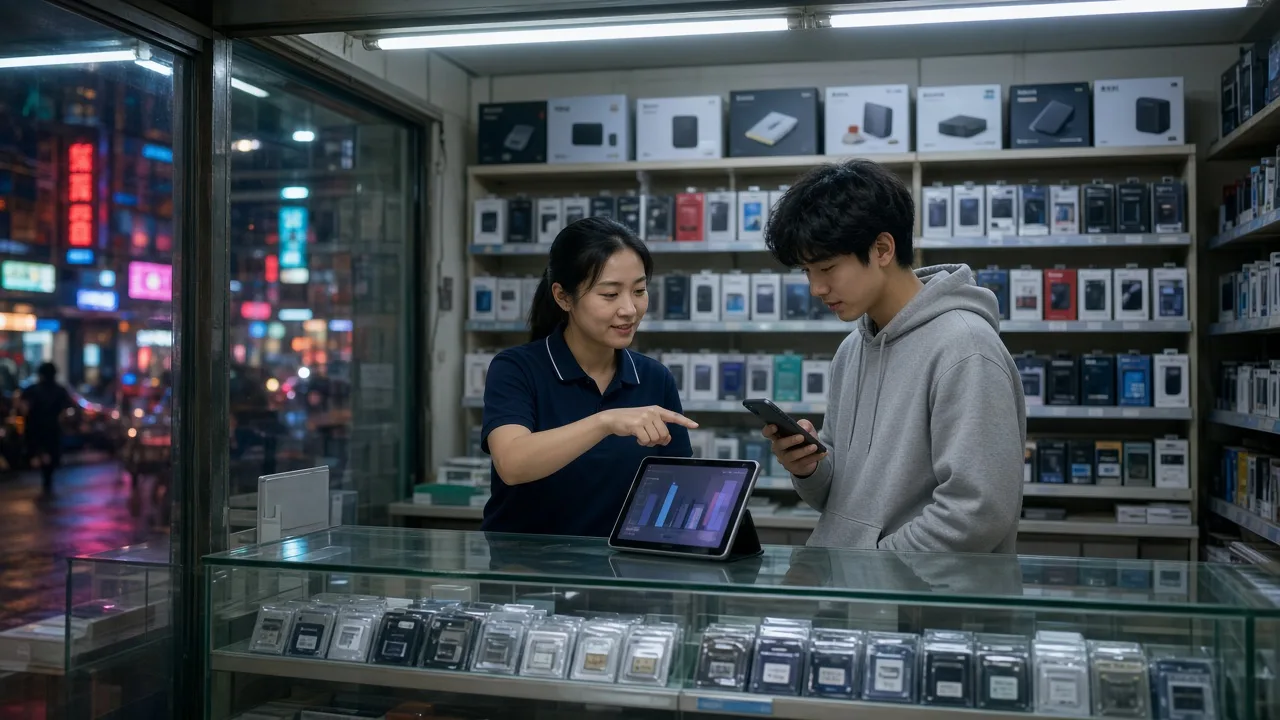
The rumor is half-right and easily misread. China is not building a speculative market in “AI coins.” It is commercializing the boring unit that already meters generative models: the token — a slice of text processed on the way into and out of a model. Rest of World documented the consumer face of that shift in September 2026: Moonshot’s Kimi card with Agricultural Bank of China and Amex paying AI quotas on spend; China Merchants Bank dangling up to 1.8 billion MiniMax tokens for new cardholders; Shanghai Pudong Development Bank subsidizing billions of Qwen tokens. Telcos sell allowances the way they once sold megabytes. China Telecom’s TokenHub advertises subscriptions across more than a hundred models; China Mobile and China Unicom package millions of tokens onto phone bills for a few yuan.
That distribution layer is the futuristic part. Intelligence is being SKU’d like prepaid data. Beijing’s Jingu Yuan dumpling house hands out computing vouchers with the meal — “feed your agent,” the table cards say — while AGI Bar offers DeepSeek access with a drink. Guangzhou’s Haizhu district even floated “token loans,” letting banks peek at a startup’s token production and consumption when physical collateral is thin. Culled has already treated tokens as a finance meter for cognitive work. China is pushing the same unit into consumer rewards and credit underwriting.
Official Shelves and Gray Relays
The darker shelf is also real. On Alibaba’s Xianyu secondhand marketplace, sellers list day passes, shared accounts, and millions of tokens for a few dollars — arbitraging official prices, free promotions, and enterprise allowances. Domestic reporting on “Token中转站” — API relay stations — describes the classic middleman: pool overseas subscriptions, reverse-proxy calls, resell by the million tokens at a fraction of list, sometimes swapping a weaker model behind a familiar name. Zhongtai Securities and state media have flagged compliance, data leakage, and bait-and-switch risk. So have local investigations of “source recharges” that only rewrite a client’s hosts file into a third-party pool. The buy/sell map is not a single exchange. It is official malls, carrier plans, and a hustle layer that looks like game-point cards mixed with shadow brokerage.
Volume Is Not the Same as Frontier
State and industry figures put China’s daily token calls at roughly 140 trillion by early 2026 and above 500 trillion by midyear in some accounts — a thousandfold jump from early-2024 baselines cited alongside them. Treat those numbers as weather, not audit. Measurement methods, paid versus free share, and model mix are rarely disclosed. Analyst Poe Zhao, quoted by Rest of World, called many consumer packages a “supply-led experiment”: ordinary users still meet AI inside an app, not a token balance. Cheap Chinese open-weight inference — often priced 60–90% below U.S. frontier APIs on Rest of World’s comparison — explains why tokens can be given away with dumplings: efficiency under chip constraint made the unit abundant enough to market. Abundance is not the same as catching GPT-class reasoning. It is closer to what the 15th Five-Year Plan’s compute-network bet needs to look like on the street: utilization, habit, distribution.
The token markets prove China can package inference. They do not, by themselves, prove China has won the frontier.
Alibaba’s capex paradox and the Qwen open-weight race still sit upstream of every voucher. Capex buys clusters; tokens are the retail receipt. Gray relays can inflate apparent demand while degrading trust. Credit-card billions of tokens can be marketing float. The useful read is narrower and still striking: China has turned the metered unit of machine text into something ordinary people encounter — on a bill, a dumpling ticket, a secondhand listing — which is how platforms win distribution wars. The skeptical test for investors and policymakers is the same: separate liquid packaging from model quality, and ask whether tomorrow’s token call was paid, substituted, or merely counted.
Continue reading


Sources
Rest of World (Sept. 2026) on consumer AI-token rewards, telco plans, Xianyu listings, and Guangzhou token loans; Chinese press on Token中转站 gray markets and official call-volume claims (140T–500T daily); Culled prior coverage of China AI efficiency, Five-Year Plan compute push, and token metering


