

Alibaba released Qwen3.8-27B, a model small enough to run on a laptop. Days after Meta's Muse Glimmer, Hangzhou also opened Qwen3.8 Max weights. The China-U.S. contest now turns on whose intelligence fits consumer hardware — not whose GPU hall is largest.
On Monday, Alibaba’s Tongyi Lab put a 27-billion-parameter model on the same hardware as a commute. Qwen3.8-27B is a dense multimodal model, Apache 2.0, and — quantized — small enough to run on a laptop. Hangzhou also opened the weights of Qwen3.8 Max, a 2.4-trillion-parameter mixture-of-experts with 95 billion active parameters: the first Max-class release in this generation. The sequence is the story. Last week Meta announced Muse Glimmer, a roughly 30-billion-parameter open-weight family aimed at laptops, and said it would open-source its most powerful model as a U.S. alternative to Chinese stacks. Alibaba answered in days, not product cycles.
Open weights are scored by what developers actually fork. Hugging Face counted 151,448 Qwen derivatives — 2.6 times Meta’s footprint, 4.7 times Llama specifically — and more than two billion Qwen downloads in the first seven months of 2026. Nick Patience of the Futurum Group told CNBC that Meta’s re-embrace of open weights was itself a response to two years of Chinese labs taking share. Neil Shah of Counterpoint Research called on-device the “next battleground.” Alibaba is not chasing a leaderboard. It is trying to become the default weights that hardware makers design around.
The Prize Moved From the Hall to the Chassis
The physics are prosaic. Quantized, Qwen3.8-27B can sit in roughly 17 gigabytes of memory; a 24-gigabyte consumer GPU is enough. Alibaba says the 27B matches Qwen3.7-Plus — a mixture-of-experts ten times its size — on coding, office work, research, and long-horizon agents. Native context is 262,000 tokens, stretchable to a million. That is not a toy. It is a claim that frontier-adjacent work can leave the rented rack.
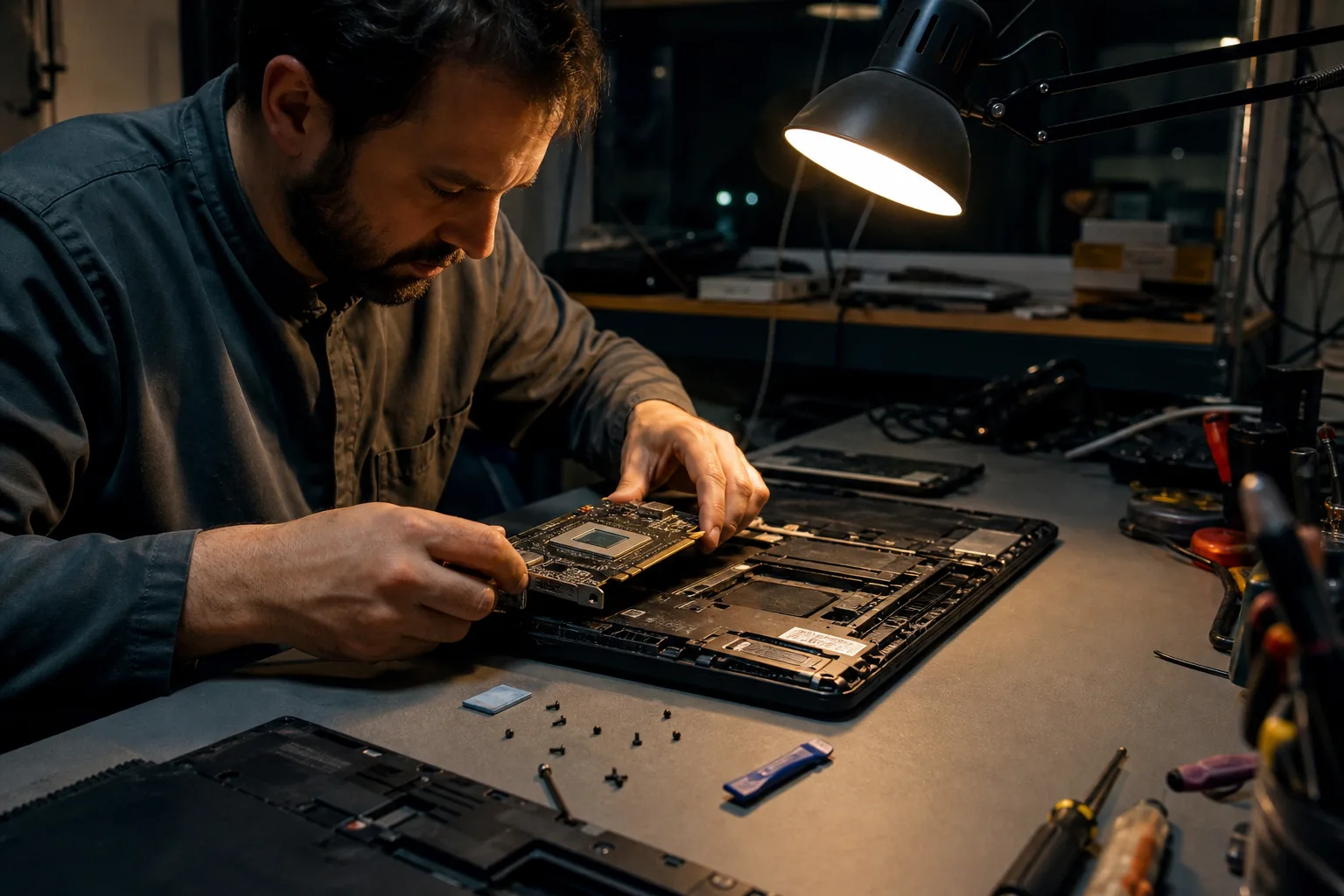
This is the same efficiency thesis Culled mapped when China’s cheaper training stack started punching through Silicon Valley’s compute-first wager. DeepSeek made the argument in API prices. Qwen is making it in a chassis. Export controls that starve Hangzhou of the best Nvidia dies do not starve it of the incentive to squeeze more capability per watt. A laptop that runs the model is the export-control paradox made portable.
Wall Street Still Prices a Megawatt Floor
Nvidia’s last historic beat taught the other lesson: record data-center revenue can arrive with a shrug when investors ask whether hyperscaler capex ever earns back. Laptop-scale agents do not cancel Blackwell racks. They change the mix. Every inference token that never leaves a 24-gigabyte card is a token that does not need a megawatt hall, a CoWoS slot, or a custom XPU designed around the queue.
U.S. hyperscalers are already writing that hedge in silicon. Broadcom’s custom-chip franchise exists because the largest buyers of GPUs decided they would rather design their own dies than wait in Jensen Huang’s line. Meta’s Muse Glimmer is the software twin of that impulse: own the weights, own the on-device runtime, own a U.S. alternative that hardware partners can ship without a Hangzhou dependency. Alibaba’s reply is that the dependency already exists. Qwen is the community’s base model. Muse Glimmer is the catch-up release.
The China-U.S. AI contest used to be a question of who could assemble the larger cluster. It is becoming a question of whose weights travel. A 27-billion-parameter model on a tray table is a small object with a large claim: intelligence that does not need permission from a data-center landlord. Watch the hardware relationships, not the press-release parameter counts. The binding constraint is now the machine on the lap.
Continue reading


Sources
CNBC reporting on Alibaba's Qwen3.8-27B and Meta's Muse Glimmer (Aug. 17, 2026); Alibaba Cloud Community and Alizila product notes on Qwen3.8-27B and Qwen3.8 Max weight release; Hugging Face derivative and download figures cited by Alibaba and CNBC; on-record comments from Nick Patience (Futurum Group) and Neil Shah (Counterpoint Research).


