

Advanced Micro Devices surged about 13 percent Monday, its best session in six months, while Nvidia dropped roughly five percent on a board probe and mounting law-enforcement scrutiny of CEO Jensen Huang. The Philadelphia Semiconductor Index still rallied nearly seven percent, and Seoul's Kospi jumped 4.39 percent Tuesday — breadth absorbed a markdown confined to the AI leader.
Investors treated Jensen Huang's governance crisis as Nvidia-specific key-person risk, not a verdict on AI silicon demand. Capital rotated toward second-source accelerators and memory while Seoul confirmed the same bid overnight.
New York, Nov. 10 — Monday’s chip tape split the AI capex supercycle into two stories: idiosyncratic leadership risk at Nvidia, and renewed appetite for everything else in the silicon stack. Advanced Micro Devices jumped 13 percent to about $508, its strongest close in six months, according to Stocktwits market coverage. Nvidia fell 4.3 percent at the cash close — intraday draws nearer 5.5 percent — leaving it the only major U.S. chip name in the red while Broadcom, Micron, Intel, and Marvell advanced with it, per GuruFocus. The PHLX Semiconductor Index still finished up 6.85 percent, a breadth reading CAPITAL has not seen since the autumn relief rallies Culled tracked after the Nasdaq’s AI correction.
The friction was never demand. Nvidia’s board said Nov. 8 that independent directors would investigate Jensen Huang after press reports tied his acknowledged extramarital affair to a woman U.S. officials reportedly viewed as a Chinese intelligence asset. Huang apologized to employees; the board said it had no reason to believe national security or company secrets were compromised. By Monday, President Donald Trump told reporters the FBI is reviewing the matter — lifting the story from corporate governance into active STATE enforcement risk, as CNBC and Business Recorder reported. A San Jose class action accuses Nvidia and Huang of concealing material facts from shareholders. Succession planning, already thin at a founder-led $4 trillion franchise, is now priced as a live gap.
Rotation, not retreat
PLATFORM economics explain why peers rallied. Hyperscalers still need accelerators, host CPUs, networking, and HBM whether CUDA’s salesman-in-chief is on stage or not. Bank of America called the scandal a new overhang, not yet an earnings event — maintaining a Buy on Nvidia while noting AMD, Broadcom, and Marvell could capture share if customers diversify orders. Oppenheimer upgraded AMD the same session. Lisa Su’s roadmap — server revenue doubling, data-center AI growing faster than EPYC, ROCm as the open counterweight to CUDA — reads as the custom-silicon diversification trade in single-stock form.
Michael Burry refused the headline chase, writing he would not trade AMD on Nvidia drama — a reminder that stretched multiples still anchor bearish CAPITAL. Yet even skeptics acknowledged the mechanism: when the binding constraint is delivery slots and power, not CEO reputation, second-source silicon earns a bid. That is the same scarcity logic TSMC cited when it raised $56 billion of capex into a sold-out 2027 pipeline.
Broader tech did not fully participate. QQQ and SMH logged modest declines in the Nov. 10 morning tape while the story circulated — a split familiar from record Nvidia prints that still sold off when the market’s question shifted from beats to duration. NetApp and ServiceNow target hikes from Argus and Needham the same week underscored enterprise software still monetizing AI storage and agent workflows; the semiconductor complex can decouple security headlines from subscription fundamentals.
“U.S. semiconductor shares rose for the second consecutive session and the PHLX semiconductor index increased sharply, boosting South Korean stocks within the semiconductor value chain,” Mirae Asset analyst Kim Seok-hwan told Yonhap.
Seoul confirms the chain
Asia carried the bid forward. Tuesday, the Kospi surged 4.39 percent to 5,239.13, snapping a three-day slide as foreigners and institutions bought a combined 860 billion won of equities, per Korea JoongAng Daily. Samsung Electronics rose 4.74 percent; SK hynix gained 6.69 percent. A buy-side sidecar halted program trading for five minutes at the open — the ninth dual-exchange trigger this year — but losers still numbered only 174 against 714 winners. Lower Brent on Middle East de-escalation talk helped airlines and batteries, yet the narrative anchor remained Wall Street’s overnight AI silicon rebound.
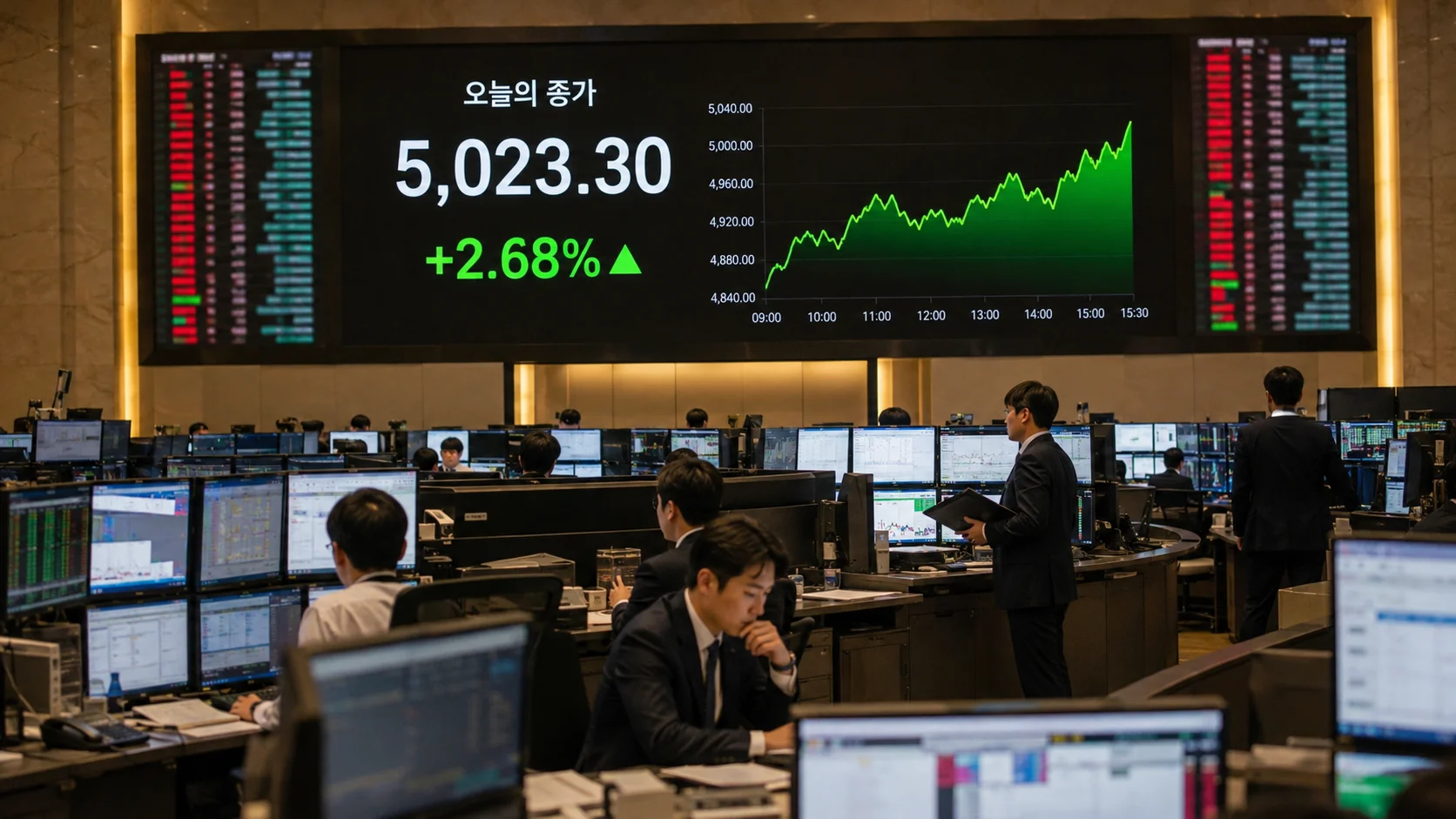
The geography matters. Memory and substrate suppliers sit upstream of the same racks AMD Instinct and Nvidia Blackwell fight over. A markdown in Santa Clara leadership does not unwind China’s efficiency push or Washington’s export frictions; it reallocates margin among vendors who can still ship. Seoul’s rally is the tell: the supercycle is broadening, not breaking.
What clears next
Three checkpoints define whether Monday–Tuesday action was repair or rotation. First, whether the FBI probe produces charges or clearance — STATE risk that can freeze procurement committees faster than any earnings miss. Second, whether AMD’s 2027 80 percent-plus revenue guide holds when hyperscaler capex reviews land; the utility gap question has not vanished. Third, whether Nvidia premarket bids after the 4 percent drop signal dip-buying by index managers who cannot exit their largest weight.
For now, the market’s verdict is narrow: punish the concentrated name, fund the complex. That is not a bear market in AI silicon. It is a CAPITAL market learning to hedge founder risk the way it already hedges dot-com-style narrative excess — one ticker at a time.
Continue reading


Sources
CNBC governance coverage, GuruFocus and 24/7 Wall St. tape recaps, Stocktwits on AMD's session, Yonhap and Korea JoongAng Daily on Kospi, Business Recorder on Trump-FBI remarks, Oppenheimer and Bank of America analyst commentary via syndicated market notes.


