

The U.S. economy added 165,000 jobs in October and the unemployment rate fell to 4.1 percent on November 7, doubling the consensus whisper and re-anchoring a December Federal Reserve rate hike at roughly seventy-eight percent probability in fed-funds futures even as the Nasdaq Composite rose 1.09 percent on a semiconductor relief rally—the binding constraint is STATE monetary reaction to resilient labor meeting CAPITAL still de-risking crowded AI hardware after the midterm regulatory shock, so the week's damage to tech multiples may not reverse until either inflation softens or AI capex guidance proves the selloff overdone.
Friday felt like two tapes in one room: the BLS headline argued the economy can carry another hike, while the Philadelphia Semiconductor Index's 4.2 percent rebound argued AI believers are not finished. Culled's [clearing duration map](/articles/ai-infrastructure-clearing-duration-nov-5/) still applies—this jobs report supplies the rates leg households will feel even if chip tickers blink green.
New York, Nov. 7 — Friday’s payroll report landed like a rate hike with the cover sheet already stamped. Nonfarm payrolls rose 165,000 in October, well above the 65,000 consensus Reuters economists surveyed, while the unemployment rate slipped to 4.1 percent from 4.3 percent, with September revised up to 60,000 jobs from a prior negative print. Treasury yields climbed on the data, the dollar firmed, and LSEG-tracked futures pushed the odds of a December Federal Reserve hike to about 78 percent from 70 percent earlier in the week, according to Reuters cash-equity wraps cited by RTHK and Anadolu Agency.
The STATE read is straightforward: Chair Jerome Powell’s committee no longer has a soft-landing excuse tied to slipping payrolls. Morningstar-syndicated Dow Jones headlines framed the tension plainly—solid jobs leave inflation and markets to settle December, and a sustained AI selloff could argue against a hike even if labor stays hot.
The split tape
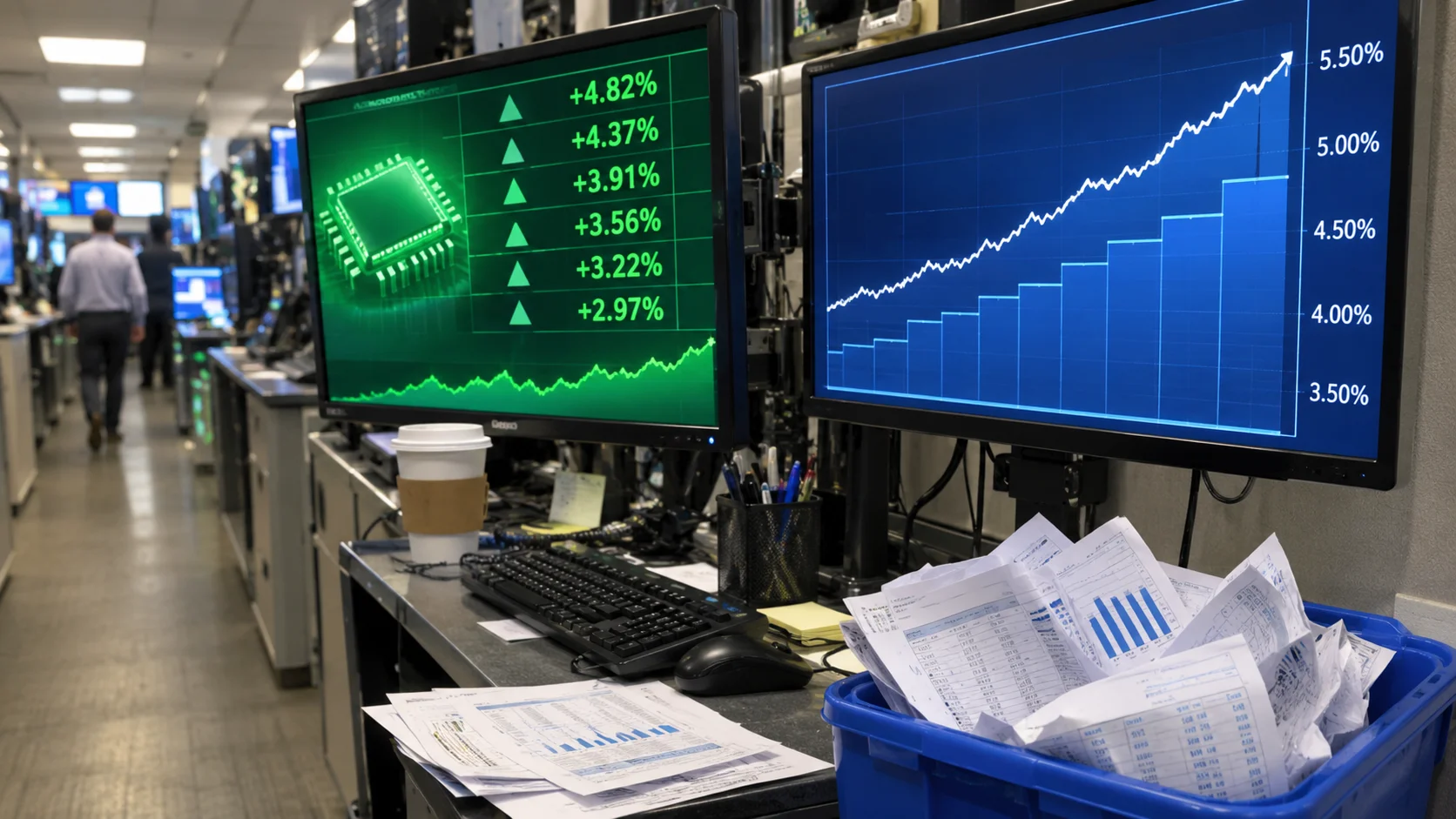
Equities did not follow a single script. The S&P 500 rose 0.31 percent and the Nasdaq Composite gained 1.09 percent, but the Dow Jones Industrial Average fell 0.46 percent, a rotation signature Culled has been tracking since industrials and consumer names held up while SOX led declines. Friday’s reversal was narrow: the Philadelphia Semiconductor Index rallied about 4.2 percent, with Nvidia up nearly 3 percent after its worst session since January 2025, AMD, Intel, and Micron up between 5 percent and 11 percent, per Business Standard’s U.S. close recap.
CAPITAL is not declaring victory. LPL Financial’s Adam Turnquist told Reuters the midweek dump was a knee-jerk to the Democratic sweep; Trust Advisory’s Keith Lerner still called AI the bull market’s dominant theme. Yet both acknowledged the Nasdaq has spent a month carving out a correction—more than 10 percent off its peak—while all three major U.S. indexes still logged weekly losses after trillions in global equity value evaporated on AI regulation fears. Relief rallies inside a factor unwind are common; they are not the same as clearing crowded positioning laid out in Wednesday’s duration guide.
“Will the Fed want to raise interest rates in the face of a market which is teetering?” Themis Trading’s Joe Saluzzi asked Reuters—the question that defines November’s second half.
Households see jobs, portfolios see AI
Labor strength is not reaching every balance sheet the same way. The University of Michigan’s preliminary November sentiment index rose to 51.0 from 48.0, beating expectations, according to the Surveys of Consumers release. Gains clustered among independents and lower- and middle-wealth respondents, while sentiment among households with the largest equity portfolios fell 5 percent, director Joanne Hsu said. Spontaneous comments flagged AI bubble anxiety—even as 57 percent still cited eroded living standards from high prices, the highest share since May.
That is LABOR and CAPITAL talking past each other in one survey: job security and nominal wage growth look fine on paper, but wealth concentrated in mega-cap tech just lived through the fastest AI drawdown of the cycle, overlaid on election-night cross-asset chaos. One-year inflation expectations eased to 4.3 percent from 4.7 percent, a mild cushion for the Fed, but still above pre-Iran conflict readings.
Oil complicates the pocketbook map. Brent settled near $97.9, down on the week as Middle East de-escalation hope competed with payroll heat, per Anadolu. Cheaper crude helps food and freight eventually; it does not instantly offset higher mortgage and auto rates if December tightening lands.
Weekend playbook
Inflation is the next circuit. October CPI due next week will either validate December pricing or force the Fed to choose between labor hotness and market fragility—a bind Morningstar flagged when AI multiples were still decompressing.
For positioning, treat Friday’s chip bounce as beta repair, not thesis repair, until hyperscaler guidance confirms 2026–2027 spend. Do watch 2-year and 10-year yields together: if payrolls keep lifting the front end while SOX rallies, duration-sensitive AI can rip higher for a day and still lose on the week—as happened here.
VIX fell about 9 percent to 25.6, per Anadolu, but 25 is not 15. The market is calmer, not convinced. Until STATE (rates) and CAPITAL (AI positioning) align, strong jobs will keep feeling like good news for workers and mixed news for anyone still long the crowded AI stack.
Continue reading


Sources
Reuters and AP Nov. 7, 2026 session wraps; Anadolu Agency and RTHK market closes; University of Michigan preliminary November sentiment; CME FedWatch via LSEG Reuters cites; Culled AI clearing coverage.


