

Democrats won Senate and House majorities on November 3 with breadth that surprised desks pricing only a narrow blue scenario. Asia session AI and memory names led a global selloff, U.S. futures cut losses as investors weighed gridlock against oversight, and the 10-year yield fell while the dollar slid—the binding force is capital repricing AI multiples on margin size, not on who holds the gavel alone.
Consensus had a Democratic Congress; it did not have South Carolina, Texas, and Ohio flipping on the same map. The residual for markets is not “who won” but how wide the win reads for AI oversight, crypto scrutiny, and 2027 debt-ceiling theater—while the president keeps tariffs and foreign policy in the West Wing.
Washington, Nov. 4 — Democrats took Senate and House majorities in Tuesday’s midterms, ending unified Republican control of Congress for the remainder of President Donald Trump’s term. Wire services framed the outcome as a blue sweep; trading desks heard something sharper—the margin. Victories in South Carolina, Texas, and Ohio Senate races, plus House gains deep into conservative districts, forced a repricing of what oversight might look like even if veto math still blocks most legislation.
That repricing arrived first in Asia, where AI-linked equities led losses as results crossed during local hours. Samsung, SK Hynix, and TSMC slid before trimming declines; Korea’s KOSPI swung from roughly 3 percent down to flat on the session, Reuters reported. The move extended a tech correction Culled tracked on election night, when the Nasdaq-100 already sat more than 10 percent off its October peak while oil and China IPO policy stole parallel headlines.
Knee-jerk, then a gridlock bid
U.S. equity futures opened the Asian Wednesday much weaker—Nasdaq contracts at one point down more than 2 percent, S&P 500 futures off sharply—before cutting losses to roughly half a percent on the Nasdaq and 0.35 percent on the S&P by the time European traders arrived, according to session wraps. European futures followed the same pattern: a deeper initial drop, then a partial recovery as strategists argued that gridlock does not automatically translate into weaker earnings.
Gridlock trims the tail of deregulation; it does not by itself shrink the AI capex already booked in hyperscaler guidance.
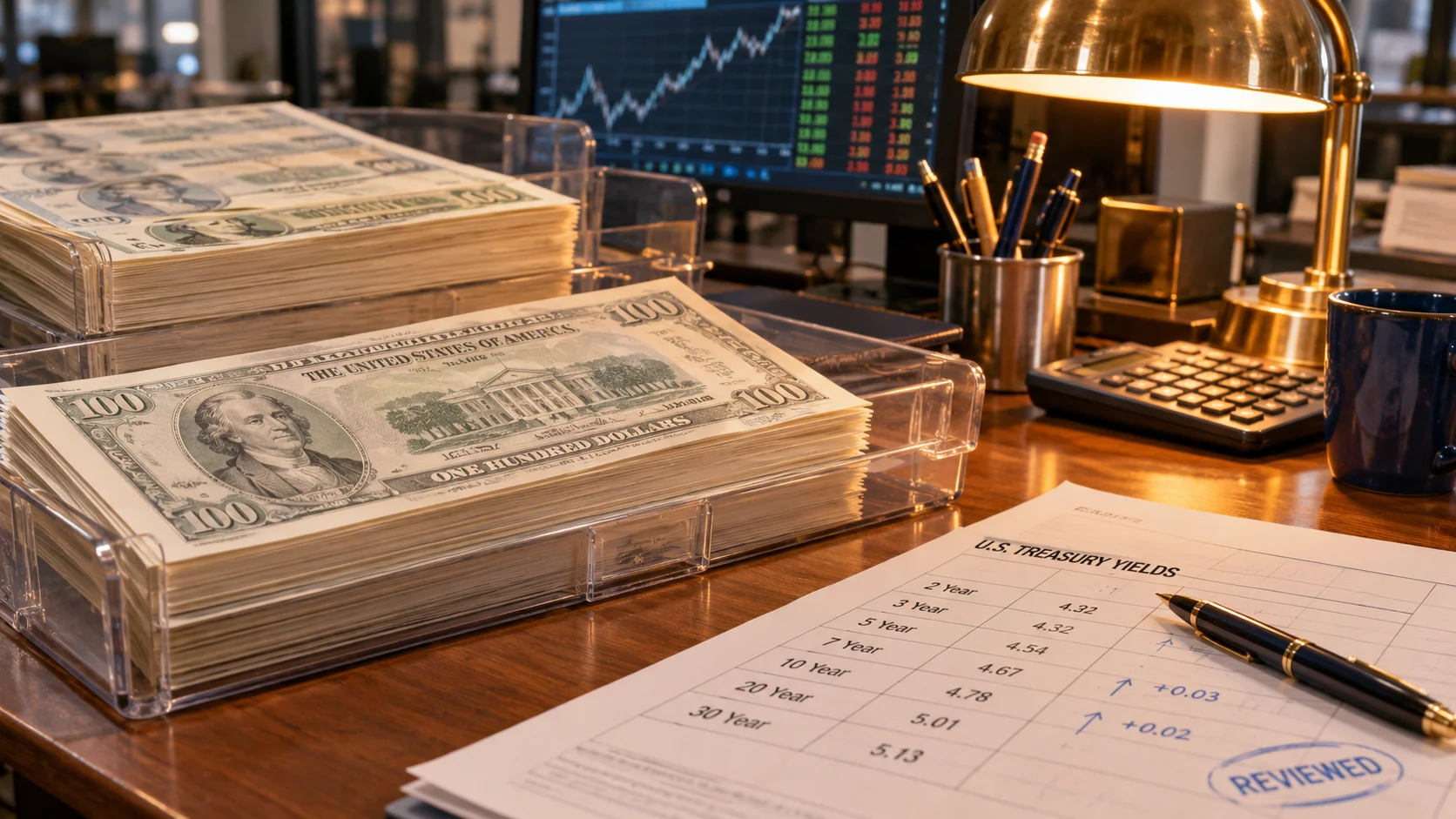
Fixed income told the other half of the story. The benchmark 10-year Treasury yield fell about 6 basis points to near 4.906 percent, Reuters cited, as investors leaned into a scenario with less fiscal momentum and more congressional friction. The dollar index lost ground against the euro and sterling, hitting roughly a one-month low in some crosses—consistent with lower yields and a risk-off first pass through AI names.
Analyst notes circulated quickly: JPMorgan had modeled a blue wave as a modest S&P 500 drag on the order of half a percent on the day; overnight pricing briefly implied something worse before the dip-buying narrative reasserted itself. Charu Chanana of Saxo summarized the pivot—investors recognizing that political stalemate and lower rates can coexist with corporate resilience.
AI as the clearing house
The sector absorbing the shock was not random. Strategists flagged greater scrutiny of the AI and crypto complex under divided government with aggressive oversight committees, plus louder talk of debt-ceiling fights in 2027 and impeachment noise that markets treat as variance, not base case. Goldman Sachs’ broad AI basket had already fallen about 15 percent in October and sat more than 24 percent below peak before ballots were counted—so the election did not invent the trade; it supplied a Catalyst for funds still overweight connectivity and memory.
Semiconductor and platform names repriced accordingly in extended and 24-hour markets: desk commentary noted AMD giving back a post-earnings spike, Nvidia testing psychological $200 handles, and private-market AI names showing relative resilience only after sharp initial markdowns. That is the mechanism Culled emphasized ahead of Tuesday: election day added variance atop an AI hardware repricing, not a clean binary for the whole index.
What Congress cannot do overnight
STATE power still concentrates in the White House for tariffs, much foreign policy, and executive-branch rulemaking; UBS Global Wealth Management argued before the vote that a congressional flip might slow fiscal tightening but would not, by itself, derail data-center buildouts driven by state and local permits. Markets therefore face a split screen: CAPITAL sells AI on regulatory option value, while STATE actors outside Washington—voters, governors, grid operators—keep constraining physical buildout on a separate calendar.
Near-term, the cash open will test whether Asia’s clearing price holds. BTIG technician Jonathan Krinsky warned pre-election that this year’s setup inverted the usual “weak into midterms, strong after” pattern because the S&P 500 entered November with double-digit 2026 gains—so a post-election rally is not guaranteed by history alone. The falsifier is simple: if 10-year yields rebound while AI multiples stabilize, the story becomes pure gridlock relief; if yields stay down and AI keeps leading declines, the margin read is regulation and duration, not politics as sport.
Election night removed one uncertainty from the tape; Wednesday is about whether capital accepts the first clearing price—or demands another leg down in the crowded AI trade Culled has been mapping since the October oil-and-AI squeeze.
Continue reading


Sources
Reuters Nov. 4, 2026 on analyst reaction and Asia AI selling; StreetInsider/Reuters Singapore wrap on futures and FX; CNBC Nov. 3 on historical midterm patterns; Pepperstone Nov. 4 election note; UBS Global midterm preview; Culled Nov. 3 election-night corrections coverage.


