

Alibaba's net income fell 75% as capital spending on AI jumped 75%. Revenue still rose 9%, and cloud accelerated to 45% growth. The paradox is China's tech spend in one print: the five-year plan demands the racks; the ADR market wants the payoff first.
Alibaba’s net income fell 75 percent as capital spending on AI jumped 75 percent. That rhyme is the print. For the quarter ended June 30, profit dropped to about 10.5 billion yuan from 43.1 billion a year earlier. Revenue still rose 9 percent, to 268.95 billion yuan, a hair above the LSEG consensus. U.S.-listed shares sold off as much as 4 percent. The cloud grew. The P&L did not.
Cloud Intelligence — Alibaba’s AI and compute sleeve — accelerated to 45 percent growth, 48.44 billion yuan. AI-related product revenue posted a twelfth consecutive quarter of triple-digit gains. CEO Eddie Wu called it commercialization of a full-stack. The ADR market called it an invoice.
Beijing Wants Racks. The Tape Wants a Register.
This is the corporate version of the 15th Five-Year Plan: AI as an economic form, not a product line. Alibaba is halfway through a 380 billion yuan, or about $56 billion, AI infrastructure program for 2026–29. Wu said the company has already spent half of that envelope this year, and that AI-related capex should break even within three years on current gross margins. Three years is a political clock. A quarter is a listing clock.
Capex in the period rose 75 percent, to 67.68 billion yuan — roughly $10 billion in ninety days — as the company bought more CPUs for agent workloads and paid up for components. Depreciation has not finished the job the cash outlay started. Adjusted earnings of 8.52 yuan per American depositary share missed estimates near 10.53. That is the same exam Wall Street gave Nvidia after a record beat: growth is no longer the grade. Payoff is.
The dot-com distinction still holds, and it does not rescue the print. Generative systems produce output; they do not automatically produce margin. Alibaba’s commerce engine still writes the check. Cloud is the growth story. Profit is the casualty. That is the utility gap in a Chinese accent — capacity racing ahead of the willingness, or the permission, to wait.
Swap the Silicon. Keep the Bill.
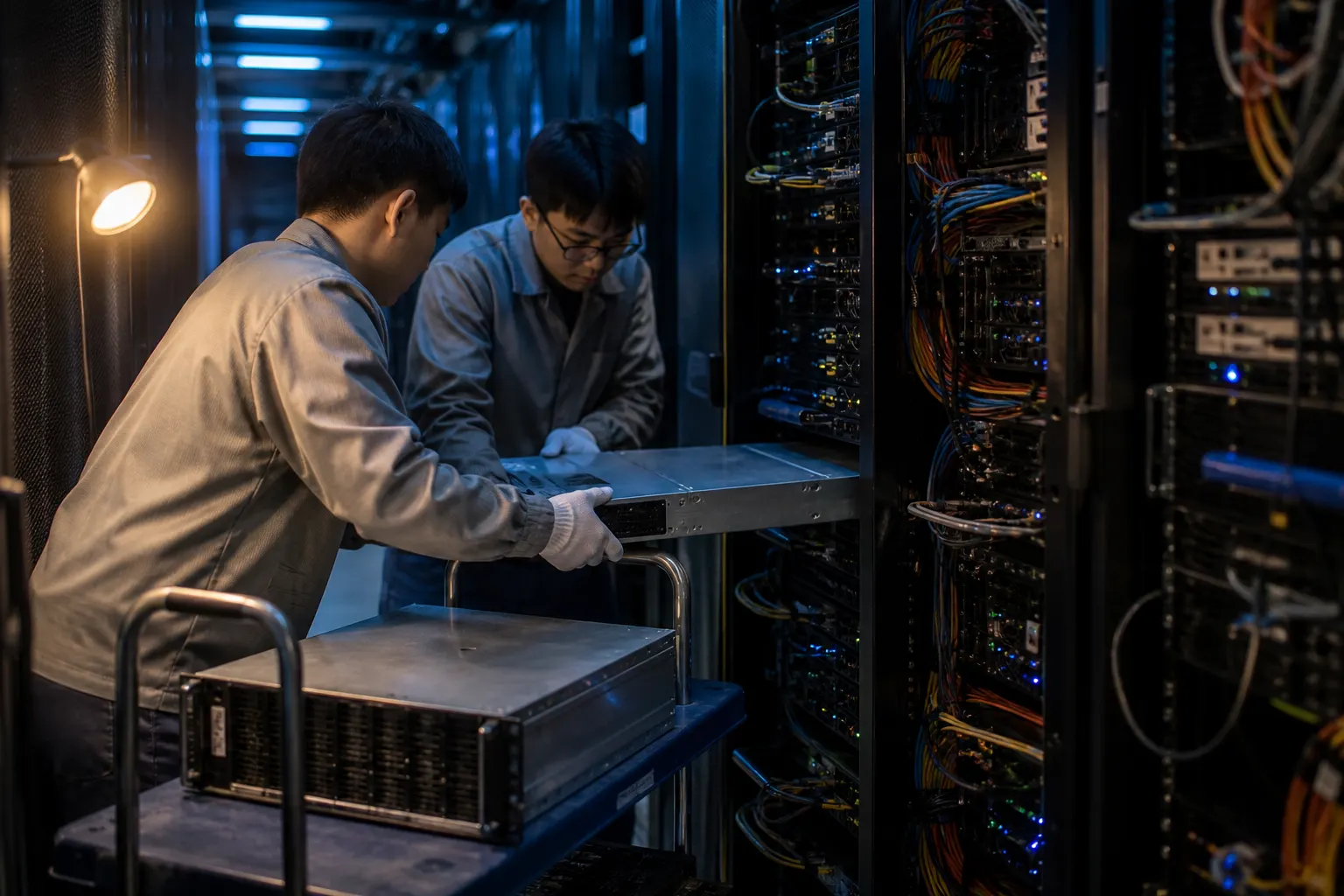
Wu’s longer answer is not less spend. It is different silicon. He wants Alibaba’s T-Head chips to displace commercial processors in the company’s own halls — Hangzhou’s entry in the custom-silicon war that already pulled Google, Meta, and the rest off the merchant GPU monopoly. Substitution is a cost story for 2028. This quarter’s 67.7 billion yuan is a procurement story for 2026. Export-control gravity makes the swap strategic, not optional; the same frontier capability that Five Eyes called a months-away cyber risk is what Beijing is paying national champions to own.
The paradox compresses to one line: Alibaba can hit the plan and miss the market in the same morning. The image is an unfinished hall and a tray coming out of a rack — concrete poured, silicon swapped, profit deferred. Trade the 45 percent cloud print as demand, the 75 percent capex print as policy, and the 75 percent profit drop as the ADR’s veto. Do not mistake a five-year industrial bet for a quarterly earnings beat.
Continue reading


Sources
Alibaba fiscal Q1 (ended June 30, 2026) results released Aug. 20: revenue RMB 268.95bn (+9%) vs LSEG estimate RMB 268.88bn; AI Cloud and Compute Services RMB 48.44bn (+45%); AI-related product revenue RMB 12.38bn (12th consecutive quarter of triple-digit growth); net income ~RMB 10.5bn (−75%); adjusted EPS RMB 8.52/ADS vs ~RMB 10.53 estimate; capex RMB 67.68bn (+75%); 2026–29 AI plan RMB 380bn (~$56bn), half already spent this year; CEO Eddie Wu on three-year AI-capex breakeven and T-Head substitution. Reuters, AP, BNN Bloomberg, company 6-K exhibit.


