

SpaceX shares rose roughly 6% Friday after three orbital missions in under 13 hours and the start of full-rate billing on major AI-compute contracts. The launches did not prove orbital-compute economics, but they made the company’s core claim more tangible: its rockets, network, and capacity leases now reinforce one another.
SpaceX shares rose roughly 5.7% to 6.4% in Friday morning trading, moving through the mid-$150s after opening near $149.50. The headline explanation was a rare launch tripleheader. The more useful one is that the company offered markets a compact demonstration of the system it wants them to value: launch capacity, satellite deployment, government work, and AI infrastructure operating at once.
At about a $2 trillion capitalization, a 6% move is not retail excitement about a single rocket. It is a repricing of whether SpaceX can make its different businesses compound each other.
Three missions made cadence the product
In less than 13 hours, SpaceX flew Crew-13 to the International Space Station, launched the Transporter-18 rideshare mission, and sent the classified NROL-97 mission aloft on Falcon Heavy. The first showed the company’s human-spaceflight reliability. The second carried roughly 130 payloads, including Google’s Project Suncatcher hardware intended to collect data on how TPU systems behave under radiation, thermal, and spaceflight stress. The third reinforced the national-security line of business, with both Falcon Heavy side boosters recovered.
No single mission settles Starship’s reuse economics or establishes a profitable market for orbital compute. But the sequence is evidence of operating rhythm. It turns a launch manifest from a collection of isolated events into a factory schedule with several customer types moving through it.
That distinction matters after Starship Flight 14’s mixed scorecard. The flight deployed 26 V3 satellites but left extended orbital operations and reuse questions unresolved. Falcon’s cadence does not erase those gaps; it supplies the cash-generating machine against which the longer Starship option can be funded.
The revenue clock started, too
Reports cited the October start of full-rate billing on an Alphabet contract worth about $920 million a month over 32 months, or roughly $29.4 billion if fully realized. A separate Anthropic contract is reported at about $1.25 billion a month. Together, those figures imply approximately $26 billion in annualized contracted AI revenue, subject to their terms, utilization, and execution.
Those leases are why Friday’s tape was not merely a launch celebration. They turn compute capacity into a recurring-revenue line just as SpaceX is asking investors to extend the story beyond launch and connectivity. As the company’s first public earnings made clear, that is also an expensive proposition: AI revenue may be real while the capital required to add capacity remains formidable.
A stronger narrative is not a finished proof
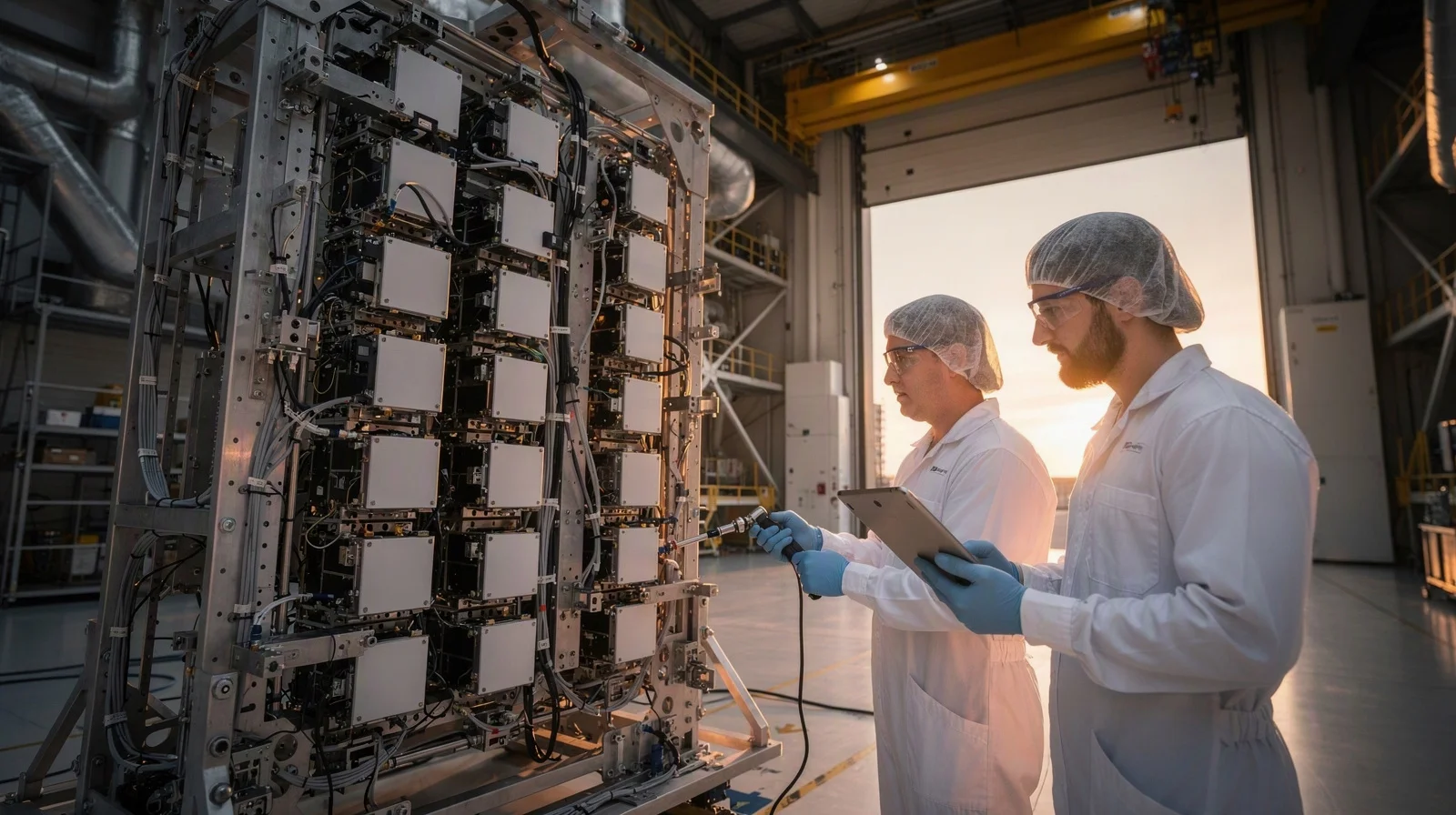
Project Suncatcher offers the cleanest bridge between the two catalysts. Transporter-18 was a normal rideshare in the near term; the Google payload was a test of whether specialized AI hardware can survive and operate in the environment that SpaceX ultimately wants to make commercially useful. It was data collection, not a commercial orbital data center.
That is the line investors should retain. The existing orbital-compute thesis depends on radiation tolerance, heat rejection, manufacturing, network performance, regulation, and launch economics—not on a successful prototype ride. Likewise, the Friday missions show reliability and reusability on Falcon hardware; they do not demonstrate Starship turnaround costs.
The rally priced an integrated operating system, not a solved engineering problem.
The constructive case is nevertheless clearer than it was a week ago. SpaceX has a repeated launch engine, government customers that value access and schedule certainty, an expanding Starlink deployment program, and AI contracts whose billing is reportedly entering full rate. The next test is whether that interlocking structure translates into margins and durable capacity rather than only an increasingly elegant story.
Friday gave the market a reason to believe the machine is running. It did not relieve investors of having to measure what it earns.
Continue reading


Sources
Contemporaneous Oct. 2 market coverage from The Motley Fool, TipRanks, Yahoo Finance, Investing.com, 24/7 Wall St., Benzinga, and prior reporting on Starship Flight 14 and AI-compute contracts.


