

Terrestrial AI hit substations and cooling water before it ran out of GPUs. Nvidia’s Starmind deal with SpaceX packages Rubin and Vera silicon for orbital racks that harvest sunlight, dump heat into vacuum, and return answers on Starlink lasers—moving the AI stack past Earth’s power queue.
The AI boom did not stall because models became boring. It stalled wherever a rack could not find a wall plug that regulators, neighbors, and transmission planners would still bless.
That is the prosaic truth behind the spectacle of SpaceX’s first public earnings and Nvidia satellite claim: hyperscalers can still write purchase orders faster than grids can clear interconnects. Memphis turbines, Texas mining campuses, and European permitting fights all say the same thing in different accents. Compute is abundant in the brochure and scarce at the meter.
Orbit Is a Power Strategy, Not a Sci-Fi Detour
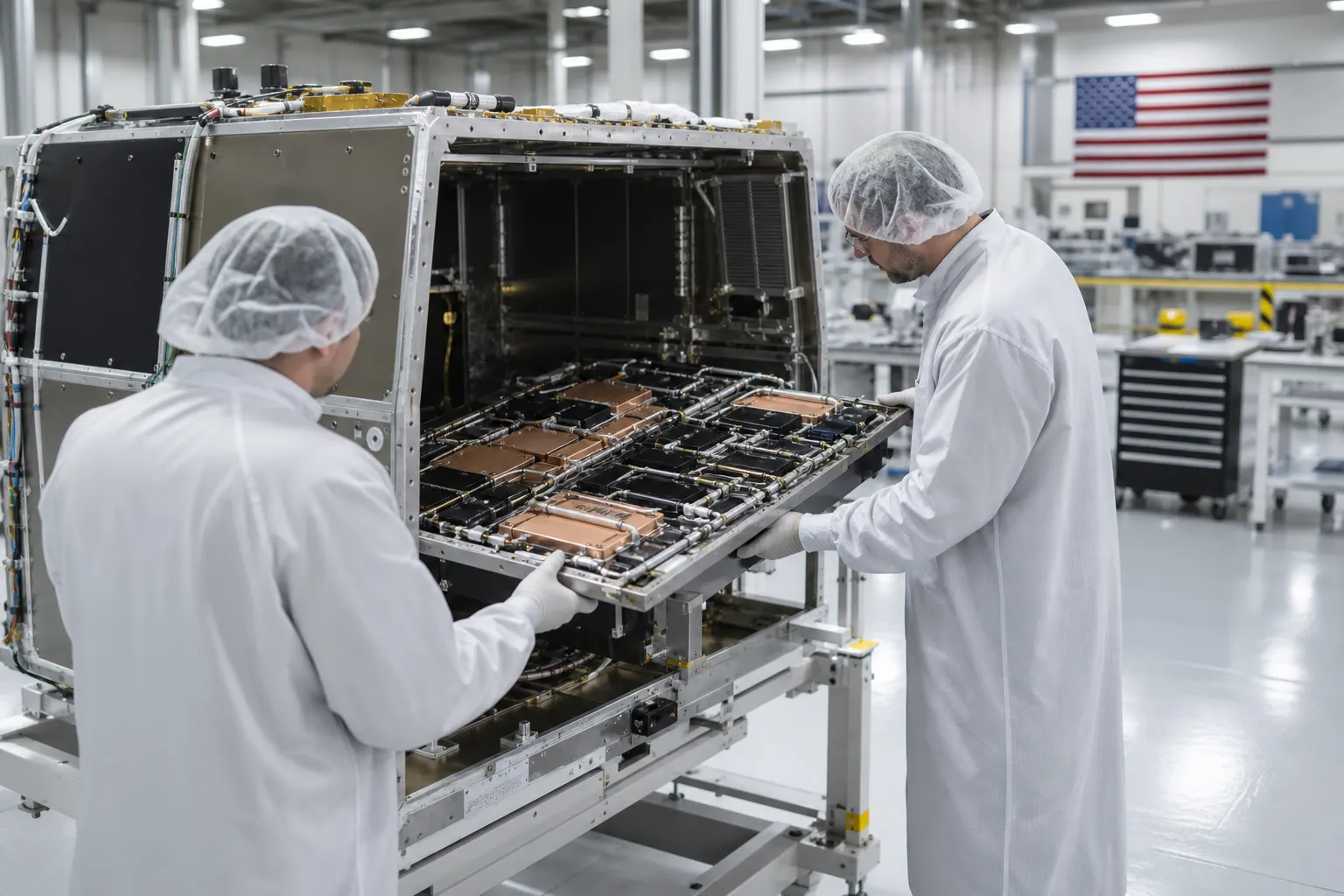
SpaceX’s Starmind program treats low Earth orbit as an industrial park with better insolation. The first-generation AI1 satellite is designed less like a broadband bird and more like a flying rack: large solar arrays for peak power on the order of a quarter-megawatt class node, deployable radiators dumping heat into vacuum, and onboard processing that returns answers rather than raw video through Starlink’s laser fabric. Nvidia’s role is the compute payload—Vera CPUs and Rubin GPUs adapted for the environment, the same architectural family that now defines terrestrial rack-scale AI.
The partnership announced in early August is therefore not a logo slap. It is Nvidia writing its stack into the only other firm that can currently combine Starship-class mass to orbit, optical mesh logistics, and a manufacturing thesis (Gigasat) that talks about constellation scale the way fabs talk about wafer starts. Musk’s public exclusivity line—“they are the best”—is marketing with a contract’s teeth: SpaceX’s AI infrastructure roadmap is being sold as Nvidia-native even as the satellite bus is described as hardware-flexible for later generations.
The Bottleneck Moves; It Does Not Vanish
Orbital compute does not abolish scarcity. It relocates it. Radiation hardening, thermal cycling, launch vibration, and software that must survive single-event upsets are real engineering taxes—Ars Technica’s July survey of the field was blunt that there is no magic, only brutal systems integration. Prototype testing for AI1 is aimed at early 2027; mass production talk points later that year if schedules hold. The FCC path for a constellation that could eventually number toward a million nodes remains unfinished business even after earlier filings for altitudes between roughly 500 and 2,000 kilometers.
What does change is who owns the binding constraint. On the ground, SpaceX’s Colossus power map already showed that deployable watts and community politics can matter as much as GPU allocations. In orbit, the scarce inputs become launch cadence, optical networking discipline, and the silicon that fits the thermal and radiation envelope. That is a PLATFORM story twice over: Nvidia’s software-and-rack moat travels upstairs, and SpaceX’s launch-plus-laser mesh decides who can sit next to the sun.
Terrestrial workarounds still matter. Bitcoin miners remodeling halls into GPU landlords are the earthbound twin of the same impulse—find power that was gathered for another purpose and recontract it for AI. Orbit is the extreme version: skip the interconnection queue entirely. Both paths thicken Nvidia’s absorption layer. Neither frees rivals from the fact that the industry’s default training and inference grammar still runs through CUDA-shaped tooling—the moat that is also a prison when every new venue, from Texas pads to LEO buses, arrives pre-wired for the same supplier.
What Markets Should Actually Price
Investors who treat Starmind as a pure option on sci-fi will misread the cash-flow path. Near-term SpaceX AI revenue still leans on grounded leases; orbital nodes are a multi-year build with prototype windows in early 2027 and production talk later that year if schedules hold. The correct lens is optionality on where Nvidia can keep selling denser systems when municipal politics and transformer lead times say no. Capital that underwrites Starship cadence and Gigasat throughput is betting that launch economics can undercut interconnection queues—not that vacuum magically cheapens silicon.
If AI1 ships on anything like the advertised cadence, the AI stack’s frontier is no longer “more halls in Northern Virginia.” It is whether two platforms—chip and constellation—can industrialize a third geography while regulators still arbitrate spectrum, debris, and optical interference. Until then, the sober trade is to watch payload integration milestones the way fabs watch yield: as proof that the bottleneck moved on purpose.
The recursive point is almost architectural. Scalable AI was always an infrastructure problem wearing a model costume. Nvidia’s push with SpaceX simply admits that the next bottleneck after HBM and foundry capacity is site—and that the site may not be on Earth at all.
Continue reading


Sources
SpaceX–Nvidia Starmind AI1 partnership coverage (Interesting Engineering, Defense News); Ars Technica on orbital data-center engineering constraints; prior Culled pieces on SpaceX post-IPO earnings/Nvidia satellites, Colossus power bottleneck, Bitcoin-miner GPU hosting, and Nvidia’s CUDA moat.


