

Post-halving hash economics pushed public Bitcoin miners to reprice their scarcest asset: grid-connected power. Multi-year AI hosting contracts now run into nine-figure-to-hundred-billion territory, and those contracts demand Nvidia-class GPUs in halls once filled with single-purpose ASICs. Bitcoin is not crashing Nvidia; its miners are inventing Nvidia a second sales channel.
Bitcoin did not teach Nvidia how to sell chips. It taught Nvidia where chips still have somewhere to plug in.
For a decade, public miners competed as leveraged Bitcoin proxies: hashrate, difficulty, and the weekly drama of fee markets. That trade still exists, and the network’s longer existential risks still matter. What changed after the 2024 halving is the opportunity cost of a megawatt. A hashfarm that once made money only when BTC and energy aligned is now a square-meter landlord for AI factories that bill in dollars, not blocks.
Power Became The Product Before Silicon Did
Miners spent years collecting what hyperscalers now treat as wartime logistics: substation capacity, interruptible or industrial power contracts, pads in Texas and the Canadian shield, and operations teams that already treat uptime as an economic instrument. Building greenfield AI campuses from zero can take multi-year transmission queues. Renting or jointly converting a campus that already speaks to the grid compresses that schedule.
Therefore the pivot reads almost vulgarly simple. Same fence line. Different tenant. Where an ASIC rack paid in Bitcoin, a dense GPU pod pays lease invoices tied to CoreWeave, Microsoft, Anthropic-adjacent offtake, or other HPC counterparties. Public miners including Hut 8, Core Scientific, TeraWulf, IREN, Cipher, and HIVE have piled multi-year AI and HPC announcements that, depending on the tally you trust, sit somewhere between roughly $70 billion and well above $100 billion across the sector—aggregates that only exist because power was already gathered for another religion. Hut 8’s Beacon Point expansions, Core Scientific’s multi-GW leased book, and TeraWulf’s early AI revenue climbing above pure mining prints in recent quarters are variations of one thesis: the network difficulty of getting power now rivals the network difficulty of mining Bitcoin.
Why That Map Remodels Nvidia Specifically
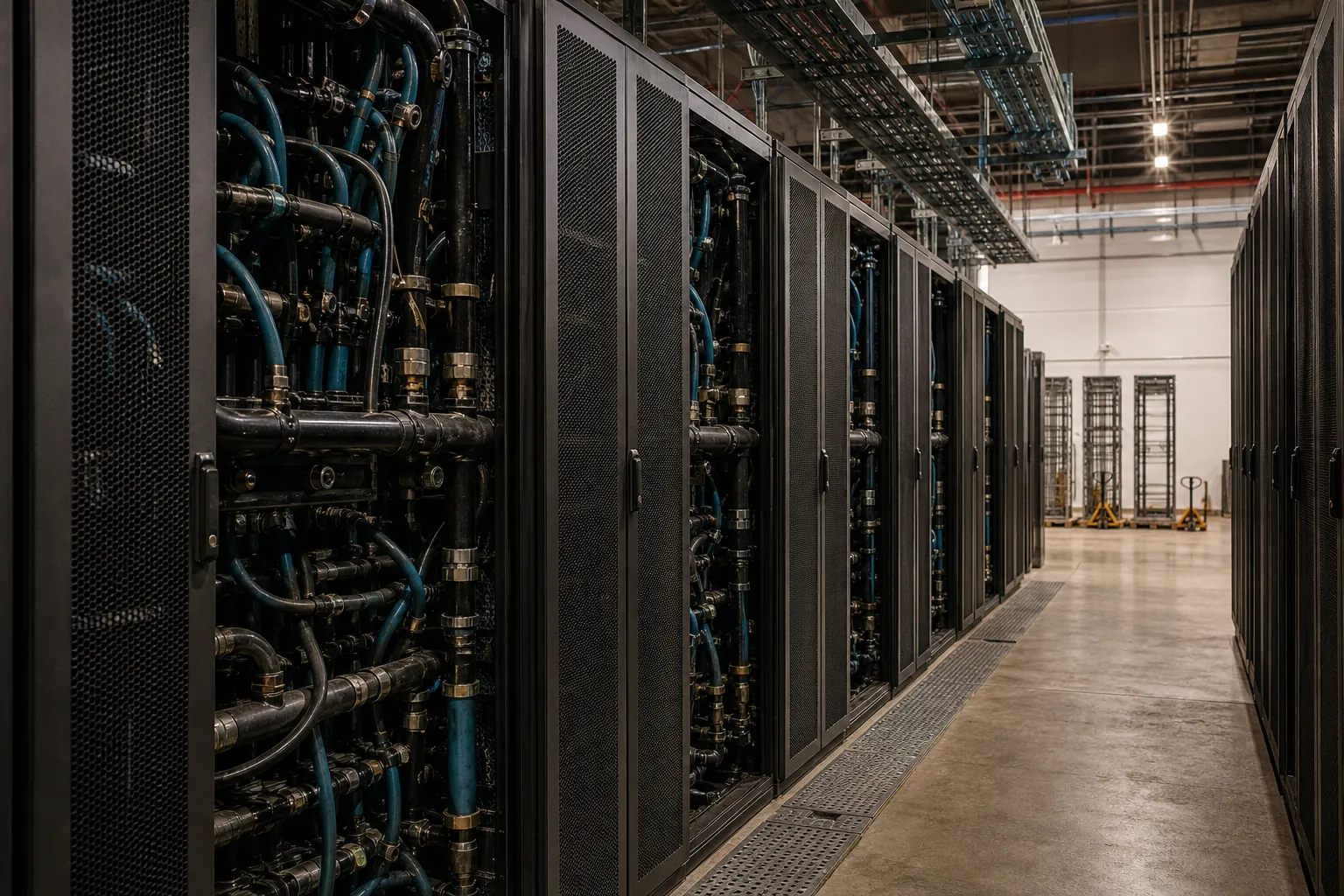
The conversion is not “crypto likes GPUs again.” Bitcoin long ago specialized on ASICs. The reshaping channel is who can host Nvidia. H100s, Blackwell systems, and the rack-scale NVL generations are power monsters with cooling and networking demands that mine halls were not born for. Retrofit is capital, liquid cooling, fabric, and SLAs—not a weekend swap.
Those retrofits, however painful, create a customer class that was not on Nvidia’s FY2023 slide decks: mid-public miners becoming colo and hosting platforms. Every leased megawatt that is ready for GPUs is an order book for silicon, or at least a staging ground that pulls inventory out of pure hyperscaler competition. Operators have framed the comparison in blunt ratios—single-digit megawatts of modern GPUs can approach the revenue of tens of megawatts of hashing—so accounting departments follow the kilowatts.
When Wall Street shrugged at Nvidia’s best quarter, part of the debate was whether demand was too concentrated. Bitcoin’s industrial layer answers by multiplying the doors a Blackwell server can walk through—not by inventing new FLOPs physics. Nvidia still prices, packages, and software-locks the stack; miners merely reorganize who can take delivery once a rail spur and a substation already exist.
Custom silicon still pressures the long runway: Broadcom’s quiet pipeline and sovereign efficiency bets elsewhere mean Nvidia is never alone in the custom silicon wars or immune to China’s efficiency campaign. Bitcoin miners do not cancel those rivals. They thicken the absorption layer under Nvidia’s high-end product stack by putting contracted landlords between energy scarcity and GPU scarcity.
The Credibility Gap Is The Real Risk
VanEck’s mid-2026 work put a hard number under the romance: a near-term funding gap on the order of $50 billion to build the AI capacity already leased, with multi-hundred-billion long-run ambition if every announcement becomes steel. Only a fraction of leased AI capacity has been brought online—on the rough order of a quarter, depending on the sample. Insider share sales around big lease headlines and “contract first, construct later” optics keep investors honest.
Miners fund the buildout by selling Bitcoin treasuries, issuing equity, and borrowing against long-duration offtake. That is a different risk stack than a pure hashprice trade: counterparty concentration, construction slippage, and cooling redesign all sit between the multiyear contract PDF and a live GPU rack drawing 100-plus kilowatts. The bulls are underwriting infrastructure developers with crypto DNA; the bears are underwriting SPAC-era energy optimism wearing an AI jacket.
That gap is bullish for Nvidia only if the projects clear Ready-for-Service gates without cancelling orders. A stranded mining shell with a press release is not a data-center customer. A funded retrofit with liquid manifolds and completed interconnection is. The distinction matters for how markets weight miner stocks—and for how much real pull-through reaches Dell, SuperMicro, and Nvidia’s channel.
Recursive Summary
Bitcoin is remodeling Nvidia by converting a hashing industry into a power-and-shell intermediary that wants GPU density as rent. The mechanism is industrial: contracted megawatts, multiyear leases, and hall retrofits—not meme GPU FOMO. Treat every new miner AI lease as a question about construction and credit, not a free option on Blackwell scarcity; the chips follow only when the campus actually becomes a factory floor.
Continue reading


Sources
Sector contract tallies and miner filings coverage (CryptoBriefing, Sandmark, CoinTribune/Bernstein, company announcements for Hut 8 Beacon Point, Core Scientific capacity updates, TeraWulf AI revenue), VanEck funding-gap analysis, and Nvidia Blackwell backlog commentary.


