

Mercedes-Benz is putting Wayve's learned driving software into future cars, while SAIC calls a ByteDance-enabled cabin its first AI-native vehicle. The announcements use the same vocabulary for two different products: one makes decisions about the road; the other turns the cabin into a sensing, conversational environment.
The phrase “AI-native car” has the agreeable vagueness of a showroom scent. It suggests a machine born after the old distinctions between software and vehicle engineering. But Mercedes-Benz and SAIC have just shown that the phrase can point in two directions at once. One is about the road. The other is about the people seated above it.
Mercedes has signed a production agreement to integrate Wayve’s AI Driver into future vehicles within two years, according to Electrek’s account of the deal. SAIC, meanwhile, introduced the Roewe Jiayue 07 with ByteDance’s Volcano Engine and a Doubao cabin assistant, calling it the world’s first AI-native car. These are not rival answers to a branding question. They locate the car’s intelligence in different places, with different failure modes.
Mercedes is buying a learned driver, not a talking dashboard
Wayve’s proposition is that driving software should learn from data rather than be assembled from hand-coded rules, painstaking high-definition maps and city-by-city permissions. The company says its system can operate without HD maps, geofences or retraining for each new city. That is a claim about generalisation; it is not yet a public promise of hands-off autonomy.
The important detail is the integration point. Wayve is being fitted into Mercedes hardware, MB.OS and map interfaces, rather than mounted as a laboratory accessory. That makes the agreement a test of whether an automaker can buy a learned driving brain without surrendering the car’s nervous system to a supplier.
Mercedes is sensibly plural about this. It already has Drive Pilot for a tightly bounded Level 3 highway use case, and it also works with Nvidia on driver assistance. The Wayve arrangement adds another stack. That is less a declaration of victory than an industrial hedge: a manufacturer keeping several technical bets alive because each solves a different slice of an unusually unforgiving problem.
The safety question remains very plain. A model that can cope with unfamiliar streets must still behave predictably around a child, a temporary road closure and the odd choreography of a rain-soaked junction. That is why the company’s lack of a named vehicle, automation level and firm launch date is meaningful. The software may be learning to drive; the product still has to learn what it is allowed to promise. The tension is familiar from Tesla’s fight over what “Full Self-Driving” can mean: the label travels faster than a vehicle’s operating envelope.
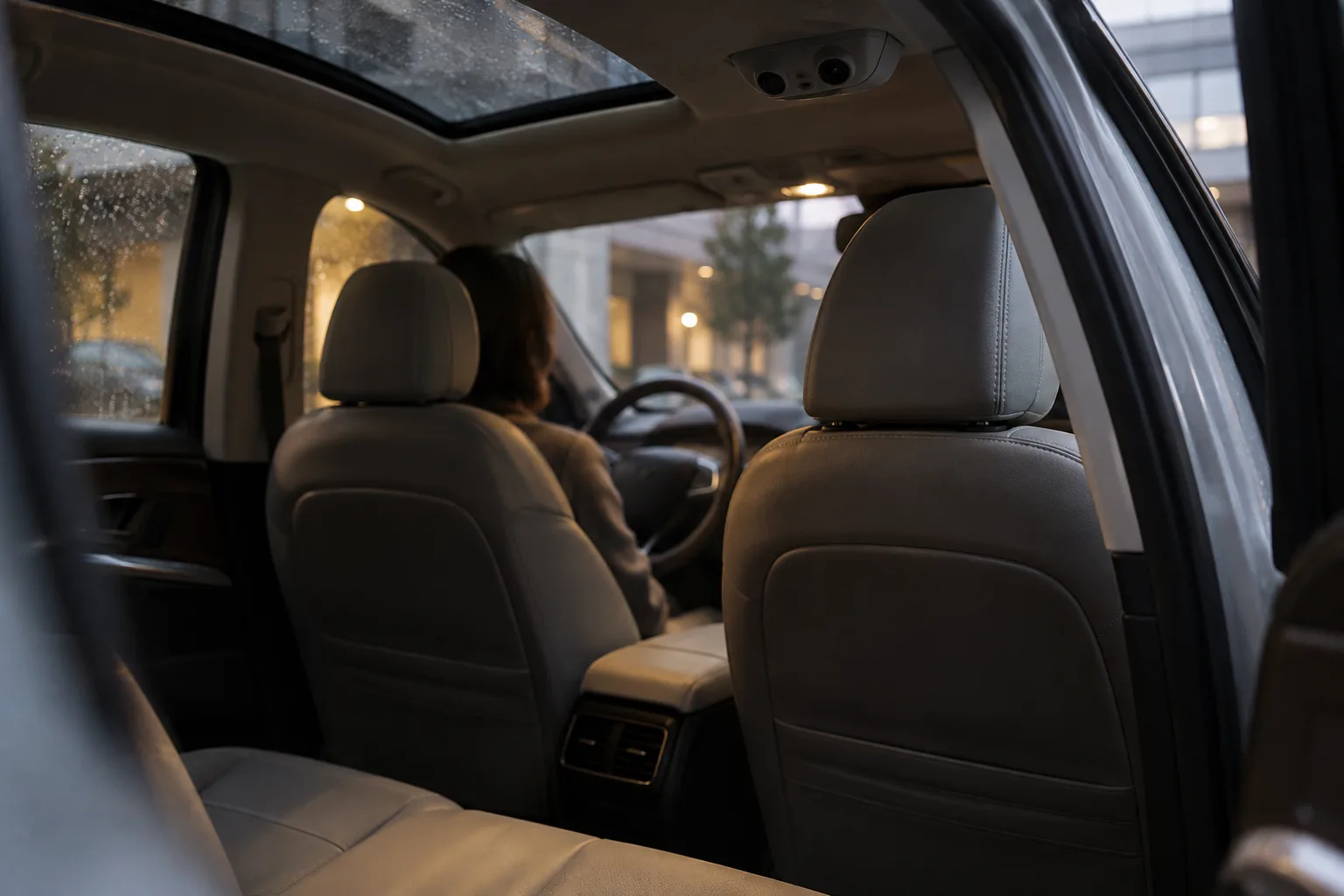
SAIC is building an attentive cabin
SAIC’s announcement starts somewhere else. Its Roewe Jiayue 07 uses ByteDance’s Volcano Engine and a Doubao assistant in what the company calls a “CPP” AI architecture. SAIC says the vehicle combines cabin and driver-monitoring cameras, voice-zone recognition, continuous conversation and contextual inference. It also says the system can reach across more than 2,000 service interfaces.
Take those claims as the manufacturer’s description of an ambition, not a settled consumer benefit. A car that can infer which occupant is speaking, remember the thread of a conversation and adjust navigation, comfort or entertainment is not necessarily a car that drives itself any better. It is a car that turns the cabin into a new kind of interface — less like a dashboard, more like a room with ears.
That may be commercially potent. A useful cabin agent reduces the nuisance of menus and fragmented apps. But it creates an awkward ledger: voices, faces, attention, destination and in-car behaviour are unusually intimate data. The technical architecture matters because it determines what stays in the vehicle, what must travel to a cloud service, and which company gets to make that decision after the sale.
An AI-native car is not one category. It is a choice about whether the machine first understands the road, the occupants, or the commercial relationship around both.
Architecture is the real dividing line
Both announcements point beyond the infotainment screen, but neither deserves a blank cheque. The meaningful test for Mercedes is whether a learned model can gain coverage without blurring responsibility when it meets the real world. The meaningful test for SAIC is whether contextual intelligence makes the cabin less distracting without converting private life into an always-on data feed.
This is also why the word native is useful only when it is made specific. Native to what: a vehicle operating system, an on-board processor, a cloud model, a supplier’s platform, a driver’s routine? The answer determines update cycles, repair rights, data governance and the amount of leverage a carmaker retains after outsourcing a critical capability.
Investors have already learned, through the robotaxi wager embedded in Tesla’s valuation, that “AI in the car” is not a single market. It is a collection of businesses with different margins, liabilities and bottlenecks. Mercedes is testing whether intelligence can take the wheel. SAIC is testing whether it can take the conversation. A truly AI-native vehicle may eventually do both. For now, the useful question is less mystical: which job is the model doing, who bears the error, and whose data makes the system better tomorrow?
Sources
Continue reading


Sources
Analysis of Mercedes-Benz and Wayve's reported production agreement and SAIC's announcement for the Roewe Jiayue 07, including the companies' stated technical claims.


