

Toyota says factory modernization across its group and major suppliers could require about ¥1 trillion a year from 2028 and roughly 400,000 robots. The estimate shifts the automation debate from a demo-day question to a capital, integration and workforce-planning problem.
Tokyo — Toyota has put a useful boundary around the factory-robot hype cycle: the boundary is a budget. Reuters reported that the carmaker estimates modernizing factories across Toyota, group companies and major suppliers could cost about ¥1 trillion ($6.4 billion) annually from 2028. In the same investor discussion, Toyota said roughly 400,000 robots could be needed across that network.
That is not a promise to purchase 400,000 humanoid robots, and it should not be reported that way. The estimate includes replacement machinery, new industrial robots, automated logistics, and prospective human-robot collaboration. Toyota did not specify whether the spending will be approved, how many years it would continue, or a fixed deployment schedule for each type of machine.
But the scale is still revealing. The story is no longer whether a robot can perform a carefully staged task. It is whether a manufacturer can fund, deploy, maintain and govern a parallel operating system across its supply chain.
The capital commitment is the signal
Pilot programs hide most of the work. A single robotic cell can be evaluated by uptime and throughput. A network-wide modernization program has to account for plant layouts, tooling, safety cases, software integration, spare parts, cybersecurity, training and the uneven capacity of suppliers. The capital budget has to cover the machinery around the robot as well as the robot itself.
Toyota’s estimate places those costs in the same category as other recurring industrial investments: neither a lab experiment nor a one-time equipment purchase. It also makes the economics more honest. A large robot count does not by itself say how much productive work is automated; it says management expects the surrounding system to require a large, sustained upgrade.
“Robot” is a broader category than the headlines suggest
The 400,000 figure has attracted attention because humanoid robots make for a vivid picture. Yet Reuters said Toyota’s estimate spans humanoid and non-humanoid machines, including existing equipment being replaced. Treating the number as an order for 400,000 human-shaped workers would overstate both the technology and the decision.
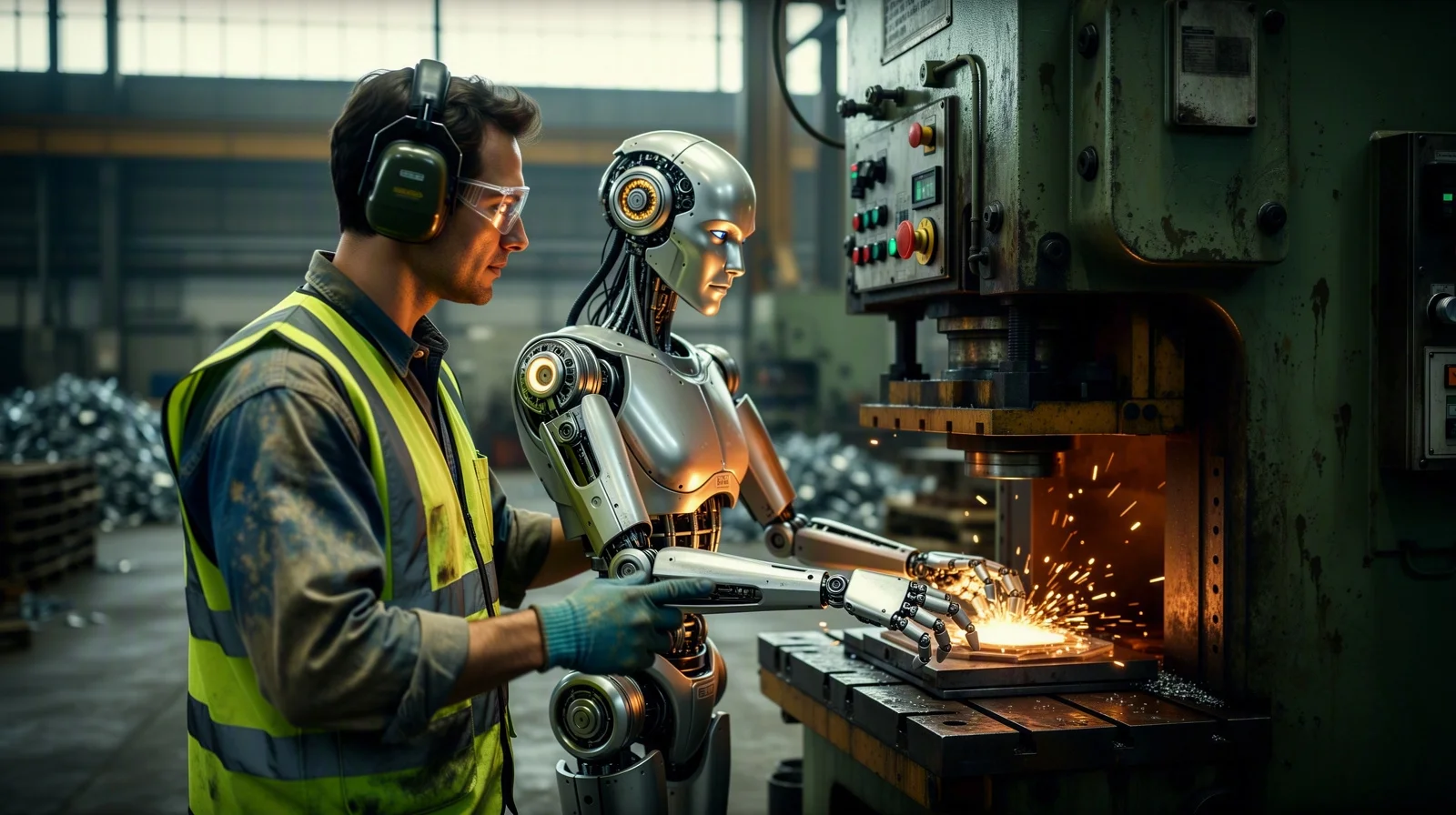
Toyota is nevertheless experimenting with a more human-facing form factor. Ars Technica reported that workers are helping train Toyota’s wheeled, two-armed ELEY robot for factory tasks. The relevant question is not whether ELEY walks like a person. It is whether experienced workers can reliably transfer judgment about a task into a system that can repeat it safely across sites.
Training becomes a production asset
That transfer of know-how is where the labor story begins. If experienced operators demonstrate tasks, review performance and define exceptions, their knowledge becomes a training input. Factories will still need people who can maintain equipment, validate changes, respond to failures and decide when an automated workflow should stop.
Toyota’s description of worker-led training does not settle the employment question. Automation can change hiring, job design and bargaining power even when it does not produce an immediate round of layoffs. It does suggest that implementation will depend on retaining operational expertise long enough to encode, test and supervise new systems.
The supplier network is the hard part
The plan’s scope is its important feature. Toyota’s own plants are only one part of the production system. Group companies and major suppliers have different equipment ages, process maturity and capital capacity. An automation strategy that works in a flagship facility can fail at the network edge if parts makers cannot finance compatible upgrades or support the software and safety burden.
That is why the ¥1 trillion figure matters more than a demonstration video. It is an early estimate of the cost of coordinating an industrial ecosystem, not a scorecard for humanoid-robot adoption. Investors should watch for approved capital allocations, named equipment programs, plant timelines and supplier participation before treating it as a committed spending run rate.
Toyota has supplied an estimate, not a finished automation blueprint. Still, it offers a clearer test for the sector: the winners will be manufacturers that can turn robotics into reliable production infrastructure without losing the human knowledge that makes their factories work.
Sources
- Reuters: https://www.investing.com/news/stock-market-news/toyota-estimates-factory-automation-could-cost-64-billion-per-year-from-2028-4906790
- Ars Technica: https://arstechnica.com/ai/2026/09/toyota-claims-plan-for-400000-factory-robots-wont-replace-human-workers/
- Toyota FY2026 financial-results presentation: https://global.toyota/pages/global_toyota/ir/financial-results/2026_4q_presentation_2_en.pdf
Continue reading


Sources
Reuters reporting on Toyota's investor discussion of a potential ¥1 trillion annual modernization cost from 2028 and an estimated 400,000 robots across Toyota, group companies and major suppliers; Ars Technica reporting on the ELEY robot and worker-led training; Toyota investor materials on robotics and human-robot collaboration.


