

Amazon now plans about $220 billion of 2026 cash capital spending. Andy Jassy said the majority supports AI and AWS, while fulfillment robotics appear as fleet counts and cost-to-serve claims, not as a disclosed dollar split. That gap is the allocation story. It is not a named labor-substitution event.
Amazon told investors on July 30 that 2026 cash capital expenditures would be about $220 billion, up from a February figure near $200 billion. Memory prices and extra AWS capacity did the lifting. Trailing-twelve-month free cash flow flipped to a $7.6 billion outflow as net purchases of property and equipment rose $66.1 billion — “primarily” artificial intelligence, in the company’s own clause. That is the market fact. The tidy story of two cost-takeout strategies, robots versus models, starts to come apart here.
The Wires Already Have a Physical-AI Allocation Story
The dominant explanation writes itself. Robotics capital is shifting toward “physical AI”: data and infrastructure first, hardware second, because digital assets reuse and metal does not. Amazon fits the template. It expects to more than double Cardinal and Sparrow robotic arms in 2026. On August 26, AWS and Nvidia said they would deploy two million additional GPUs in 2027–2028 and that Amazon Robotics would train on Nvidia’s simulation stack — on GPU-accelerated EC2.
An AWS executive had already given the phrase its travel papers: physical AI as the “next frontier.” Commentators treated that frontier as an event, and the event as Amazon’s labor strategy. If the thesis is a quantified split inside Amazon’s budget, why do the 10-K, the Q2 release, and the call still refuse to print it?
Amazon Reports One Capex Number and Two Vocabularies
Jassy was explicit about mix in one direction only. The majority of the 2026 spend supports AI and AWS. He then walked the cycle that actually sits in the model: data-center shells started two years before servers can earn; servers bought a few months before they go live; break-even in a little under three years; useful life of five to six; AI capacity often contracted for at least five. That is a reuse story with a contracted offtaker.
Robotics arrives in another dialect. Fleet counts. A next-generation Proteus that takes plain-speech commands. “We continue to lower our overall cost to serve,” he said, in the same breath as fuel inflation and higher line-haul rates. Q2 shipping costs were $27.9 billion, up 19 percent. Cost-to-serve is an operating claim. It is not a capex line.
The 2025 cash outlay for property and equipment was about $128 billion, after $78 billion in 2024. The annual report still lumps fulfillment square footage with data centers. Q4’s outlook named “AI, chips, robotics, and low earth orbit satellites” as reasons to spend about $200 billion — a list, not an allocation. Anyone who needs a robotics-versus-AI ratio is synthesizing. A filing that printed that ratio would kill this piece. It has not arrived.
Amazon will tell you how many arms it plans to double. It will not tell you how many of the $220 billion those arms consume.
The mechanism that does show up is the one the Nvidia note accidentally made precise. Simulation, synthetic data, training, and real-to-sim validation run on the same GPU-accelerated instances that sell to every other AWS customer. Capital can land on models and plants first because those assets transfer across buildings. A Cardinal arm does not. Integration, maintenance, and site geometry still meter physical rollout even when the training stack is already paid for.
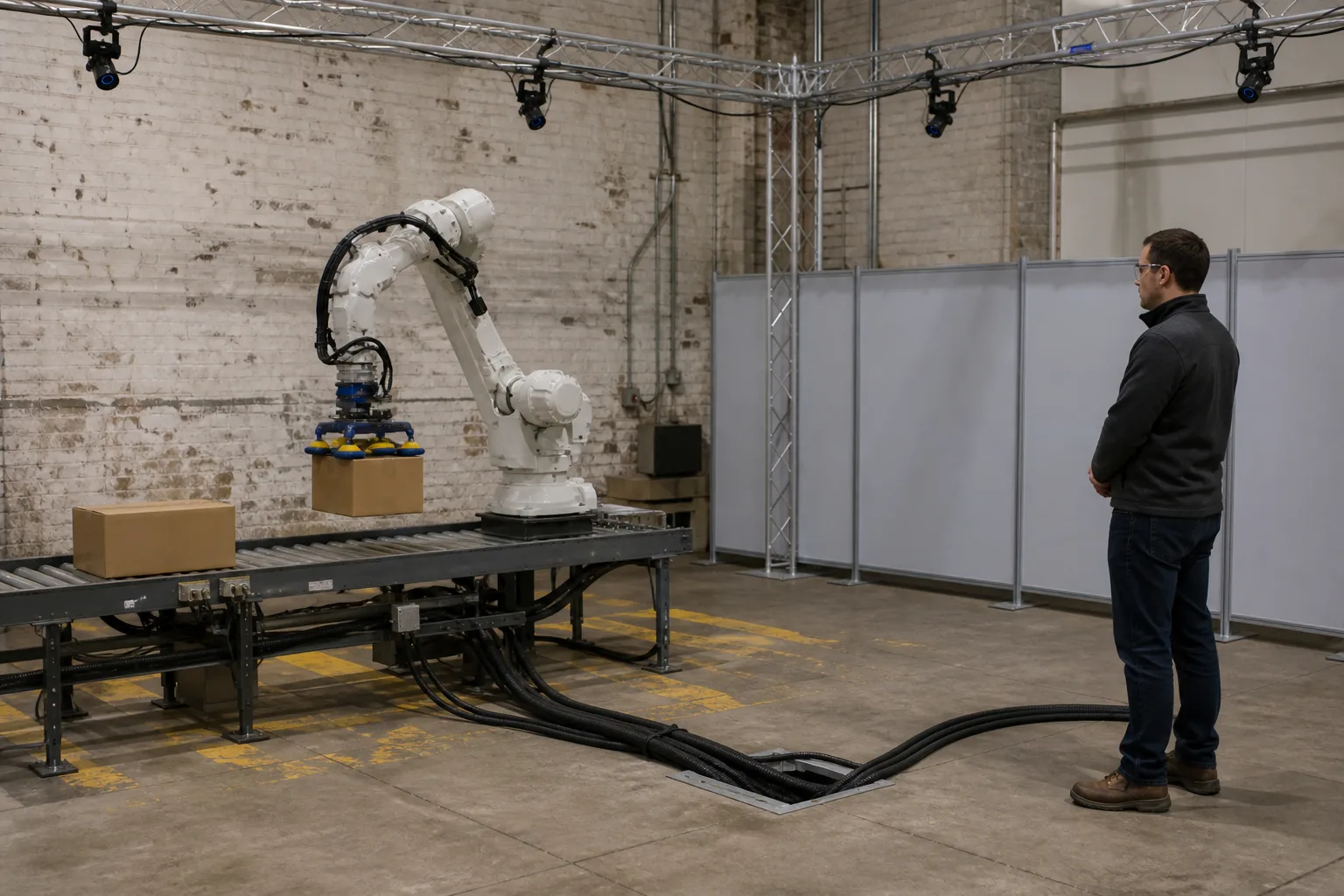
What Still Gets Treated as a Labor Hedge
Markets have been trained, after Nvidia’s record quarter met a shrug, to ask whether capex converts. Amazon’s test for AWS is utilization and contracted terms. The test for warehouse automation would be throughput and fulfillment cost after deployment, matched to the dollars that bought the machines. Those series are not in the 10-K. Funding can finance platforms. It does not, by itself, prove takeout.
That is why the utility-gap problem and the dot-com echo belong here. Hyperscaler cash is real. So is the lag before someone pays. Shipping inflation can erase robot savings that never got a footnote. China’s cheaper inference path is a reminder that software takeout can move without a new aisle of steel. Amazon is running both plays. The accounts price only one of them in billions.
Underwriters who treat robot headlines as a substitute for AWS payback are mixing two duration profiles. Treating the $220 billion as a labor-substitution program reads a press adjective — “physical” — as a segment. The split becomes a fact when Amazon reports robotics capex separately, or when North America fulfillment cost per unit falls faster than AWS mix can explain, and the company ties that drop to named deployments. Until then, the Automation Frontier is a phrase. The cash-flow statement is still a data-center document with a robot in the remarks.
Continue reading


Sources
Amazon Q2 2026 results and earnings call (July 30, 2026); Amazon Q4 2025 results (February 2026 capex outlook); Amazon Form 10-K for the year ended Dec. 31, 2025; AWS–NVIDIA press release (Aug. 26, 2026); Amazon Q2 2026 cash-flow statement (purchases of property and equipment).


