

BMW has measured a Figure robot’s work across 30,000 X3s and is testing a humanoid in Leipzig, while Hyundai and Boston Dynamics have opened a Georgia centre to train Atlas for manufacturing. Their real challenge is economic: whether a flexible machine earns its place beside automation that is already very good at fixed tasks.
The car factory has never lacked robots. It has lacked robots that can walk into a workstation designed for a person, cope with an irregular tote or a moved cart, and then do a different job tomorrow. That is the opening BMW and Hyundai are trying to price with humanoid machines — not the familiar fantasy of an empty plant, but the much harder business of fitting a flexible body into an existing one.
BMW now has a useful amount of evidence. In Spartanburg, South Carolina, its Figure 02 pilot assisted the production of more than 30,000 X3s over ten months, according to the company. The robot retrieved and positioned sheet-metal parts for welding, moving more than 90,000 components across roughly 1,250 operating hours. In Leipzig, BMW is putting Hexagon’s wheeled AEON humanoid into battery-module and component work. Hyundai, meanwhile, has opened a robotics testing and training centre inside its Georgia manufacturing operation, where Boston Dynamics is preparing Atlas for factory deployment.
The figures are a welcome change from the usual humanoid montage. They still do not answer the question that matters: what work can this shape perform economically that a conventional industrial robot cannot?
Fixed robots win whenever the world stays fixed
Traditional industrial robots are brutally good at their chosen jobs. Put a part in the same place, use the same gripper, give the arm enough guarding and a repeatable path, and it will weld, bond, lift or place with frightening consistency. The payback comes from volume and predictability. A robot arm does not need legs because its station does not move.
That is why BMW’s Spartanburg choice is revealing. Figure 02 did not arrive to replace the body shop’s automation. It handled a repeatable but line-side task: retrieving and positioning sheet metal with millimetre precision. BMW says the trial also exposed practical requirements — extra barriers and partitions, and better 5G coverage in the hall. The factory was learning around the robot as much as the robot was learning the task.
Humanoids earn their keep only when the alternative is worse. They might move material through a narrow aisle, reach into a container designed for human shoulders, tend a task whose layout changes too often to justify a dedicated cell, or take over the bending, lifting and awkward reaches that wear down workers. In other words, the prize is not dexterity in the abstract. It is lower conversion cost in a plant full of legacy geometry.
That framing should make everyone less easily impressed by a robot walking across a stage. The shape is expensive: balance, batteries, hands, sensors and safety systems all demand maintenance. A fixed arm remains the better machine for a fixed operation. A humanoid is an argument that the operation is not fixed enough.
BMW is testing work, not a mascot
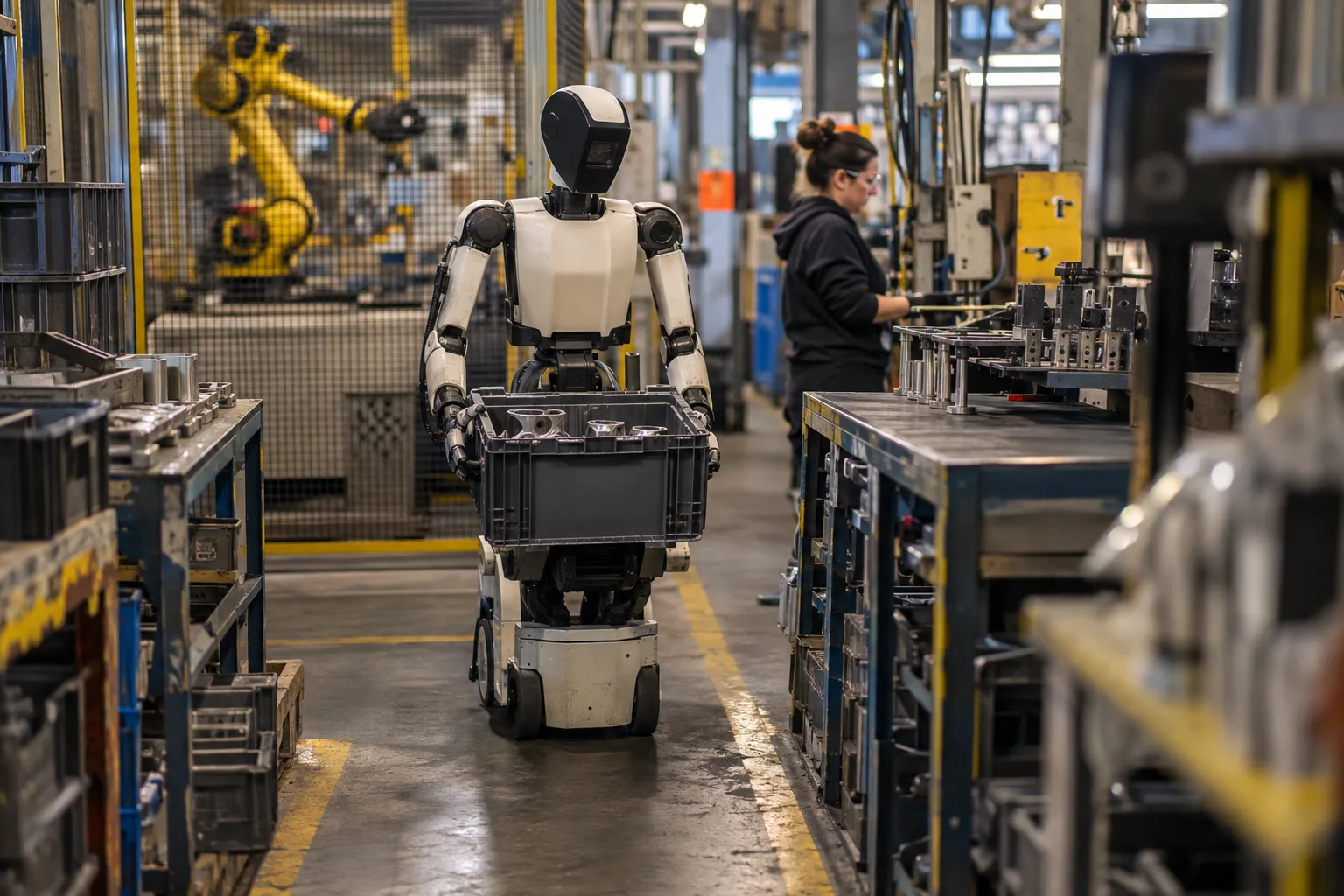
BMW’s Leipzig project makes that distinction unusually explicit. AEON is 1.65 metres tall, rides on wheels and is being tested first in high-voltage battery assembly and component production. The company says it will deliver materials, navigate around obstacles and take on jobs where repetition, precision and ergonomics converge. Rather than assigning it one theatrical assignment, BMW plans to adjust stations and let teams identify where it actually helps.
That is the sober way to run the experiment. The Figure 02 pilot has already yielded a next question: Figure 03 is intended to sort unsorted parts into just-in-sequence trolleys for logistics. Sequencing is a legitimate factory problem. A part that arrives correctly but at the wrong moment still stops the line. If a humanoid can handle variable bins and preserve the rhythm of that flow, it has a more credible route to scale than a machine built to wave, climb stairs or charm a camera.
The humanoid’s economic case begins where a dedicated robot would require the plant to become less human before the robot can become useful.
The labor implication is not simple subtraction. BMW describes the intended use as support for repetitive, physically demanding and safety-critical work, while people oversee process, quality and integration. That can mean better ergonomics and fewer brutal tasks. It can also mean fewer entry-level roles, more monitoring, and a demand for workers who can recover an automated process when it goes wrong. As AI’s pressure on middle management shows, the first effect of automation is often a reorganisation of responsibility before it is a clean count of jobs lost.
Hyundai’s centre is a test of transferability
Hyundai and Boston Dynamics’ Georgia centre supplies the other half of the story: training and validation inside a live manufacturing setting. Atlas has to demonstrate that an action learned in a controlled environment survives the noise of a real plant — shifting inventory, different light, spilled fluids, human coworkers and the unglamorous accumulation of exceptions that makes factories difficult.
That is physical AI’s real bottleneck. The software may improve quickly, but the task succeeds only when perception, grasping, movement, safety rules and plant systems agree about the same physical moment. A factory is not a benchmark. It has shift changes, throughput targets and a manager who notices when the tote arrived late.
For that reason, the early scorecard should be prosaic: operating hours, recovery time, safety interventions, changeover time, output quality and the cost of supervising each robot. The same discipline that asks where AI moves scarcity after expertise gets cheap applies here. Value will not accrue merely to the machine that resembles a person. It will accrue to the system that can turn a variable human workspace into dependable output without rebuilding the factory around it.
Sources
Continue reading


Sources
Analysis of BMW Group's reporting on Figure 02 and AEON pilots and reporting on Boston Dynamics' Hyundai Motor Group Metaplant America robotics centre.


