

SpaceX's first post-IPO quarter delivered $7.8 billion in revenue, up 92%, powered by Starlink and wholesale AI compute leases. The stock still sank on AI capex that outran the rent. Markets are no longer pricing rockets; they are pricing whether Nvidia-backed orbital satellites can convert today's power bottleneck into SpaceX-owned inventory.
SpaceX’s first public print arrived almost exactly as the IPO choreography promised — and almost exactly as investors now refuse to celebrate. Revenue climbed to $7.8 billion in the second quarter, up 92% from a year earlier. Connectivity, still mostly Starlink, contributed $4.29 billion. The AI segment nearly tripled year over year to $2.56 billion after Anthropic and Google locked wholesale capacity at the Memphis-area Colossus campuses. The net loss narrowed to $541 million. After hours, the stock still slid as much as 8%.
The market is not scoring this print as aerospace. It is scoring it as an infrastructure claim.
Ground Rent Is Real. Capex Is the Argument.
CFO Bret Johnsen told analysts that hosting deals threw off high incremental EBITDA because SpaceX monetized capacity already standing on the floor. That is the grounded half of the thesis: xAI’s training plant, once a pure cost center and scandal machine, now bills frontier labs like a landlord. Johnsen also pointed to $6.7 billion of cloud services revenue under contract over a six-month ramp starting in October — the nearest thing the call offered to a backstop against the utility gap that still haunts pure AI builders.
What broke the mood was the other half of the ledger. AI capital expenditures hit $15.8 billion in the quarter, well above consensus ~$13.1 billion, inside total capex of roughly $18.4 billion — more than double the period’s revenue. Starlink subscribers landed at about 12 million, a hair light versus estimates. The arithmetic is familiar from Nvidia’s best-quarter paradox: when growth is already priced into a mega-cap narrative, beat-and-spend reads as uncertainty rather than proof.
Capital set the IPO stage when the May split preceded the June Nasdaq listing at a $1.75 trillion target and more than $85 billion raised. Platform constraints now set the multipole. SpaceX can grow rents on fixed racks; markets care whether those racks scale into a new architecture only it can launch.
Nvidia Allocation Is the Binding Constraint
Musk’s most consequential line of the session was not about rockets. It was about silicon. SpaceX, he said, has an “understanding with Nvidia” that it will receive a “very significant percentage” of Nvidia GPUs next year — the scarce intermediate good that still sits behind every hyperscaler capex slide and every custom-XPU hedge tracked in Broadcom’s quiet AI takeover.
That claim reorders the earnings lens. Anthropic and Google leases show demand for SpaceX space to run GPUs. The Nvidia understanding is a claim on who gets the GPUs at all. In a market already rewiring enterprise budgets through deals like Nvidia’s Groq licensing, preferential allocation is platform power, not a procurement footnote. If SpaceX becomes a privileged channel for next-generation Vera Rubin deployments on the ground, the Colossus model is not a side business; it is a clearing house between chip scarcity and model demand.
Starmind Prices the Residual Multiple
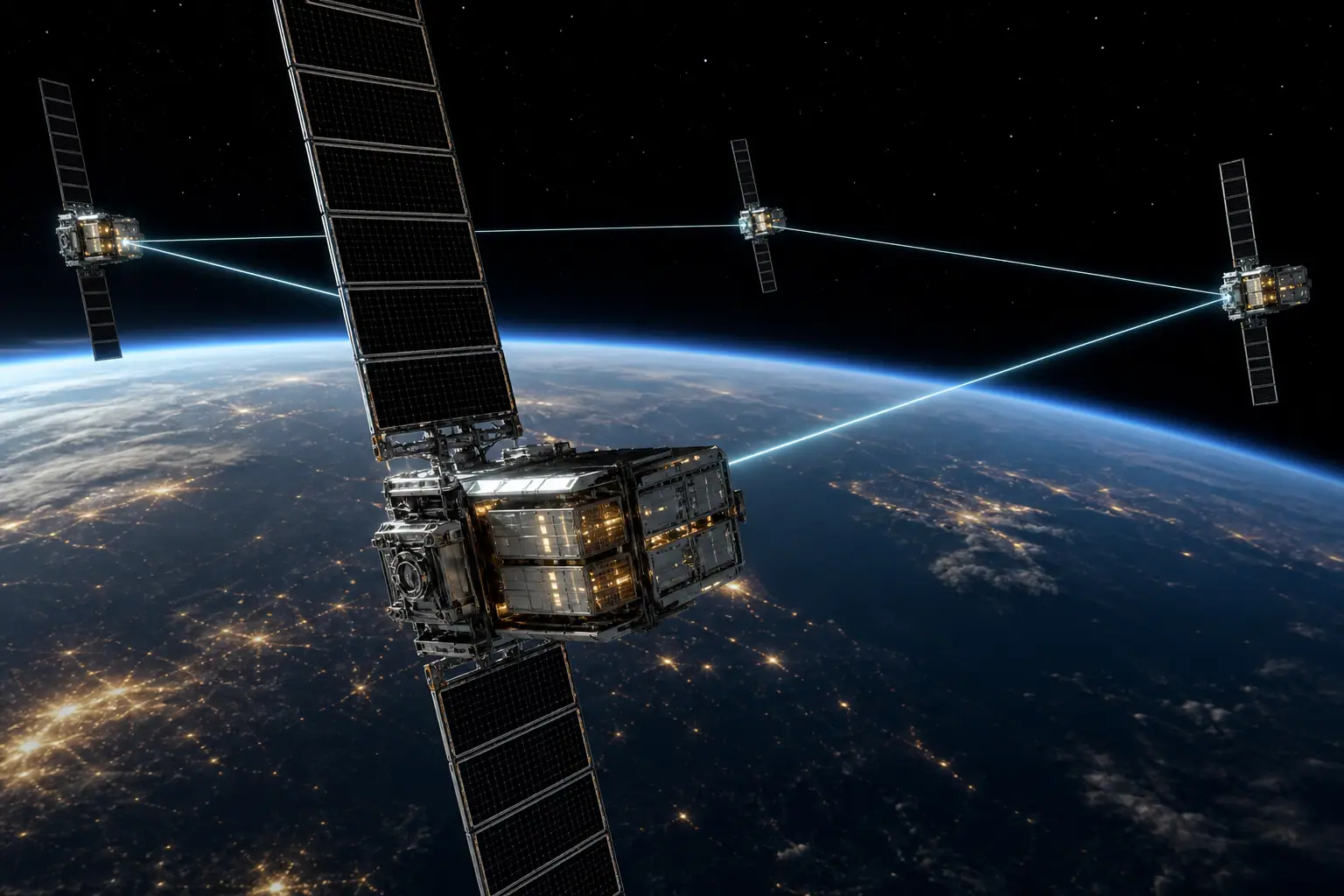
The longer option is orbital. Starmind — SpaceX’s AI-satellite constellation, pitched as compute nodes rather than broadband pipes — is framed around Nvidia payloads and Starlink’s laser mesh as the backplane. FCC filings seek authority for up to a million orbital data-center satellites; prototypes of AI1 hardware targeting ~120 kW of average compute per craft are still 2027 stories. Musk’s public assertion that space becomes the lowest-cost place to park AI wattage within a few years remains a prediction, not a cash-flow line.
That does not make it irrelevant to today’s multipole. The dot-com echo taught investors to separate speculative fiber from real scarcity. Power queues, turbine permits, and interconnect lead times are real. Orbit answers a different scarcity calendar: continuous solar, radiative cooling, and no local zoning board. Starship launch economics either collapse deployment cost enough to make million-node ambitions less absurdist — or they do not, and investors keep renting Colossus while the residual IPO premium decays.
The recursive read is simple. SpaceX just proved it can sell AI watts while losing less money on a bigger top line. Markets price the stock as whether those watts remain a landlord’s inventory on the Mississippi — or become a constellation only a launch company with Nvidia silicon can assemble. Act on one principle: value the company as a platform that can manufacture capacity queues, not as a rocket ticker with an AI wallpaper.
Continue reading


Sources
TechCrunch first-earnings coverage of SpaceX Q2 2026 revenue and cloud contracts; TradingKey segment breakdown of connectivity, AI, and space; Business Insider on after-hours reaction, Starlink subscribers, and Musk's Nvidia GPU comments; prior Culled coverage of the SpaceX split/IPO, Colossus bottleneck, Nvidia's prove-it paradox, Broadcom custom silicon, and the AI utility gap


