

Verizon signed a multi-billion-dollar deal for Corning to supply more than 80 million miles of high-density optical fiber from 2027 through 2032. The buy covers broadband passings and long-haul AI data-center links. The scarce input is not software. It is glass drawn at industrial scale years ahead of need.
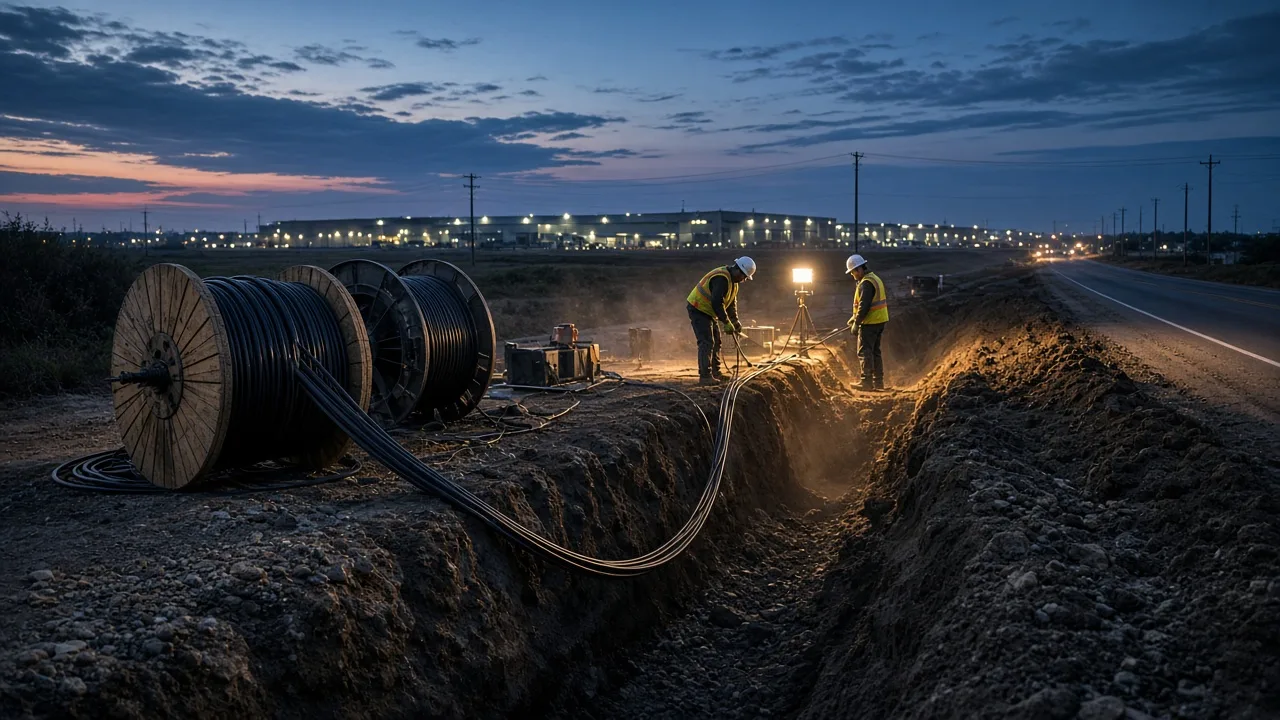
Verizon and Corning announced a multi-billion-dollar supply agreement covering more than 80 million miles of high-density optical fiber and connectivity solutions from 2027 through 2032. Dollar terms stay undisclosed. The volume does not. For scale, that length is hundreds of round trips to the Moon. Verizon is not merely ordering cable for next quarter’s trench crew. It is reserving manufacturing capacity years ahead so it can expand ordinary broadband and the long-haul links that stitch AI data centers together.
The carrier’s own framing is dual-use by design. The fiber accelerates a push toward 40–50 million broadband passings while feeding what Verizon calls AI Connect corridors — ultra-dense cable across major long-haul routes that hyperscalers need for near-zero-latency interconnect. Cell sites, enterprise campuses, and residential neighborhoods are supposed to hang off the same high-capacity backbone. Contour Flow ribbon cable packs more strands into existing conduit, which is how you raise bandwidth without always digging a new hole. Corning, for its part, gets a multi-year demand signal to keep scaling U.S. optical manufacturing. After three decades of partnership, the companies are treating glass draw capacity as a strategic input, not a spot commodity.
Capacity Reservation Beats Spot Fiber
That is the residual most wire coverage underplays. Algorithms still improve. GPUs still ration training runs. But the physical AI stack keeps migrating scarcity upstream — into power and cooling clocks, into CoWoS and packaging slots, into turbines and switchgear. Fiber now joins that list. Ultra-pure silica, drawn into hair-thin strands at absurd volume, is hard to improvise. You cannot prompt a draw tower into existence. You book it.
Corning as Mental Model
The useful analogy is not another software startup. It is Corning: a firm that performs extremely difficult manufacturing at continental scale and gets paid when someone else needs the output of that difficulty. SoftBank buying DigitalBridge for data-center constraint was a claim on shells and power adjacency. Verizon’s Corning pact is a claim on the glass that makes those shells talk to each other across states. Cloud races still collide with packaging limits; interconnect races collide with who can pull enough fiber on schedule.
The AI boom is quietly becoming a boom in companies that can manufacture the hard physical inputs at absurd scale.
What markets still misprice is the difference between a theme and a bottleneck. “AI needs connectivity” is a slogan. Eighty million miles booked through 2032 is a production plan. If Gen AI workloads keep forcing denser long-haul corridors while consumer broadband still needs passings, the same scarce glass serves both bills — and the manufacturer with reserved capacity captures optionality the model lab cannot print. The test is simple: watch whether more carriers and hyperscalers convert interconnect anxiety into multi-year offtake with the few firms that can actually draw the strand.
Continue reading


Sources
Verizon Sept. 8, 2026 press release on Corning multi-billion fiber supply agreement 2027–2032; Reuters coverage of undisclosed terms; Culled prior coverage of power bottlenecks, packaging constraints, and electricity supercycle manufacturing scarcity


