

QuantumScape shares rose about 7 percent in premarket trading on October 22 after the company reported a third-quarter loss of 14 cents per share, beating the 17-cent consensus, and announced a planned 100 megawatt-hour solid-state cell line aimed at AI data centers, aerospace, and defense. Cell production on the new line is targeted for 2028, with equipment costs below $100 million and site selection still open. CNBC listed QuantumScape among the morning's biggest movers, tying the jump to the manufacturing plan rather than grid-scale power relief.
QuantumScape entered Thursday’s session with a story that sounds like the AI power crunch in headline form and reads like a pre-revenue manufacturing bet in the footnotes. On October 21 the company reported a third-quarter GAAP loss of 14 cents per share, narrower than the 17-cent loss analysts expected, and paired the print with a plan for a 100 megawatt-hour solid-state cell production line serving AI data centers, aerospace, and defense. CNBC’s premarket movers list attributed a roughly 7 percent gain in QuantumScape shares to that manufacturing announcement—not to evidence that solid-state packs are already clearing interconnection queues behind new gigawatt campuses.
The distinction matters for anyone holding the stock or benchmarking the sector. Data-center operators are scrambling for megawatts on the grid and for ride-through inside the hall; battery energy storage is part of that toolkit. What traded higher overnight is a capacity plan—engineering work with Germany’s Muehlbauer Group on assembly equipment, production targeted to start in 2028, site selection still underway, and management guiding to equipment costs below $100 million with a fuller capital plan promised alongside 2027 financial guidance on the fourth-quarter call. Capital markets are pricing optionality on a factory that does not yet have an address.
What the company actually shipped this quarter
The earnings layer is real but small relative to the narrative. Customer billings reached $9.8 million in the quarter, including initial revenue under the Honda agreement and first billings from the advanced-solutions vertical that covers defense and aerospace, according to summaries of the release. Liquidity stood at $819.8 million; the company reaffirmed a 2026 adjusted EBITDA loss range of $250 million to $275 million and capital spending of $27 million to $37 million. Those numbers describe a firm still burning cash to prove manufacturing—not one booking hyperscaler storage at utility scale.
CEO Siva Sivaram framed the 100 MWh line as the step after the Eagle Line pilot in San Jose, which management says is producing QSE-5 cells for customer sampling at increasing volume. Partnerships with Murata, Corning, and now Muehlbauer are meant to signal an end-to-end production path toward eventual gigawatt-hour scale. For investors, the binding constraint is not whether ceramic separators work in a lab; it is whether sampling converts to priced volume in a vertical where incumbents already ship.
The data-center product—and the incumbents
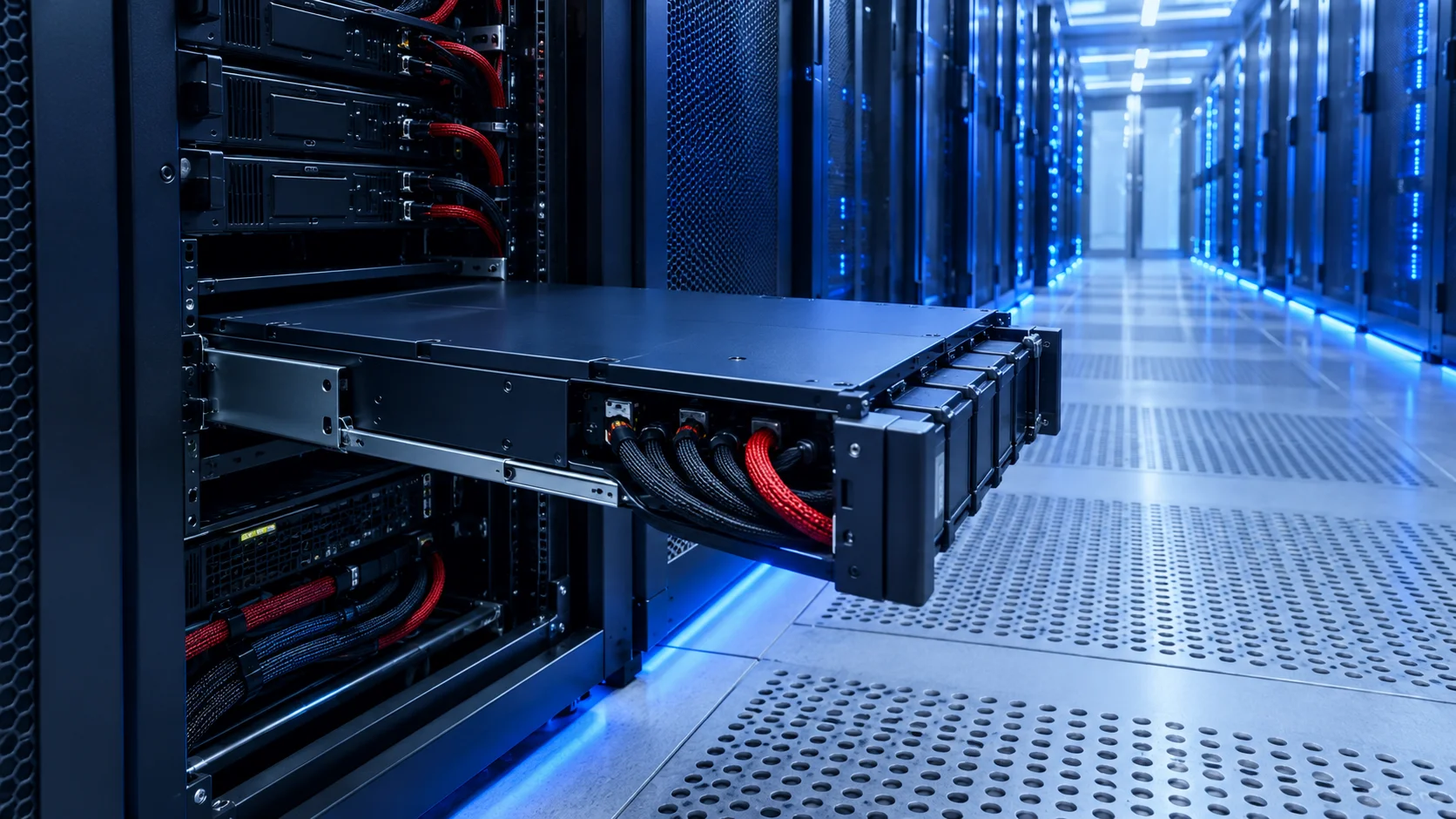
QuantumScape’s data-center wedge is not a field of Megapacks behind a substation. On October 8, alongside the Open Compute Project Global Summit, it launched the QS PowerBlock, an in-rack energy storage reference design built around QSE-5 cells. Management said internal testing showed four times the power density and five times the runtime of the OCP reference specification, and emphasized thermal stability above 300 degrees Celsius—contrasted with conventional lithium-ion chemistries that lose stability around 180 degrees Celsius, a selling point when batteries sit adjacent to high-value compute.
That architecture competes on safety and density inside the rack, not on the economics of multi-hour grid backup. The buyers already moving budget today look different. CNBC reported in August that SpaceX spent $295 million on Tesla Megapacks in the second quarter alone—$329 million in the first half of 2026—to support Colossus AI data centers near Memphis, illustrating how hyperscaler-adjacent builders procure containerized lithium-ion at scale now. Fluence, Sungrow, BYD, and CATL sit on Wood Mackenzie-style leaderboards for utility and C&I storage; Fluence’s CEO told analysts the firm signed master supply agreements with two hyperscale data-center developers after multi-round reviews, with a first project order expected in the third quarter of 2026, per Energy-Storage.News coverage of its earnings call.
Solid-state specialists—Solid Power, SES, and others still climbing manufacturing curves—are not yet the reference vendors in those procurement lists. QuantumScape is betting its ceramic separator and domestic supply-chain story can jump the queue by solving insurance and permitting friction near GPUs. The market’s 7 percent premarket move prices that possibility; it does not prove a Fortune 50 cloud operator has signed.
Bull case, bear case, and milestones
Bullish readers can point to execution on 2026 goals: Eagle Line operational, automotive partnerships advancing, and billings beginning to register outside demos. Management highlighted customer pull from defense and aerospace—buyers sensitive to export controls on Chinese graphite and equipment—as well as data-center architects testing PowerBlock designs. Funding sources flagged on the call—customers, government programs, ecosystem partners, licensing—suggest management wants to avoid dilutive equity for the sub-$100 million equipment package. If a named hyperscaler or neocloud adopts in-rack solid-state as a standard, the 100 MWh line becomes a foot in the door rather than the ceiling.
Bearish readers will note scale and timing. One hundred megawatt-hours of annual cell capacity is tiny next to a single large campus’s backup or peak-shaving requirement, let alone the grid constraints discussed in DOE supply-chain filings and transformer bottlenecks elsewhere in the AI build-out. Production in 2028 leaves two years of execution risk—yield, cost per kilowatt-hour, and competition from improving LFP blocks—while the stock reacts today. QuantumScape still carries no disclosed multi-year data-center offtake comparable to Fluence’s MSAs or SpaceX’s Megapack invoices.
Milestones to track: site announcement and funding structure (expected with 2027 guidance); customer names attached to PowerBlock deployments or volume purchase agreements; quarterly billings growth in the advanced-solutions line; Eagle Line throughput and yield disclosures; and any hyperscaler reference design wins through OCP or direct RFPs. Until one of those prints, the trade is whether capital believes a solid-state factory can exist—not whether batteries solve AI’s megawatt problem in the abstract.
Continue reading


Sources
QuantumScape IR release and Q3 2026 earnings call Oct. 21, 2026 on 100 MWh line, Muehlbauer partnership, 2028 production target, and QS PowerBlock; CNBC Oct. 22, 2026 premarket movers on ~7% share move; TipRanks and Benzinga on Q3 loss of $0.14 vs $0.17 estimate, $9.8M billings, $819.8M liquidity; prior CNBC Aug. 2026 on SpaceX Tesla Megapack spend; Energy-Storage.News on Fluence hyperscaler MSAs; pv magazine on data-center BESS economics.


