

SpaceX's third public quarter delivered $14.6 billion in revenue, $4.4 billion in net income, and its first consolidated operating profit since listing — powered by cloud contracts, the Cursor acquisition, and Starlink's recurring engine. Starlink still earns the margin; SI now owns the headline.
SpaceX closed the books on its third quarter as a public company with numbers that read less like an aerospace supplier and more like a vertically integrated utility that also launches its own freight. Revenue reached $14.6 billion, up 161% year over year and nearly double the $7.8 billion printed in Q2. Net income was $4.4 billion — 35 cents diluted per share — against a $1.1 billion loss in the year-ago quarter. Consolidated income from operations flipped to $2.8 billion after a $143 million operating loss in June.
The segment map is the story. SpaceX renamed its AI reporting line Super Intelligence (SI); it generated $7.56 billion of revenue, ahead of Connectivity at $5.25 billion and Space at $1.77 billion. That ordering is new. The margin ordering is not: Connectivity operating income was $2.37 billion, SI $431 million, and the launch segment roughly breakeven at a $7 million operating loss.
Markets finally received the profit print many desks expected after the IPO. They also received a reminder that profit here is a composite of recurring satellite cash, wholesale compute rent, and accounting choices around the largest software acquisition in the company’s history.
Three engines, one income statement
Connectivity remains the disciplined franchise. Consumer revenue hit $3.12 billion, up 57% year over year; enterprise and government added $2.13 billion, up 91%. Starlink consumer subscribers reached 13.6 million, a 1.6 million sequential add, with monthly ARPU rising to $69. Aviation partnerships now cover more than 3,800 equipped aircraft. Operating leverage showed up plainly: Connectivity operating income nearly doubled year over year while capex in the segment was $1.5 billion — large, but not on the same planet as SI.
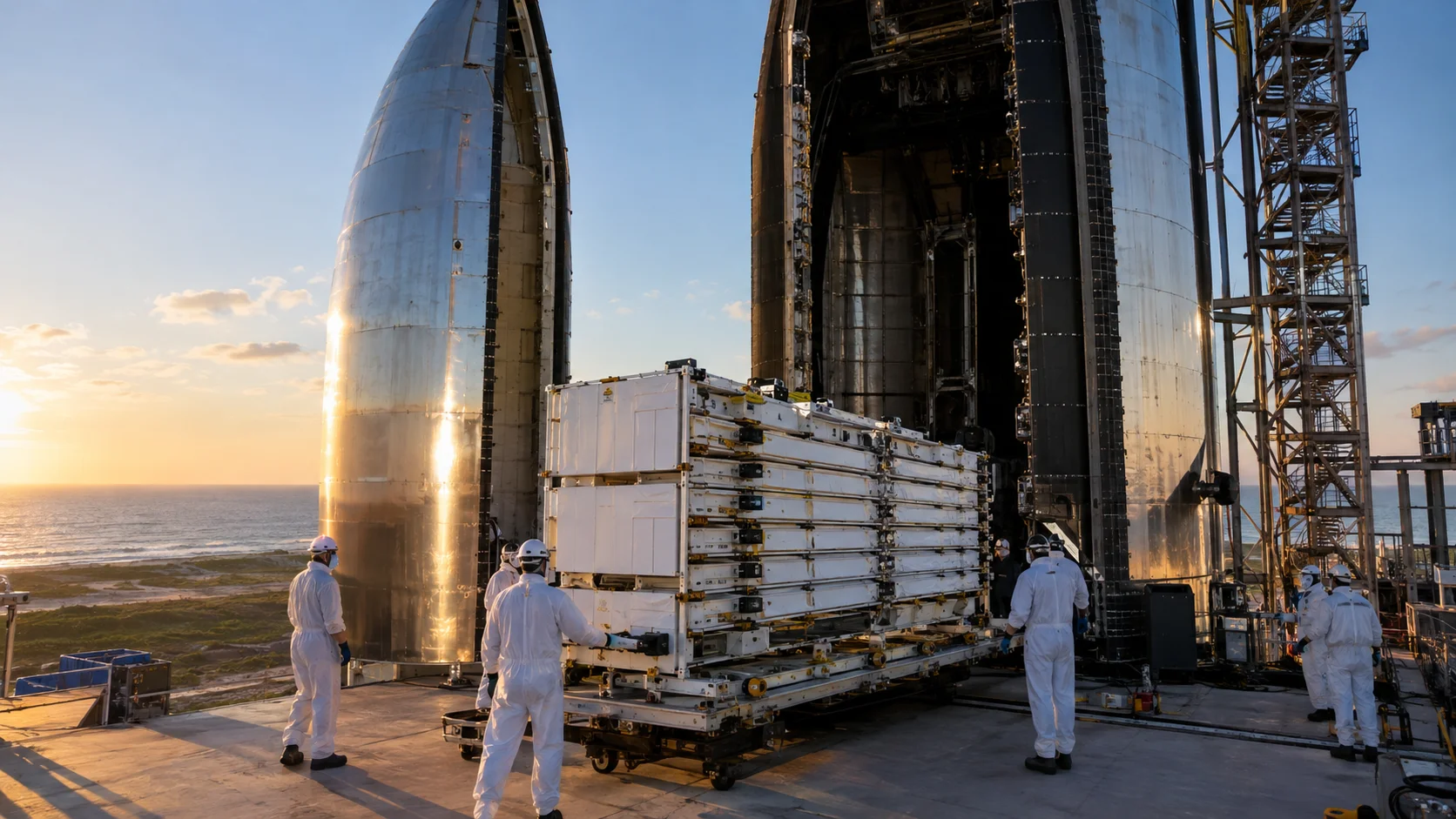
Space is still the capex-heavy proof layer. Launch services revenue was $1.13 billion; launch and development added $637 million. Customer launches numbered 12 in the quarter, including NASA’s Nancy Grace Roman telescope mission. Internally, SpaceX flew 23 more missions — mostly Starlink replenishment — so 476 metric tons reached orbit. The milestone investors had been waiting for arrived here: Starship Flight 14, described in the release as the first revenue-generating Starship mission, placed 26 Starlink V3 satellites on orbit, with SpaceX claiming roughly ten times the downlink capacity of a Falcon 9 Starlink launch. R&D in the segment ran $1.2 billion as Starship spending accelerated; segment adjusted EBITDA was $357 million despite the near-zero GAAP operating line.
Super Intelligence is where the quarter’s volatility lives. SI solutions and infrastructure revenue alone was $7.02 billion, up from $2.19 billion in Q2, with advertising contributing $538 million. Nameplate compute reached 1.7 gigawatts as of September 30 — up from 1.4 GW in June and 0.6 GW a year earlier — as Colossus II buildout continued. Management attributed the surge to activated cloud services agreements, Grok adoption, and the Cursor merger closed August 14.
Cursor is not a footnote. The deal carried $42.5 billion of GAAP purchase consideration and $23.4 billion of equity awards tied to post-close service; the release booked $1.2 billion of acquisition-related share-based compensation in SI for the quarter. Cursor contributed $608 million of revenue from closing through quarter end. Strip the acquisition noise and SI still crossed into GAAP operating profit — but the margin investors will debate is the one after GPUs, power, and retention grants, not the headline beat.
Cash, capex, and the balance sheet IPO
Adjusted EBITDA reached $8.8 billion, up 306% year over year. That is the number bulls will cite against $19.6 billion of quarterly capex — $16.4 billion in SI alone, essentially flat with Q2’s AI spend. Nine-month operating cash flow was $13.1 billion even as the company reported a $413 million net loss for the first nine months of 2026, illustrating how heavy depreciation and deferred revenue can separate cash from GAAP earnings in an infrastructure sprint.
The balance sheet looks like the June listing worked as intended: $51.3 billion of cash and $38.6 billion of marketable securities against $89.5 billion of net property, plant, and equipment and $48.4 billion of goodwill — much of it Cursor-shaped. Deferred revenue climbed to $17.5 billion combined current and long-term, up sharply year to date, which matters for anyone modeling how much of SI revenue is contracted versus recognized on activation.
Fortune and other same-day coverage noted that Starlink’s 1.6 million net adds fell short of some analyst subscriber models near 2.3 million, even as revenue and ARPU beat expectations. That is the tension in a $2 trillion class name: the market now grades SpaceX on whether connectivity growth can keep funding an SI build that already dominated the Q2 narrative when operating income was negative.
What changes for SPCX holders
The earnings release is a hinge, not a verdict. Q2 taught investors to fear capex without operating income. Q3 answers with profit on a revenue base that is mostly rent and subscriptions, while still spending like a hyperscaler in SI. The vertical-integration thesis — rockets deploy the network, the network bills consumers and governments, the data centers bill frontier labs — now has a consolidated P&L that matches the slide deck.
Three questions stay open after the print. First, durability: how much of the SI step-up is contract activation and Cursor consolidation versus run-rate demand from Anthropic, Google, and internal Grok workloads. Second, physics: whether Starship V3 deployment at scale lowers the cost curve enough to defend connectivity ARPU as the company pushes into lower-income markets. Third, supply: lock-up tranches and index flows still interact with a stock that trades on narrative as much as on $0.35 of EPS.
SpaceX also disclosed a post-quarter agreement to acquire 800 MHz spectrum licenses for Starlink Mobile, expected to close in the first half of 2027 — another regulated choke point layered onto the same ticker.
For holders, the clean read is bifurcated. Starlink is the cash-flow engine that made a $2.8 billion operating quarter possible. Super Intelligence is the revenue leader that forces the market to value SpaceX as a compute platform with a launch division, not the reverse. Until capex intensity eases or SI margins widen without acquisition accounting, the stock will keep trading on whether those two statements can stay true at once — the same question the first public quarter posed, now with a positive answer on the bottom line and a larger one on the capital account.
Continue reading


Sources
SpaceX Q3 2026 earnings release and SEC filing (quarter ended September 30, 2026); AP and Fortune contemporaneous earnings coverage; prior Culled reporting on Q2 results, industrial valuation, and lock-up supply.


