

South Korean memory leaders sold off sharply in NexTrade premarket on October 15 as the October chip repricing jumped from a U.S. semiconductor pullback to a cross-market liquidation. Samsung Electronics fell about 6.5 percent and SK hynix nearly 7 percent before the regular session, KOSPI 200 futures dropped enough to halt program selling for five minutes, and foreign investors extended net selling to a seventh session. Taiwan Semiconductor Manufacturing Co.'s earnings and margin outlook arrive next as the market asks whether AI capex still clears without rescuing DRAM valuations.
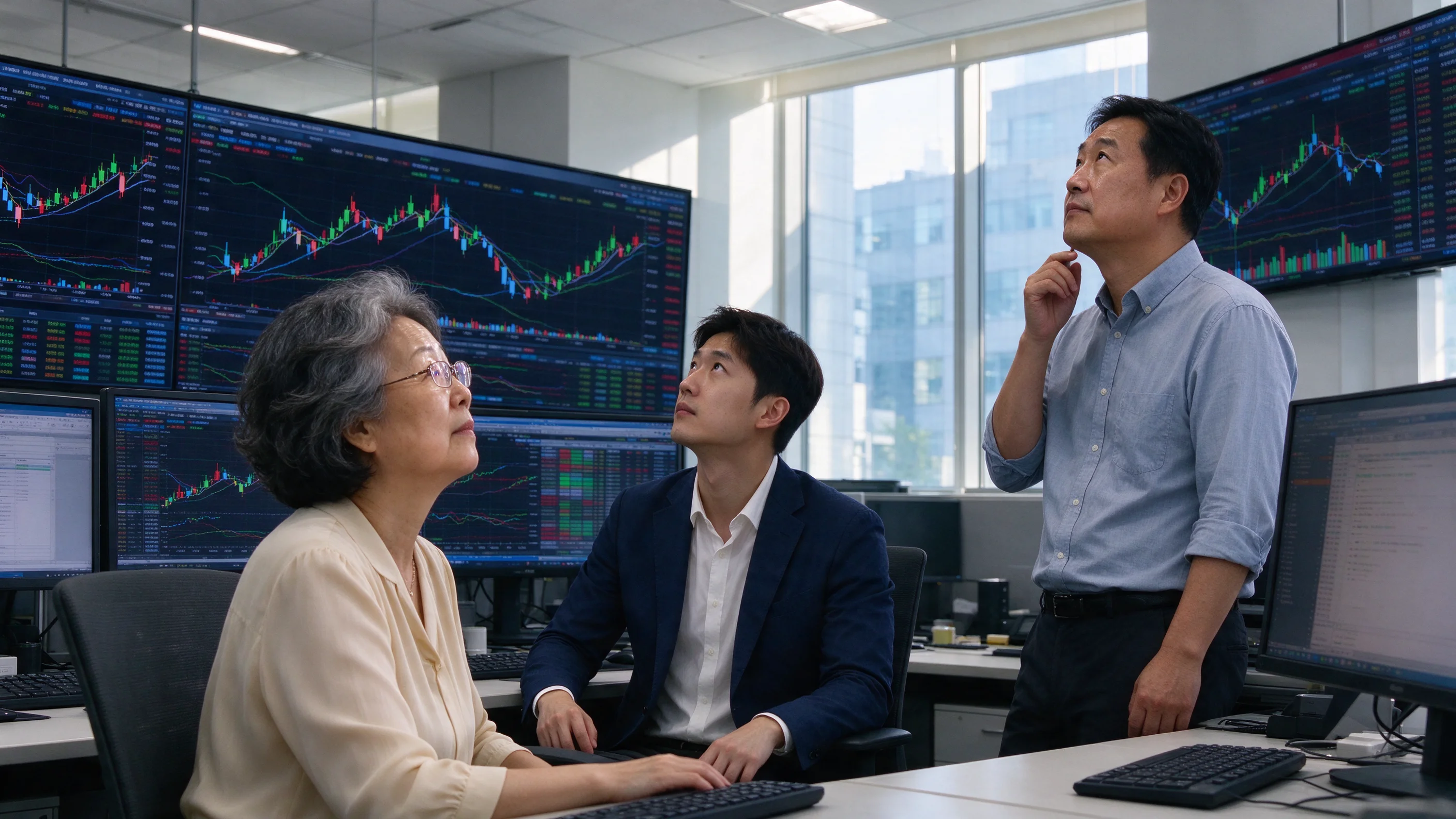
Thursday in Seoul opened with a sharper verdict than Wednesday’s 0.44 percent KOSPI decline to 6,008.81. In NexTrade premarket, Digital Times reported Samsung Electronics down about 6.47 percent and SK hynix down about 7.19 percent shortly after 8 a.m. local time, with SK Square and Samsung Electro-Mechanics also deep in the red. That is observed price action — not yet a full cash-session close — but it extends a memory-led unwind that already stopped looking like a one-day CXMT headline trade.
The market structure underneath is harder to dismiss. GMT Eight reported the Korea Exchange activating its five-minute sidecar on KOSPI 200 index futures after they fell more than 5 percent in morning trade, halting program selling while cash equities absorbed chip-led pressure. Foreign investors, meanwhile, had net sold roughly 1.17 trillion won on the prior session according to Aju Press exchange data — extending an exit streak that turns Seoul’s memory concentration, which we mapped when Yeouido became Wall Street’s AI pre-market, into a liquidity event rather than a sentiment blip.
What the Tape Proves — and What It Only Suggests
Separate the ledger from the narrative. Observed: large premarket drops in the two Korean DRAM and HBM anchors; futures deep enough to trigger a sidecar; sustained foreign net selling; a KOSPI that failed to hold an intraday rebound on October 14 even after an early pop in Samsung. Inferred, not confirmed in the same prints: that U.S. September CPI above consensus, weakness in U.S. AI infrastructure equities, CoreWeave bond-yield stress, or Gartner-style ROI warnings caused Thursday’s Seoul open. Korean desk commentary in Digital Times cited those U.S. factors as context; they are plausible amplifiers, not courtroom evidence tied tick-for-tick to each won of selling.
That distinction matters because the October 13 chip-led repricing already framed CXMT’s server-memory roadmap as a margin-calendar scare. Wednesday’s bounce and partial foreign buying tested whether investors would treat it as headline noise. Thursday’s premarket answer leans the other way: competition risk and financing risk are being priced into memory even when the open question for AI remains foundry and accelerator demand at the leading edge.
Supply Chain, Not Monolith
Capital is sorting the stack. Memory names earn when bit growth and pricing power outrun new entrants and when hyperscalers keep buying HBM and conventional server DRAM at premium mix — the profit league Micron’s guide highlighted against Samsung and SK hynix. Foundry and packaging earn when advanced-node wafers stay scarce and AI accelerators keep shipping. Nvidia’s memory-capital trade already showed how supplier financing and return of cash interact with Samsung’s balance sheet; today’s move is the equity market’s parallel stress test on multiples, not necessarily on bit shipments overnight.
If TSMC’s results and margin guidance confirm tight leading-edge capacity and durable AI accelerator builds, that can validate capex duration without repairing Korean memory valuations. Strong foundry outlooks do not automatically repeal CXMT competition fears or lift DRAM price assumptions into 2028. Weak or cautious TSMC margin commentary would tighten the screw on the entire AI hardware complex — but memory would still bear the heavier relative de-rating because that is where this week’s forced selling has concentrated.
The hinge is no longer “do chips matter.” It is whether AI demand clears at the foundry gate while memory is repriced for who keeps the margin.
What Would Change the Verdict
A sustained foreign-buying reversal and a cash-session close that holds above Wednesday’s levels would argue Thursday’s premarket was gap risk, not liquidation. Continued seven-plus sessions of foreign net selling, repeated sidecar or circuit-breaker episodes, and memory leaders making new lows would confirm the broader test: Korean market liquidity carrying global AI beta. TSMC’s margin bridge is the next dated catalyst; until then, treat Seoul’s memory rout as a forced experiment in whether AI capex narratives can diverge from DRAM multiples — not as proof that demand collapsed in a single premarket print.
Continue reading


Sources
Digital Times NexTrade premarket reporting (Oct. 15, 2026); GMT Eight on KOSPI 200 sidecar activation and chip-led session weakness; Aju Press on Oct. 14 KOSPI close, foreign flows, and Samsung/SK hynix session moves; prior Culled coverage of chip-led repricing and Korean market concentration


