

AI's next material constraint may sit outside the GPU. As data centers push toward faster optical interconnects, manufacturers are expanding indium-phosphide capacity for the lasers that move information as light. Coherent, Sumitomo Chemical, Sivers and OpenLight are all scaling production as 800G and 1.6T networking moves into volume deployment.
The first AI bottleneck was computation. The next one may be communication. When copper cannot move enough data far enough without wasting too much power, the machine reaches for light - and light requires a surprisingly specialized semiconductor supply chain.
The AI bottleneck is moving between the chips
A GPU can calculate only as quickly as data reaches it. As AI clusters scale from thousands toward tens of thousands of accelerators, the network connecting processors, memory and racks becomes part of the computer itself. Copper remains excellent over short distances, but higher speeds make electrical links increasingly costly in power and signal integrity. More of the traffic therefore leaves copper as light.
That shift is making an obscure compound semiconductor strategically interesting: indium phosphide, or InP.
InP is used to build high-performance lasers and photonic devices for optical communications. The industrial signals are accumulating quickly. Sumitomo Chemical said on August 31 that it had begun mass production of 4-inch InP epitaxial wafers aimed at AI data centers and high-speed networks. The company wants the product family to reach roughly JPY10 billion in annual sales by the mid-2030s.
In Scotland, Sivers Semiconductors is investing $30 million to expand its Glasgow InP fab to capacity exceeding 100 million continuous-wave DFB lasers annually. Optics industry reporting says major producers including Coherent and Lumentum have been persistently sold out.
AI is turning the ability to make light into a semiconductor-capacity problem.
A laser supply chain is becoming part of the AI stack
The scale-up is also visible in Texas. The U.S. Commerce Department’s CHIPS office signed a letter of intent for up to $50 million to support Coherent’s expansion in Sherman, home to what the government calls the world’s first and largest high-volume 150-millimeter InP manufacturing facility.
Coherent’s photonic devices move data between processors, memory and systems inside AI data centers. That makes the factory less like a niche telecom asset and more like part of the compute supply chain.
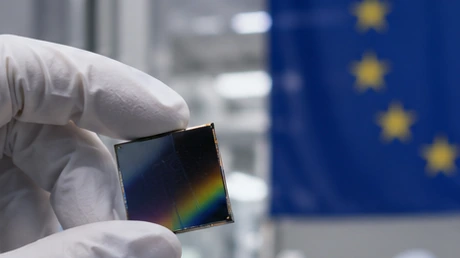
OpenLight offers another clue. In March it announced the first volume-production customer orders on its InP-on-silicon platform for 800G and 1.6T laser-integrated photonic chips. Those speeds matter because AI networks are rapidly moving toward terabit-class links while trying to contain the energy consumed simply moving bits around.
This is the physical meaning of optical interconnect. Instead of asking copper traces and cables to carry every signal electrically, systems increasingly convert data into photons, move it optically and convert it back where needed.
The conversion requires lasers. The lasers require materials, epitaxy, fabrication and packaging.
Scarcity is migrating from computation to communication
The AI buildout has repeatedly moved its constraint. GPUs led to high-bandwidth memory shortages. HBM pushed advanced packaging. Dense racks exposed cooling and power problems. Now networking is forcing attention onto the photonic layer.
Indium phosphide will not replace silicon. Its importance comes from doing something silicon struggles to do efficiently on its own: generate the light required by high-speed optical systems. That makes InP complementary to the giant silicon ecosystem rather than a rival to it.
The capacity announcements from Japan, Scotland and Texas do not prove an imminent shortage. They show something subtler: manufacturers are investing before demand fully arrives because customers are already asking for volumes the existing photonics industry was never built to supply.
The AI machine is becoming too large to communicate entirely in electricity.
Once that happens, the semiconductor story changes. After copper comes light. And behind the light sits a material most investors had no reason to know existed.
More in AI & Compute


Sources
Company and government disclosures from Coherent, NIST, Sivers Semiconductors, Sumitomo Chemical and OpenLight on InP capacity and AI optical networking.
