

El Reno lost 3.8 million gallons of municipal water through a private line serving a Bitcoin mining facility that city officials say should never have opened. The leak closed schools and businesses, but the more consequential failure was administrative: a 2023 stop-work order had effectively disappeared inside city government.
A town can see a water tower from almost anywhere. That did not mean El Reno could see what was happening beneath it. When millions of gallons vanished into a private line serving a Bitcoin mine, the city discovered that the facility itself had slipped through its permitting system.
The water disappeared before the paperwork reappeared
The visible crisis in El Reno, Oklahoma, was hydraulic. Roughly 3.8 million gallons of treated municipal water escaped through a private line serving a cryptocurrency mining and data-center site, according to city officials. Pressure fell across the system, schools closed for two days, businesses were disrupted and crews searched for the leak while the town’s water storage rapidly declined.
The stranger crisis was bureaucratic. Local station KOCO reported that the site had been issued a stop-work order in 2023, yet construction apparently continued and the facility eventually operated without a final certificate of occupancy. City officials said the order had fallen through the cracks. After the August leak, El Reno condemned the property.
That makes this more than another story about Bitcoin’s appetite for resources. The mine did not merely consume power and water. It exposed a gap between the scale of an industrial compute load and the administrative machinery of the small city hosting it.
El Reno’s scarce resource was not water alone. It was municipal attention.
Data Center Dynamics reported the 3.8-million-gallon loss and the subsequent condemnation. The event belongs beside the emerging Texas fight over data-center water disclosure: as we recently reported in Texas’s enforcement turn, governments that welcomed compute infrastructure are beginning to discover how little they can reliably measure once those projects are operating.
A stop-work order is useful only if someone remembers it exists
Industrial projects normally accumulate layers of permission: zoning, utility service, construction inspections, certificates of occupancy and environmental requirements. Each looks mundane in isolation. Together they are the operating system of local government.
El Reno’s failure shows what happens when a project outgrows that operating system. A stop-work order can be legally valid and practically irrelevant if there is no durable process that carries it from inspector to utility department to occupancy review. The building keeps changing while the city’s institutional memory remains static.
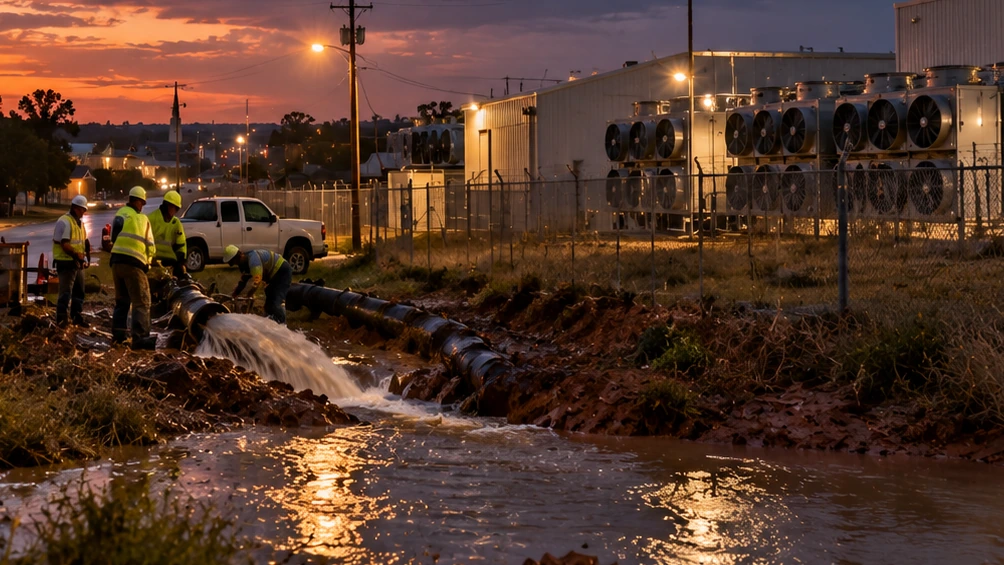
That asymmetry matters because compute infrastructure is unusually easy to misunderstand from outside the fence. A mining operation can occupy an industrial shell while pulling power at a scale associated with heavy manufacturing. Cooling and water requirements vary widely. Ownership can sit behind special-purpose entities. The physical footprint looks smaller than the infrastructure footprint.
The result is a peculiar governance problem: a town may approve something that resembles a warehouse and inherit something that behaves like a power plant.
Compute is becoming a local-government stress test
The national debate over data centers tends to happen in gigawatts. The local debate happens in valves, substations, road permits, inspectors and utility accounts.
El Reno’s episode compresses those layers into one image: a municipal water system losing millions of gallons to a facility that, according to the city, was not supposed to be operating in the first place. The leak made the administrative failure visible because water is difficult to abstract once it leaves the pipe.
The lesson is not that every Bitcoin mine or data center is badly governed. It is that the boom is creating industrial-scale obligations in places whose oversight systems were designed for much slower-moving development.
A 3.8-million-gallon leak can be repaired. The harder repair is institutional: making sure the next stop-work order survives long enough to stop the work.
More in AI & Compute


Sources
KOCO local reporting and Data Center Dynamics reporting on the El Reno leak, condemnation, and 2023 stop-work order.
