

Broadcom posted $16.7 billion of AI semiconductor revenue, up 221 percent year over year. Total sales beat, and management raised the fiscal 2027 AI chip outlook to about $115 billion. Shares fell because a $34.8 billion fourth-quarter guide sat a tick under Street. Demand is no longer the debate. Priced-in capex is.
Broadcom reported $16.7 billion of AI semiconductor revenue in its fiscal third quarter. That is 221 percent more than a year earlier and 54 percent more than the prior quarter. Total revenue reached $29.59 billion. Adjusted earnings were $3.32 a share. Management told investors to expect $21.7 billion of AI-chip sales in the current quarter and roughly $115 billion in fiscal 2027, with a $230 billion line of sight for 2028.
The stock fell anyway. Fourth-quarter revenue was guided to $34.8 billion, a tick under the $35.03 billion Wall Street had written down. The gap is about $230 million on a $35 billion quarter. In a market still treating AI as a discovery story, that print would have been a celebration. This week’s preview already warned that confirmation can trade as a sale. Overnight, it did.
Revenue growth is no longer the proof. The proof is whether the capital already committed to the buildout earns its keep.
The AI number was not the miss
Hock Tan’s quarter did what a supplier quarter is supposed to do. Custom accelerators and networking more than tripled. Mix is now majority-AI: $16.7 billion of $29.59 billion. The company raised its fiscal 2026 AI outlook to about $58 billion. Tan said demand exceeds the 2027 supply Broadcom has already secured. None of that is a demand scare.
What moved the tape is the same arithmetic that hit the name after June, when a beat, a raise, and a restated $100 billion-plus slogan still produced a double-digit decline. At this multiple, a 93 percent year-over-year fourth quarter that undershoots consensus by seven-tenths of a percent reads as deceleration, not as a boom. Marvell paid a similar timing tax last week. Broadcom is larger. It is not exempt.
Nvidia counts GPUs. Broadcom counts the plant.
Nvidia still tells you whether buyers want general-purpose accelerators. Broadcom tells you whether hyperscalers are specifying the rest of the machine — XPUs, Ethernet fabric, SerDes — and paying to have it built. Tan named the usual commissioning class: Google, plus labs that have become plant operators in their own right, Anthropic and OpenAI among them. The custom-silicon chain is no longer a slide. It is more than half the income statement.
That is why the selloff matters more than a guidance miss. If the custom-plus-networking layer is accelerating and the stock still falls, the market has stopped arguing about architecture. It has started arguing about payback.
Nvidia already taught the desk this lesson: a record beat can erase market value when the question has shifted from whether the cycle is real to whether the cycle is priced. Broadcom is the same lesson on the other side of the rack.
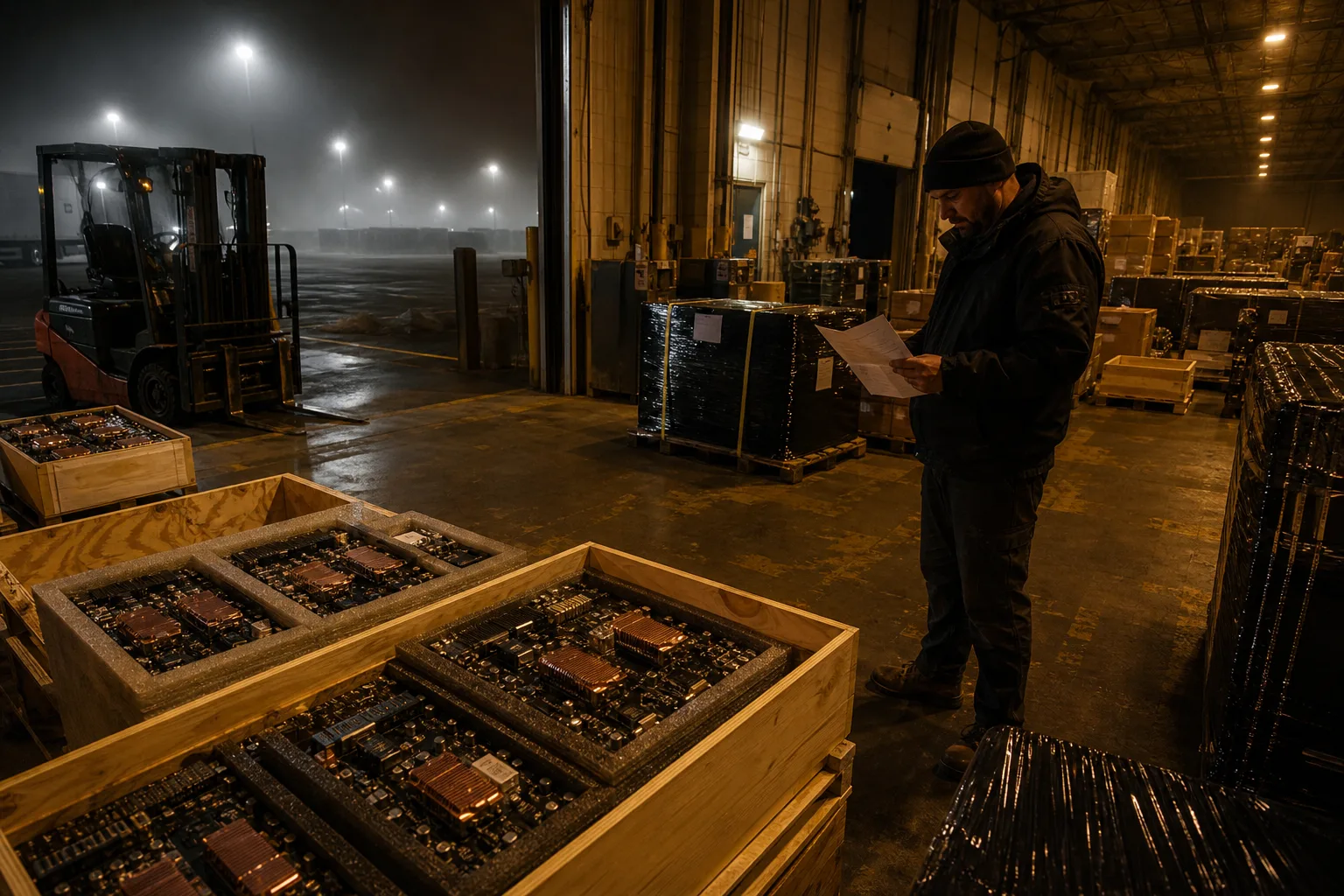
The boom is now a capital-spending problem
Phase one asked whether AI was real. Phase two asked how much infrastructure companies would build. Phase three asks whether the economic returns on that plant can justify the capital being poured into it. We are in phase three.
Amazon, Alphabet, and Microsoft are already spending like utilities, with capex that can swallow a year of cloud revenue before the halls are fully sold. Broadcom collects on the intermediate goods. The hyperscalers collect later, if utilization and pricing cooperate. Labs that will soon be public companies — Anthropic’s annualized run rate has been reported above $65 billion, OpenAI’s near $40 billion, with accounting that makes the comparison messy — are both customers of this silicon and claimants on the same scarce cash. Their prospectuses will have to show whether token revenue covers the compute bill, not merely whether the bill is large.
That is the same inversion as the SaaS margin collapse. AI is not only sorting software winners from losers. It is forcing a decision about who captures the capital running through the stack: the chip vendor, the cloud landlord, or the model company whose revenue still has to be defined for the SEC.
Broadcom is telling investors that infrastructure demand is accelerating faster than almost anyone modeled. Shares falling on that news is the clearest sign yet that the debate has left existence and entered returns. The next useful number is not another AI growth rate. It is whether the people writing the checks ever earn them back.
Continue reading


Sources
Broadcom Q3 FY2026 earnings release and call (AI semiconductor revenue $16.7B, +221% YoY / +54% QoQ; total revenue $29.59B; Q4 revenue guide $34.8B vs LSEG $35.03B; Q4 AI semiconductor $21.7B; FY2026 AI ~$58B; FY2027 AI ~$115B; FY2028 AI ~$230B); CNBC and after-hours coverage of the share move; Reuters-noted competition including Marvell; prior Culled analysis of the Sept. 2 print, Nvidia's prove-it quarters, hyperscaler capex, custom silicon, and SaaS margin compression; Axios/Bloomberg reporting on Anthropic and OpenAI annualized run rates.


