

For forty years, capital wanted to own the factory, the field, the software company. The scarce object now is a place in line: electrons at a named substation, a hold period, a berth, a slot. Once that right can be reserved, lenders treat it as collateral — and the week's headlines start rhyming.
For most of the last forty years, money wanted to own the asset. The factory. The building. The oil field. The software company. The portfolio company. The scarce thing now is often smaller and harder to see: the right to go first. The right to get the electricity at a named bus. The right to keep an illiquid company for five more years. The right to load a cargo, land a plane, withdraw the water, or sit in a transformer production slot. Once that right is scarce enough, someone prices it, borrows against it, prepays it, leases it, or slices it. The week’s headlines look unrelated until you notice they are all doing that conversion.
Finance has priced risk for a century. What is being marked now, often under other names, is certainty: that the megawatts arrive on a date, that the distillate can be refined and insured, that the fund does not have to sell in 2026, that the aircraft can still use Heathrow at 07:00. Certainty is becoming expensive because the physical and legal pipes that deliver it are congested. Congestion capitalizes the bottleneck. The downstream stack — GPUs, tankers, LPs, airlines — starts setting the value of the gate in front of it.
Deliverable electricity is not a commodity
Everyone says AI needs electricity. Electrons, as a physics joke, are not scarce. What Microsoft, Meta, Amazon, and OpenAI are buying is a different good: electrons at a particular location, in enormous quantity, with high reliability, beginning on a particular date. Call it deliverable electricity certainty. An interconnection agreement, a substation reservation, a transmission position, or a twenty-year power-purchase agreement starts to behave like an option on that good. If the option is valuable enough, the project can be financed against the contract before the first watt exists. A future place in line becomes present-day collateral.
The queue numbers make the optionality visible. Lawrence Berkeley’s Queued Up: 2026 Edition, covering requests through the end of 2025, counted about 8,200 active generator and storage projects totaling 2,061 gigawatts — 1,312 GW of generation and 749 GW of storage. That is generation seeking the grid, not the separate large-load queues that hyperscalers actually live in. Even so, the friction is the same species. Median time from interconnection request to commercial operation exceeded five years for projects that reached COD in 2025. Only 13 percent of capacity that entered queues between 2000 and 2020 had reached commercial operations by the end of 2025; three-quarters had withdrawn. 549 GW already had a draft or executed interconnection agreement and still had not started operating. The paper is not the plant. The paper is the right.
Hyperscalers have been writing around the paper. Microsoft’s twenty-year deal with Constellation to restart Three Mile Island Unit 1 locked 835 MW of carbon-free output to a named site and a restart budget of about $1.6 billion. In June 2026, Chevron’s Energy Forge One signed a twenty-year PPA with Microsoft for Project Kilby: roughly 2.67 GW of gas generation on more than 2,000 acres in Reeves County, built behind the meter, outside the ERCOT interconnection queue, first power aimed at late 2028. Meta’s January 2026 nuclear package with Vistra, TerraPower, and Oklo, stacked on the earlier Constellation Clinton PPA, was sold as up to 6.6 GW. The Oklo piece in Ohio was described as a prepayment toward future delivery — cash now, power later, the prepayment then used to help raise project debt. That is the chain in miniature: reservation, contract, collateral.
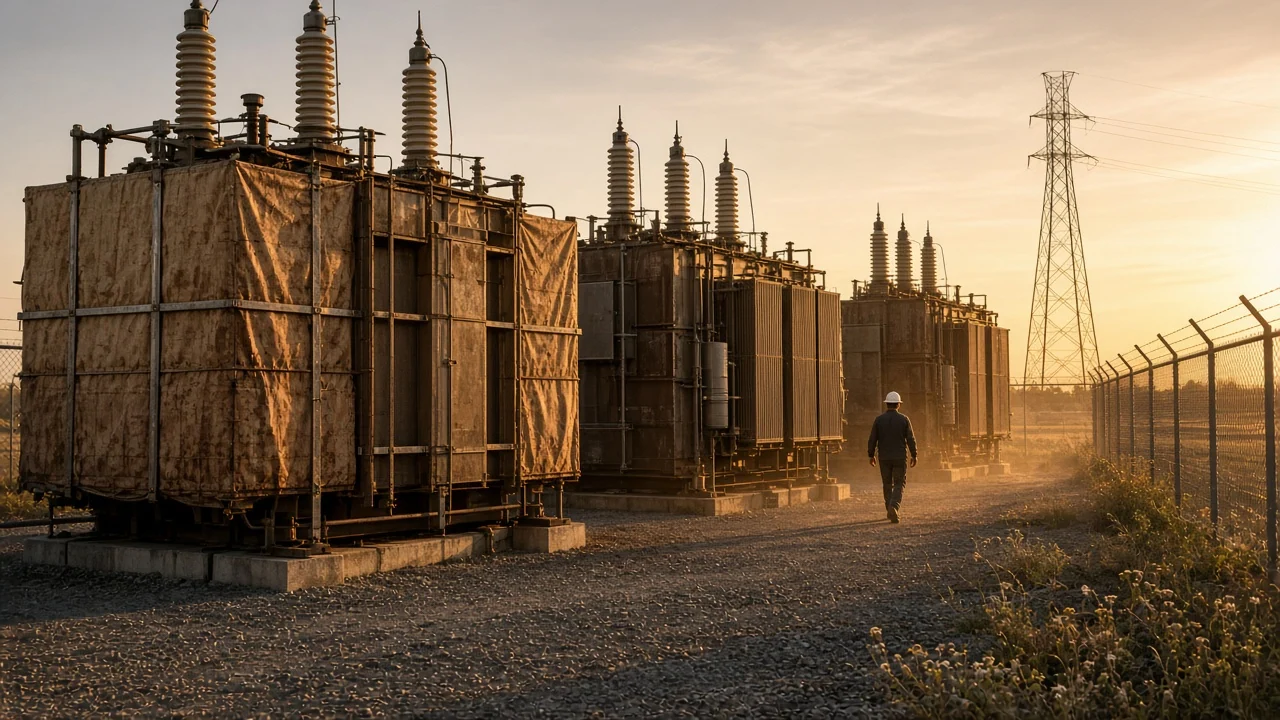
The steel that makes the contract real is itself a reservation market. Wood Mackenzie had large power transformers around 128 weeks and generation step-up units around 143 weeks in the second quarter of 2025. Reuters, citing the same supply-chain work, had GSU lead times past 160 weeks by the first quarter of 2026, with high-voltage circuit breakers at 125 weeks. Roseville Electric in California, which used to buy about a year ahead, told Reuters it was locking equipment on a three-year clock and buying large substation transformers five years out. The factory slot, not the wire transfer, is the scarce input — capital cannot buy the years back. We have already tracked the same clock on the AI side: time-to-power and the transformer-and-cooling constraint decide whether racks ever leave the crate. H.R. 9340 and the state large-load tariffs are the political half of the same fight — who pays for reserved megawatts that may never be taken.
Time is the private-equity bottleneck
Private equity’s surface story is a liquidity drought. Exits through IPOs and sponsor-to-sponsor sales have not returned enough cash, so distributions to paid-in capital sag, and limited partners ask for money. The instrument that answers them is not a sale of the company. It is a sale of time.
Evercore put global secondaries at a record $226 billion in 2025, up 41 percent. GP-led deals — mostly continuation funds that let the manager keep the asset — were $106 billion, up from a prior peak of $71 billion. William Blair’s 2026 survey put the year near $220 billion, with single-asset continuation funds jumping from $34 billion to $60 billion. The first half of 2026 did not cool: Evercore had secondaries above $120 billion, with single-asset continuations $34 billion in six months. Someone with a longer liability — an insurer, a pension, a dedicated secondaries fund — buys the right to the future payoff. The GP keeps the company. Existing LPs can roll or cash out. Future certainty is swapped for present liquidity.
NAV loans do the same conversion with debt. KBRA rated a record $23 billion across 38 NAV facilities in 2025; cumulative rated issuance since 2018 passed $82 billion through the first half of 2026, and that excludes unrated and credit-fund facilities. The loan is secured by a mark on a portfolio that is hard to sell. As we wrote when NAV lending became PE’s crisis toolkit, the product manufactures cash without an arm’s-length exit. The deeper point is the rhyme with Kilby and Oklo: a claim on a future state is being borrowed against today.
Deliverable petroleum is not a barrel
A barrel can exist in a reservoir and still fail as a commodity. Can it be insured, put on an acceptable vessel, moved through an acceptable waterway, unloaded in an acceptable jurisdiction, and refined into the molecule a truck actually burns? The valuable good is deliverable petroleum. Distillate can then trade at a premium to crude that geology cannot explain, because the bottleneck is the chain of permissions between the well and the tank.
That is already on the tape. The U.S. diesel crack printed an all-time $102.20 a barrel in mid-August while WTI sat well below its spring peak and distillate stocks sat at their lowest for that week since 1996. The stress was in the product, not the quote. Earlier in the Iran war, seven P&I clubs cancelled war-risk cover for Hormuz and froze a fifth of seaborne oil without laying a mine — insurance as the real chokepoint. The molecule was never the whole market. The right to move it was.
LNG has been running this playbook for twenty years. Venture Global’s CP2 filings, Commonwealth’s JERA SPA, Delfin’s Vitol SPA: twenty-year firm contracts, take-or-pay at the loading-arm flange, annual quantities in the millions of tonnes, the offtake used to support project finance before commercial operation. Cheniere’s Sabine Pass terminal-use agreements were collecting capacity reservation fees in installments before the trains were built. You pay for the right to use the plant. Sometimes you never take the cargo. The unused right is still the product.
Bottleneck rent is a price, not a vibe
Some of what gets called inflation is monetary. Some of it is a commodity squeeze. A growing residual is bottleneck rent: capital and demand exist, sometimes the resource exists, and what does not exist is enough grid connections, transformers, skilled crews, refinery configurations, tanker and insurance capacity, data-center-ready land, GPUs, cooling gear, nuclear fuel, water rights, or approved projects. Pools of money then compete for permission to pass. That competition capitalizes the gate.
Valuation starts to run backward. A grid connection is not worth its electricity revenue. It is worth whatever sits idle without it — a few billion dollars of accelerators, a campus that cannot energize, a take-or-pay that still bills. A port is not a throughput multiple if losing the berth strands millions of tons. A refinery is not a crack-spread DCF if fragmentation makes its configuration the only legal way to make diesel for a given flag. A Texas water right is not an irrigation cash-flow if the next bidder is a semiconductor fab or a cooling loop. The downstream capital stack is bidding for the upstream constraint. Sometimes the bidder takes equity in the bottleneck it created: Amazon’s Generac warrants vest as generator invoices are paid. That is a different appraisal problem than “what does this asset earn.”
Private credit is the native bank of the bottleneck
The official story of private credit is that banks retreated after 2008 and non-banks filled the hole. That is true and incomplete. Private credit specializes in things that are hard to price, hard to sell, contractually thick, long-duration, and inconvenient for a standardized market. The bottleneck economy manufactures exactly those things.
European Parliament staff work putting Preqin and related estimates together had global private credit around $2.3 trillion of AUM in 2025, from about $380 billion in 2010, with some houses projecting $4.5 trillion by 2030. The IMF had already called a $2.1 trillion complex two years earlier. PIMCO’s wider net, including semi-liquid vehicles, is larger still. We have worried about the opacity. The complementary observation is demand-side: every interconnection is different, every data-center lease is different, every continuation vehicle is different, every tolling agreement is different. Public markets like fungibility. Bottlenecks are not fungible. The mess is the spread.
A contractual claim on future scarce throughput is one object. The industries just gave it different names.
Capacity reservation. Interconnection agreement. Airport slot. Spectrum license. Offtake. Tolling. PPA. Water entitlement. Pipeline capacity. Port berth. Chip supply agreement. Compute reservation. Development entitlement. Mineral royalty. Shipping charter. Transmission right. PJM capacity commitment. They arose in different statutes and trade associations. Economically, many are a claim on future scarce throughput. Financial markets have not fully unified them as a sleeve. They have already completed the last steps of the chain in pieces.
Heathrow is the exhibit that should end the argument that this is metaphor. IBA still cites the 2016 Oman Air purchase of an Air France–KLM slot pair for $75 million. In November 2025, Apollo-managed funds completed a $745 million senior secured financing against Virgin Atlantic’s Heathrow take-off and landing slots; Virgin’s 2024 accounts had marked the portfolio at £715 million. IAG had already pledged Heathrow and Gatwick slots in earlier financings. A permission to use a runway at a clock time became collateral, then a rated capital-markets object, then the funding source for cabin refits and A330neos. That is mortgages in 1983, with better catering.
Redundancy is starting to pay a coupon
The last thirty years optimized for one of everything: one specialized supplier, one shipping corridor, one interconnected grid, one just-in-time warehouse. Geopolitics repriced duplication. Redundancy is inefficient by definition, so someone has to be paid to hold it: reserve LNG, spare transformers, idle generation, second fabs, extra inventory, alternative routes. Traditional capitalism hates idle assets. Strategic capitalism will pay for them not to be used.
Capacity markets already do this in daylight. PJM’s Base Residual Auction for 2024/2025 cleared at $28.92 per MW-day. The 2025/2026 auction jumped to $269.92 for most of the footprint ($466.35 in BGE, $444.26 in Dominion) and about $14.7 billion of load cost. The 2026/2027 and 2027/2028 auctions cleared at the FERC collar: $329.17 and $333.44 per MW-day, with cleared-times-price on the order of $16.1 billion and $16.4 billion. You are not buying energy. You are buying the option that the megawatt will exist on a peak day. That is an insurance premium with a generator attached.
Insurance, in the ordinary sense, is monetized redundancy: pay now so that capital exists when the improbable happens. Capacity payments, LNG reservations, reliability must-run contracts, semiconductor supply agreements, and military stockpiles are cousins. The architecture of the real economy is becoming more insurance-like even where no underwriter is in the room. Insurers and pensions, with long liabilities, are the natural buyers of the other side — which is why they show up in continuation funds, in NAV facilities, and in infrastructure offtake.
The chain to watch is mechanical, not oracular:
scarcity → reservation → contract → collateral → asset class.
It should show up as weird little mutations that do not share a headline: a utility selling queue position or take-or-pay large-load rights; a fund lending against PPAs the way Apollo lent against slots; rated tranches of interconnection or water entitlements; options on transformer production slots; indexes of “priority rights” that mix capacity, berths, and spectrum. If those mutations stay confined to their home industries, the unification thesis is wrong, and we merely have a cluster of local shortages. If they cross-pollinate — if a continuation-fund lawyer starts sounding like an LNG offtake lawyer, and a hyperscaler prepaid nuclear deal starts looking like a Heathrow slot book — then the next major sleeve is not “infrastructure.” It is the right to go first.
The test is already partly passed. Virgin borrowed against a clock time. Microsoft and Meta prepaid watts that do not yet exist. Sponsors borrowed against marks they would rather not sell. PJM is collecting more than sixteen billion dollars a year to keep generators available. The loading arm on the Gulf Coast is not a picture of gas. It is a picture of a contract that got built.
Continue reading


Sources
Lawrence Berkeley Queued Up 2026 (year-end 2025 queues); Wood Mackenzie and Reuters transformer lead times; Microsoft–Constellation TMI PPA and Chevron Project Kilby (June 2026); Meta nuclear agreements (January 2026); Evercore and PitchBook secondaries; KBRA NAV-loan issuance; European Parliament/Preqin private-credit AUM; PJM BRA reports 2025/26–2027/28; EIA/Culled diesel-crack coverage; Apollo–Virgin Atlantic Heathrow slot financing (November 2025); DOE LNG SPA summaries for CP2, Commonwealth, and Delfin.


