

The U.S. diesel crack spread hit $102.20 a barrel Monday, an all-time high. WTI remains far below its spring peak while distillate inventories sit at their lowest for this week since 1996. Food-at-home has not spiked yet. The stress is in the product and the lag — not the crude quote.
The U.S. diesel crack spread — heating-oil futures minus West Texas Intermediate — printed an all-time intraday high of $102.20 a barrel on Monday and still hovered near one hundred on Tuesday. That number is not what a trucker pays at the pump. It is the refiners’ margin, and when it blows out, refined product is scarce relative to crude. WTI remains far below its April peak of $114.58. Jefferies analyst Sam Burwell put the diagnosis in one clause: global tightness is showing up in cracks, not crude.
The physical stack agrees. U.S. distillate inventories are at their lowest for this week since 1996. Gasoline stocks are at their weakest seasonal level since 2012. AAA’s national average on Tuesday was $4.07 a gallon for regular, up 29 percent from a year ago, and $5.47 for diesel. Crude can look “contained” at eighty-five to ninety dollars and still leave a freight economy running on a fuel that has already repriced.
That is a state problem wearing a market costume. Kpler has Hormuz flows of crude and products averaging about two million barrels a day in August, against roughly eighteen million before the war — diesel down even harder than crude. Russia curbed diesel exports after Ukrainian strikes on its refining system. Houthi and Libyan disruptions added noise. The IEA counted a 2.4 million barrel-a-day global stock draw in the second quarter, the largest in at least a decade. If Tehran, Washington, or Moscow changed position, the crack would move. Until they do, Brent is a lagging indicator.
Tightness Is in the Crack, Not the Barrel
Markets have spent the war learning the wrong lesson from the crude quote. When the S&P priced peace off a ceasefire that had not reopened the strait, equities treated a headline as a barrel. When the Versailles MOU sent Brent toward $79, the celebration arrived before the tankers. Bürgenstock talks jolted oil without restoring product. The diesel market did not attend those ceremonies. It prices what is missing from the rack.
A crack above one hundred dollars is a rationing signal. It tells refiners to delay maintenance, swing yields toward distillate, and export whatever the U.S. still has — already at record diesel shipments — into a world bidding for the same molecules. That response can prevent a true shortage. It cannot refill a 1996-low inventory in a season when harvest diesel, heating-oil pre-build, and trucking all want the same barrel. Patrick De Haan at GasBuddy warned that the worst retail diesel for consumers may still be ahead. Wholesale leads the pump. The pump leads the grocery aisle — later.
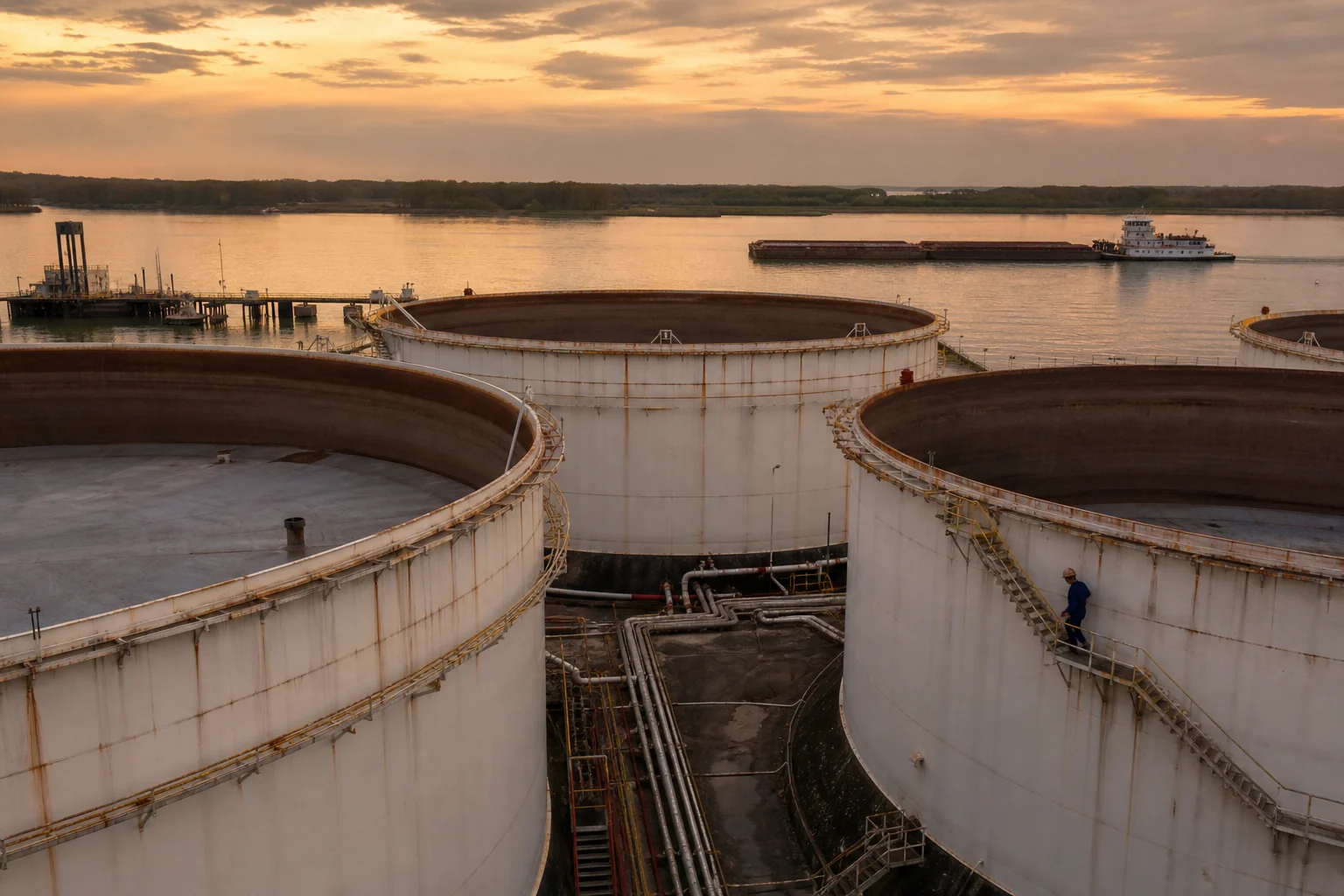
Freight Is the Months-Long Fuse Into Food
Diesel does not print on a receipt overnight. RSM’s Joe Brusuelas has the correlation: trucking costs move with diesel at about 0.68, and diesel alone explains 46 percent of the variation in the producer price index for truck transportation. Producer prices were already running hotter than consumer prices in the spring. The lag is months, not days. July’s food-at-home index actually fell 0.1 percent on the month and is up 2.7 percent over the year — a calm that FMI’s Andy Harig noted arrived despite the Hormuz energy spike. That calm is not a clearance. It is a delay.
Inside the basket, categories have already diverged. USDA’s 2026 forecast has beef and veal up about 11 percent on a historically small cattle herd, eggs down about 31 percent, sugar and fresh vegetables still elevated. Culled mapped the biological lag in beef this week: the herd cannot be wished larger by autumn. Add a freight surcharge on everything that moves by truck, and the next grocery wave does not need a new crude spike. It needs the diesel crack to stay ugly long enough for distributors to stop eating the cost.
The watch is therefore not whether Brent tags ninety-five. It is whether the crack stays in triple digits into harvest and heating season; whether U.S. distillate draws keep setting 1990s comparisons; and whether food-at-home, still polite in July, starts to follow the PPI for trucking rather than the WTI close. State force still binds the strait. Capital is staring at the wrong quote.
The proposition compresses to one line: prolonged stress has left the crude barrel for the diesel tank and the loading dock. The image is a reefer idling before dawn, burning a fuel the grocery index has not yet billed. Trade the product, the freight lag, and the inventory — or keep mistaking a calm WTI for a calm kitchen.
Continue reading


Sources
U.S. diesel crack HOCL1 all-time intraday high $102.20/bbl Aug. 17, hovering near $100 on Aug. 18; WTI well below April 7 peak $114.58; AAA Aug. 18 regular $4.07/gal (+29% y/y), diesel $5.47; EIA-linked distillate stocks lowest for this week since 1996; BLS July food-at-home +2.7% y/y, −0.1% m/m; Kpler Hormuz flows ~2 million bpd in August vs ~18 million pre-war, diesel down more than crude; IEA Q2 global stock draw 2.4 million bpd; Russian diesel export curbs after Ukrainian refinery strikes; Jefferies Sam Burwell on tightness in cracks not crude; RSM Joe Brusuelas on diesel–trucking PPI; USDA 2026 food-at-home and beef forecasts; prior Culled Hormuz, MOU, Bürgenstock, and peace-pricing coverage


