

Nasdaq-100 futures spent Friday morning trying to break 30,000. That is not a duration rally or an oil-collapse rally. Huang said Nvidia will sell twice as many units next year, crude is slipping on Saudi reroutes, and a weekly close on top would look like a renewed bull run.
Nasdaq-100 futures spent Friday’s overnight session trying to punch 30,000 — the round number above this week’s 29,800 ceiling, with 30,343 sitting as the next map point if the break holds. QQQ had already closed Thursday at $716.92, up from $704.72, a 1.7% chip-led bounce that put cash Nasdaq back on the front foot after Warsh’s first hike.
The textbook post-hike script is a bond rally and an energy unwind. Friday’s tape is running without waiting for either to finish the job.
The hike was absorbed. The engine is units.
Wednesday’s FOMC lifted the funds rate 25 basis points to 3.75%–4%, unanimous, and left most officials pointing to at least one more move this year. Equities wobbled, then came back. The 10-year, which had tagged about 5.04%, backed off toward 4.95% as Warsh’s inflation talk was read as credibility rather than as a growth scare.
That is a mild duration assist, not a bull market in Treasuries. Bulls do not need it. They have Jensen Huang.
On Thursday, before a Scotland summit with King Charles III, Huang told reporters he expects Nvidia to sell twice as many chips next year as this year — units, across GPUs, networking, and the rest of the stack — because countries and industries are still building AI. The same company that watched Wall Street shrug at a record quarter is now handing the tape a volume map through 2027.
Nvidia, Micron, Intel, and AMD carried Thursday. That is why NQ can hunt 30,000 two nights after a hawkish hike. The constraint the market is buying is silicon, not the funds rate.
Oil is falling because barrels found a detour
Crude is doing the other half of the old script, and it is not because the war ended.
By early Friday, Reuters had Brent near $102.53, down about 2%, and WTI near $100.04, a third session of losses and on track for the first weekly drop in three. Prices had tagged four-month highs this week after Yanbu loadings were halted and Europe lost some Saudi cargoes when the East-West pipeline was hit.
The unwind is logistics. Riyadh is talking about restoring about half that pipeline’s capacity within days and is moving extra Asian barrels by ship-to-ship transfer off Oman’s Port of Sohar. Energy Secretary Chris Wright has said crude should start moving through the line in days. Demand is a second weight: J.P. Morgan has global consumption about 4.4 million barrels a day below last year, enough slack to absorb a messy Gulf.
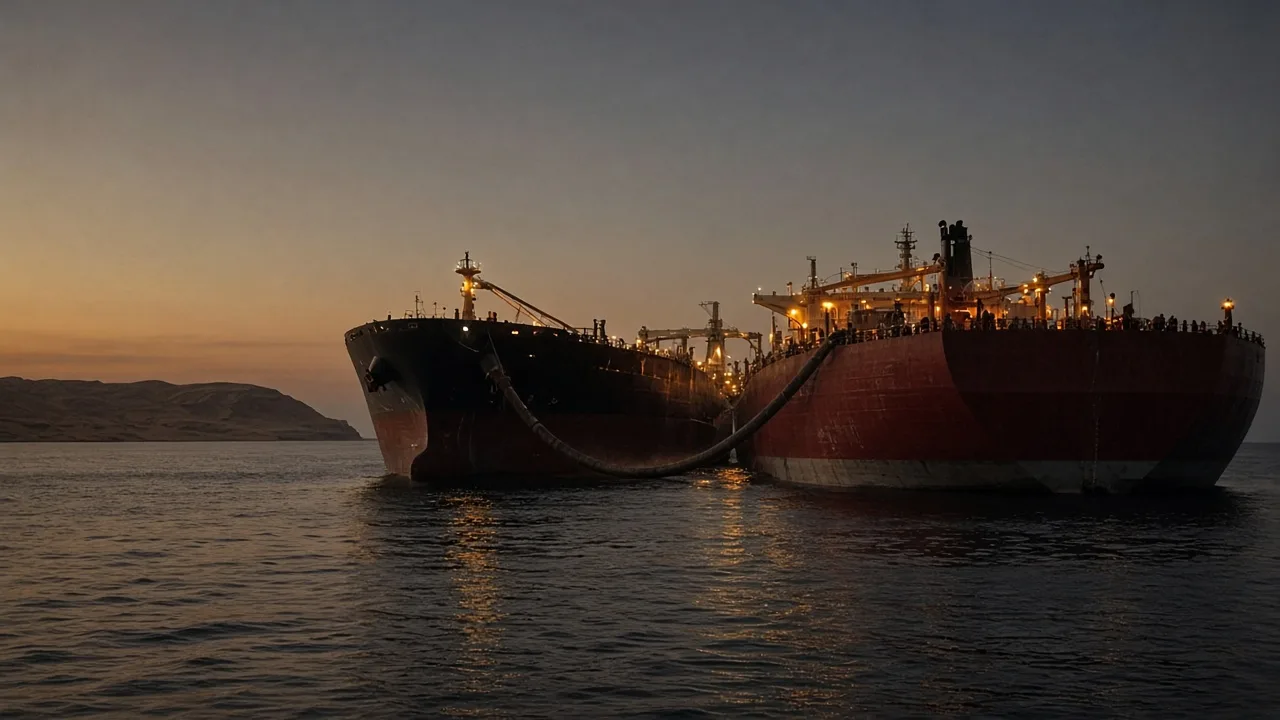
The premium is not gone. Houthis and Saudi Arabia traded fresh strikes Thursday. A tanker was hit in Hormuz. Oil is still above $100. What fell is the panic that every damaged pipe equals a missing cargo. That is why crude can drop while the Middle East gets worse — and why this equity bid does not need $80 oil to exist.
The old coupling was rates meeting oil as one constraint. This morning they decoupled. Energy eased on reroutes. Duration barely helped. NQ still went for the round number.
A weekly close on top would re-rate the year
Friday is the week. If cash Nasdaq and NQ finish on the highs — holding Thursday’s chip break and converting 30,000 from a magnet into a floor — the combination with Huang’s doubling is a different tape than the one that spent August proving AI.
It would not cancel Warsh. Sixteen of eighteen officials still see another hike this year. Diesel and Brent can still re-arm the inflation test.
It would mean allocators decided the post-hike draw was inventory, not a new bear. Silicon demand doubled in public. Oil found a bypass. Bonds did not have to lead. If that close prints, the market is allowed to talk about a renewed bull run without pretending the Fed or the Gulf went quiet.
More in Markets & Finance


Sources
Reuters oil (Sept. 18); CNBC Huang remarks (Sept. 17); FOMC hike to 3.75%–4%; QQQ and index closes Sept. 16–17; SpaceX/chip tape context.
