

Brent crude eased toward $106 as Saudi Arabia moved to restore its damaged East-West pipeline and offer extra Asian cargoes off Oman. The relief may say less about peace than about an export system learning to route around failure.
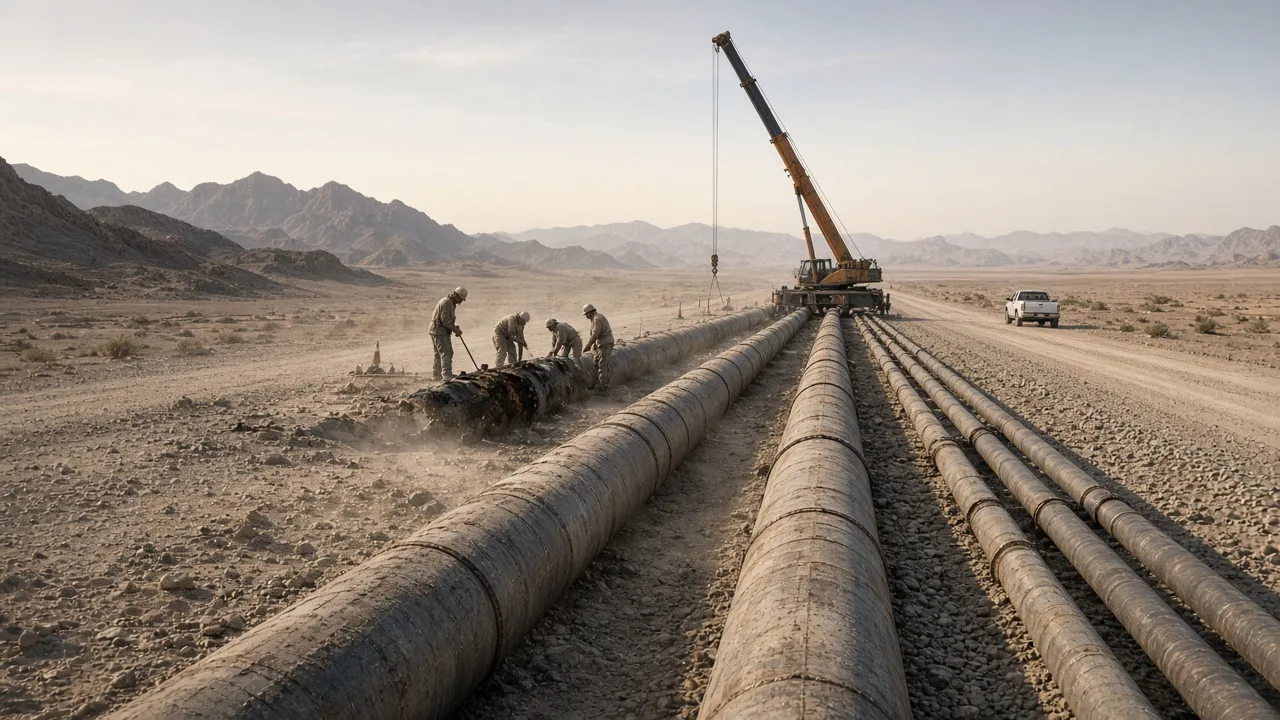
Saudi Arabia built the East-West pipeline — Petroline — so crude could reach Yanbu on the Red Sea without living entirely on the Strait of Hormuz. After drone strikes on September 10 in the Riyadh and Madinah regions, the Energy Ministry shut the line. The bypass around Hormuz was itself offline. The next layer of redundancy is floating.
Brent, which had pressed toward $109, eased toward $106 as two Saudi supply stories landed. Aramco is working to restore about half of East-West capacity within days by routing around a damaged section, with full recovery targeted in about six weeks, people familiar told Bloomberg. In parallel, it is offering Asian term buyers more Arab Light, Medium, and Heavy via ship-to-ship transfers off Sohar, Oman. Yanbu loadings remain suspended. Some September European cargoes were cancelled; at least one Asian Yanbu stem was delayed.
The tape looks ordinary: oil down, risk assets firmer. The machinery is not.
Adaptation is what got priced, not peace
Hormuz is still an economic closure more than a physical one — insurance and sparse transits, not a textbook blockade. A pipeline that had been run hard as a wartime lifeline, about 7 million barrels a day of nameplate, went dark. Estimates this week put Yanbu-related export risk around 2.5 to 2.7 million barrels a day. Brent is still above $100. Houthis have not gone home.
What changed is the conversion rate from damaged steel to missing barrels. That is a different variable from whether the region is safe.
The Sohar offers should not be read as a new map around Hormuz. Crude loaded at Saudi Gulf terminals still has to transit the strait to reach Oman. Drones, not warships, already showed how cheaply that water can be made uninsurable. STS does something else: it keeps long-haul tankers out of the Gulf. Shuttle hulls fetch crude; VLCCs wait outside; grades get handed to Asia without Yanbu or a Red Sea berth.
Aramco had already used Sohar and Fujairah transfers in late August. The pipeline halt turned a workaround into the program. Muscat is again the hinge — not only for Hormuz route diplomacy, but for an anchorage that behaves like a temporary terminal.
A tanker becomes infrastructure when the concrete route is the one on fire.
Redundancy here is partly steel and partly procedure: vessels, storage, scheduling, a port that sits outside the minefield of premiums. None of those pieces is invulnerable. Freight near wartime highs can eat the option. Repeated hits can stack faster than crews can patch. Restricted Hormuz flows still cap how many shuttle runs you get.
Together they change the arithmetic. Repair a section. Load more from the Gulf if hulls and insurance allow. Transfer off Oman. Bring Yanbu back as Petroline returns. Saudi Arabia does not need every layer to be permanent. It needs enough barrels to bridge six weeks.
The market came into the week thinking in maps: Hormuz, Petroline, Yanbu, the Red Sea. It is starting to think like a logistics desk. The next shock will be a contest in how fast those movable pieces can be reassembled — not only in how many pipelines an attacker can scorch in an afternoon.
Continue reading


Sources
Bloomberg on East-West half-capacity bypass within days and six-week full recovery; Reuters on Sohar STS offers of Arab Light, Medium and Heavy; Saudi Energy Ministry on Sept. 10 attacks; Brent close near $105.83 on Sept. 16.


