

Count February 28 as day one and this weekend is day 191 of Hormuz closure. IMF PortWatch's latest print is six commercial transits against a pre-crisis 85 a day. Insurance still prices most operators out. The strait has been "about to reopen" since April. Four paths through year-end, not one more decisive headline.
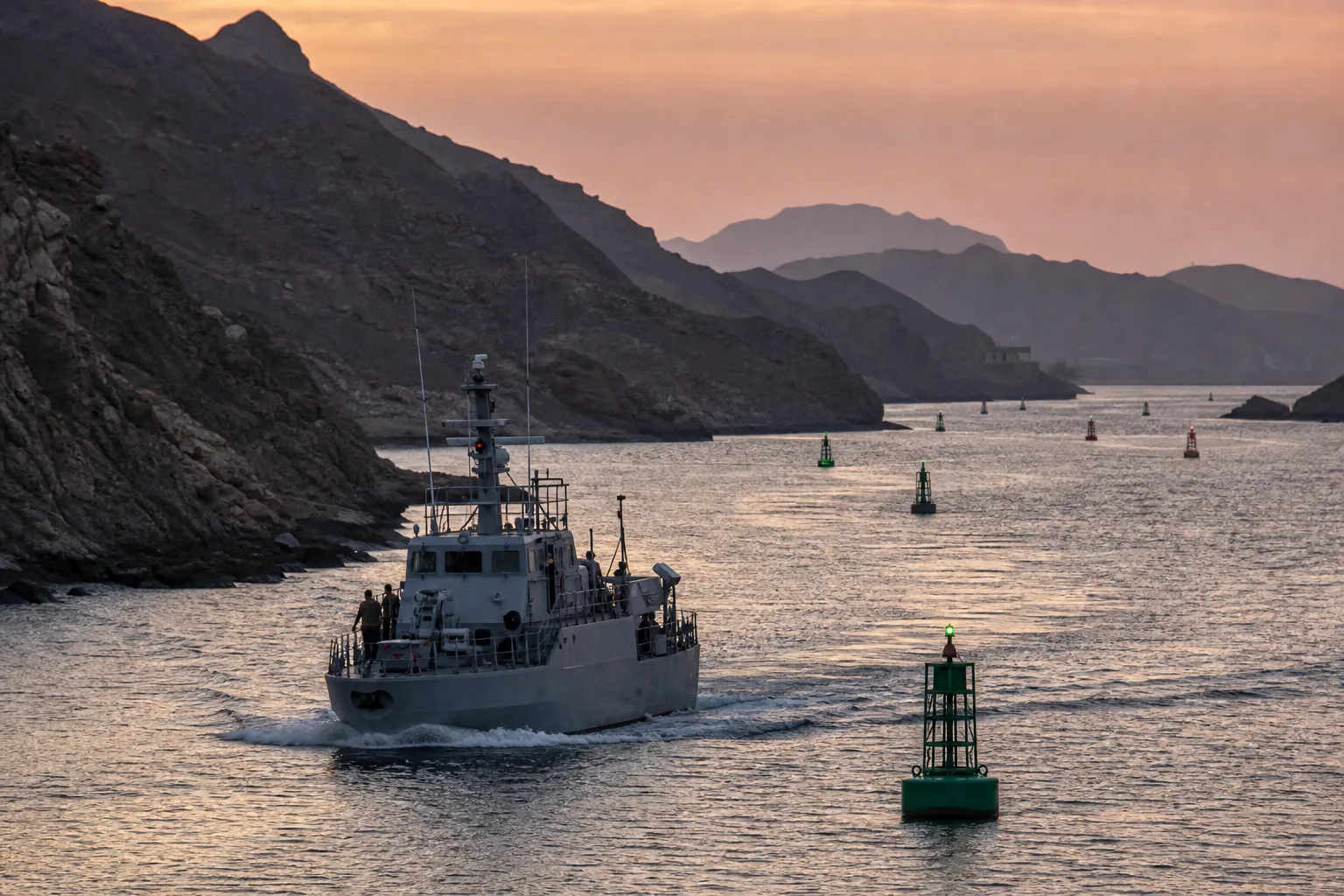
The strait is not a boom of mines across a channel. It is a price. IMF PortWatch’s most recent published day, August 30, logged six commercial transits against a pre-crisis baseline of about 85. That is seven percent of normal, a week lagged, and AIS still shows on the order of 445 vessels holding away from berth. War-risk cover is quoted near forty times peacetime; Marsh had hull premiums as high as ten percent of value at the peak and still in the high single digits. Four of the nine largest container carriers by TEU have told customers they are not using the route. P&I clubs already demonstrated in March that a cancellation stack can freeze oil without a physical barrier. That freeze is the baseline, not the shock.
The June memorandum is still cited by both capitals and still unconsummated as a reopening. Markets priced peace when the ink was wet; Hormuz did not reopen, and Israel was not in the room. Bürgenstock talks lived, then strained. Oman is the coastal-state track that still functions: a temporary joint corridor and mine-clearance talks announced after the August 25 Tehran meeting, with a 30-to-60-day window toward something more permanent. Iran has been clear that an Oman line is not unrestricted navigation. Howden Re has already called the marine war-risk repricing structural, in the Red Sea sense: premiums lag the shooting in both directions.
Lebanon is the parallel fuse, not a separate war. Sunday’s Israeli strikes around Nabatieh al-Fawqa and Arab Salim killed four, per Lebanon’s health ministry, after alleged Hezbollah drones toward troops in the self-declared southern zone. The June Israel-Hezbollah ceasefire has been extended, tested, and not formally buried. A ridge fight can stay local. It can also become the event that collapses the Gulf file.
The Fed is inside the same map. Chair Kevin Warsh, confirmed in May, used Jackson Hole to say inflation had not improved enough, to keep forward guidance thin, and to leave September live. Traders lifted hike odds toward roughly three-in-five. Breakevens already showed the war premium in the reaction function. Any easing path still runs through this water. Hiking into a supply shock is a choice, not a footnote.
Four Paths, Held as Judgment
These weights synthesize prediction-market behavior, reinsurance language, and the last four months of false dawns. They are a reasoned map through year-end 2026, not a model with error bars.
| Path | Weight | Brent band | Fed |
|---|---|---|---|
| A. Grind | ~45% | $90–100, range-bound | One hike, then hold |
| B. Partial corridor | ~30% | Drift $78–88 | Hike, then room to pause |
| C. Spiral | ~15% | $115–140+ | Hikes into growth risk |
| D. Deal that holds | ~10% | $65–75, sharp | Cutting talk returns |
A. Grind (~45%). Nothing resolves. Oman inches. Transit stays in single digits. Both sides quote June. This is what April-to-September already looked like. Brent stays elevated without a new spike. Diesel stays sticky. Energy keeps a quiet premium. Warsh hikes once if the data cooperate, then holds — unwilling to run a full cycle into a war that can still break either way. A tanker hit that matches the last hundred days is evidence for A, not a rewrite.
B. Partial corridor (~30%). The Oman framework becomes a monitored lane, not a press release. Transit lifts toward a fifth or a third of normal by the fourth quarter, visible in PortWatch rather than in communiqués. Insurance eases from extremes without collapsing. The 445-ship queue starts to clear. Prediction markets have been more willing to sell year-end normalization than September normalization, which is the same sentence in odds form: eventually, not this meeting. If B prints, the energy-premium trade fades and a pause after one hike becomes discussable.
C. Spiral (~15%). A loss event that is not like the last hundred days: a U.S. hull, a Ras Tanura-scale refinery hit, a mine barrier that is real rather than rumored. Flows fall from an already crippled baseline. Risk desks talk $120–150 Brent. Howden’s warning becomes operational: a marine-and-specialty loss that stresses reinsurance, not only oil. Warsh has staked early tenure on not blinking at inflation. A fresh shock mid-hike is a stagflation exam. Gold and the long bond stop theorizing.
D. A deal that holds (~10%). Not another ten-day extension. A UN-visible settlement both sides honor. The calendar is littered with prior versions: April’s “set to reopen,” June’s ceremony that did not stick, early-September renaming talk that lasted two days. Prediction markets have already shown they can jump a reopening contract in a session and give it back. If D hits, Brent sells hard, forced climate participation via closed water reverses as a flow story, and the energy trade that has been working gets crowded on the way out.
A headline is not a regime change until PortWatch and the Joint War Committee say so.
Use the map that way. Quiet Oman days with no new strikes are a small update toward B. Sunday in Nabatieh, absent a wider Israeli-Iranian coupling, is still A with a hotter fuse. Do not call a winner. Call which branch the day’s facts moved, and whether the weights should move with them.
Continue reading


Sources
IMF PortWatch transit prints through Aug. 30, 2026; AIS holding counts and carrier advisories as compiled in early-September maritime briefs; Marsh and Howden Re war-risk reporting; Iran-Oman corridor statements (Aug. 25–26); Warsh Jackson Hole remarks (late August 2026); Lebanon Health Ministry reports of Sept. 6 Nabatieh-area strikes


