

Ukrainian drones struck Russia's Ust-Luga Baltic export hub before dawn Tuesday, setting fire to a major transshipment terminal Moscow has leaned on as Hormuz risk reroutes barrels north. Governor Alexander Drozdenko said regional defenses downed fifty-two drones in four hours while NATO's Baltic mission scrambled Turkish F-16s after incursions into Estonia and Latvia.
The binding constraint on Tuesday’s energy tape was not only Hormuz. It was whether Russia can keep moving hydrocarbons through ports that now sit inside both Ukrainian reach and NATO airspace.
What Happened at Ust-Luga
Ukrainian drones struck Russia’s Ust-Luga complex on the Gulf of Finland early Tuesday, according to Leningrad region officials. The attack ignited a fire at one of Moscow’s largest Baltic transshipment terminals — a hub that handles crude, refined products, coal, and fertilizer exports when southern corridors tighten.
Crews extinguished the blaze by mid-morning. The physical damage looked contained relative to the sortie’s political payload: Ust-Luga is where Russia proves it can export at scale without sailing past Hormuz or through a contested Black Sea. A successful overnight strike, even with a quick firefight, tells shippers and insurers the northern route is not a safe haven.
Leningrad Governor Alexander Drozdenko said regional air defenses downed fifty-two drones over roughly four hours. That number matters less as a scorecard than as evidence of swarm density — the same cheap, long-range pressure that has made Hormuz insurance and cloud infrastructure a joint commercial-military problem now applies to Baltic loading schedules.
Export geography is a story markets tell until a terminal catches fire. Ust-Luga is where that story gets stress-tested in the north.
NATO’s First Baltic Scramble
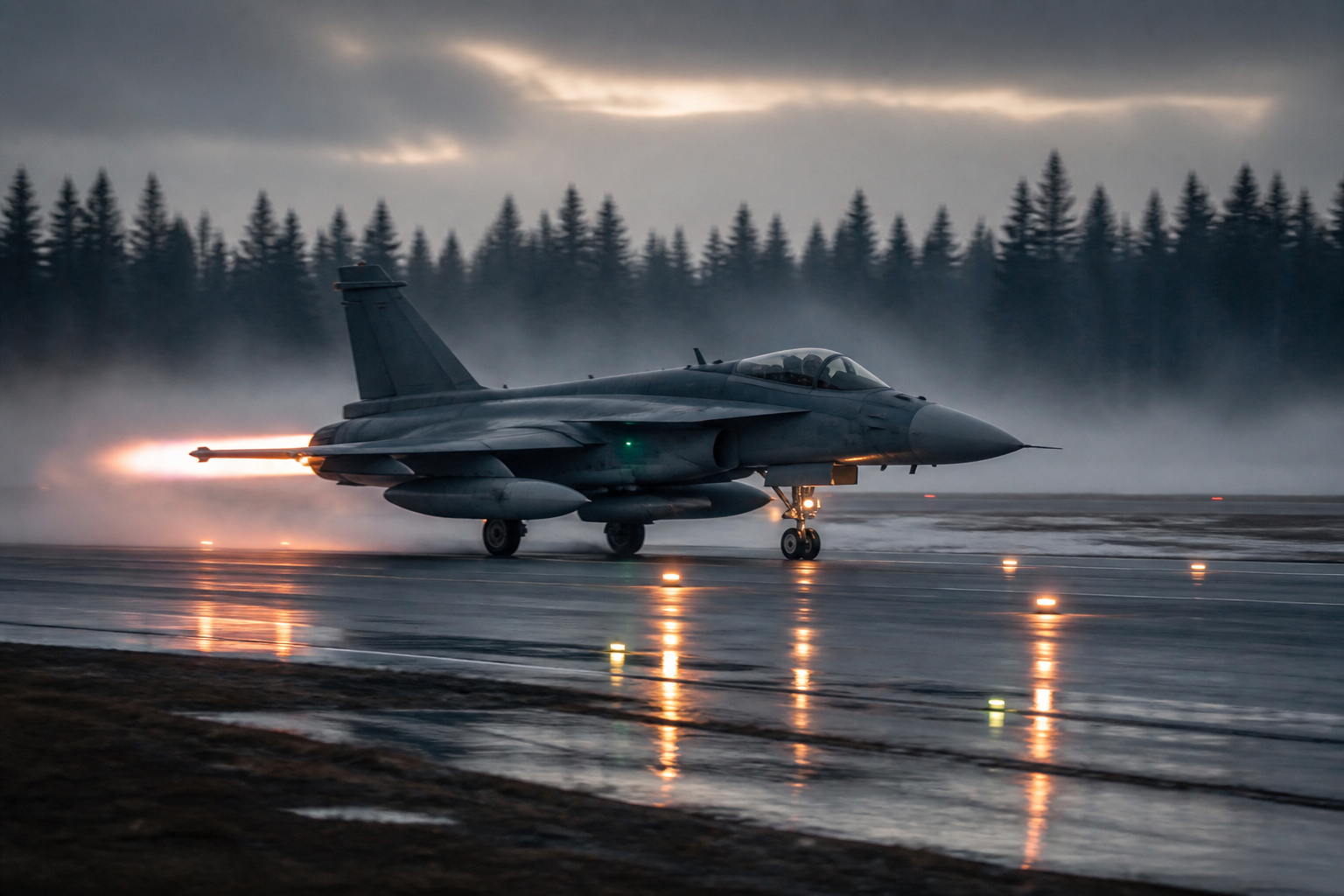
The overnight wave did not stop at the Russian coastline. Drones crossed into Estonian and Latvian airspace, triggering alerts across the alliance’s northeastern flank. Turkish F-16s scrambled from Ämari Air Base in Estonia — the first activation under NATO’s new Baltic air-defense mission, stood up after months of Russian incursion warnings.
Alerts lifted by mid-morning local time. No allied casualties were reported in the initial wire copy. The episode nonetheless compresses two wars into one airspace: Ukraine’s deep-strike campaign and NATO’s obligation to defend member territory without becoming a co-belligerent on Russian soil.
Estonia and Latvia sit minutes from Ust-Luga by jet. A drone swarm that begins at a Russian export terminal and ends in NATO radar coverage forces finance ministers — gathered the same day in Asheville to argue about Iran sanctions — to price security spillovers they would prefer to keep in the Black Sea chapter of the conflict.
Why Markets Care
Tuesday’s macro tape was already an energy-inflation story before Ust-Luga flared. Brent traded above $92 after twin Saudi-loaded supertankers were struck off Oman completing Hormuz transits. Eurozone August HICP printed at 3.3%. Germany’s ten-year bund touched a fifteen-year high near 3.36%. The Ust-Luga hit adds a secondary channel: rerouted Russian barrels may cost more to move even when they move at all.
Moscow’s public line has been diversification — Baltic and Caspian workarounds when Novorossiysk or southern routes stall. We mapped the same logic when Novorossiysk grain hubs went offline: rerouting is a coping mechanism, not a capacity substitute. Ust-Luga is higher throughput and higher visibility. A fire there reaches freight forwards and European power buyers faster than a downed drone count in a regional Telegram channel.
Capital is not waiting for confirmed export outages. Duration markets repriced all morning on the combined Hormuz and inflation read — the same fed-oil-inflation loop Bessent tried to manage at the G20 while pressing Iran sanctions. Baltic disruption is smaller in barrel terms than Hormuz closure, but it lands on a tape with no spare complacency.
The Corridor Logic
Ust-Luga sits on the Baltic corridor Moscow uses when buyers want Russian molecules without transiting chokepoints that Western navies and Ukrainian drones contest daily. Transshipment terminals decouple load timing from draft limits and mixed-cargo logistics — useful when sanctions force creative routing and when buyers demand prompt liftings.
Ukraine’s strike logic is symmetrical: raise the cost of every workaround until geography offers no discount. If Baltic loading schedules acquire the same insurance premia and delay risk as Hormuz passages, Russia loses the narrative that the war’s energy damage is confined to the south. Diplomatic offers — like Tehran’s Tuesday restatement of the expired Islamabad framework we covered when markets priced peace too early — do not unwind that arithmetic.
Shipping emissions and longer reroutes are a tertiary effect, but not zero. When Hormuz disruption forced extra miles, the climate accounting followed the barrels. Baltic delays would show up similarly: more anchorage time, more secondary handling, more fuel burned per delivered ton.
What to Watch
Three indicators will tell whether Tuesday was a contained fire or a corridor repricing.
First, Ust-Luga loadings over the next seventy-two hours — are vessels delaying berthing or shifting to Primorsk and other Baltic ports? Second, NATO rules of engagement after the Ämari scramble: does the alliance publish tighter intercept protocols, and do Russian sorties test them again? Third, Brent’s reaction once traders separate Hormuz tanker risk from Baltic terminal risk — if the spread between near-term crude and European gas power contracts widens further, markets are treating northern export vulnerability as additive, not substitutable.
The fire is out. The corridor question is not. Russia wanted the Baltic to be the backup plan; Ukraine showed the backup has smoke stacks too — and NATO airspace begins where those stacks meet the horizon.
Continue reading


Sources
Culled upfront banner, world desk briefs, Leningrad region reporting on Drozdenko statements, NATO Baltic air-defense mission activation


