

Australia and New Zealand are reopening the fuel-security ledger after Hormuz draft rules and thinner Gulf traffic made a free reopening look like a managed corridor. Both countries import most refined product, hold stocks well below IEA norms, and now price diesel freight, insurance, and CPI as a single chokepoint risk.
The Pacific stopped treating Hormuz as someone else’s waterway this week. As Iran floated a draft that would bar U.S. and Israeli ships and condition transit on compensation — while Oman corridor language still promised a traffic split — Brent reclaimed the mid-$80s and vessel counts through the strait collapsed toward a handful of merchant transits a day. For Australia and New Zealand, that is not a Middle East color story. It is a balance-sheet event that arrives as landed diesel, jet fuel, and CPI.
The sequence is familiar to anyone who watched markets price the Versailles MOU as peace before traffic recovered. Paper arrangements do not clear fixtures. A managed corridor with fees, bans, and a U.S. naval blockade still on the map looks more like conditional access than free flow — the same trap we tracked when Bürgenstock talks kept moving while oil jolted.
Import Desks, Not Refineries, Hold the Risk
Australia no longer refines its way out of a product shock. Closure of most domestic refining capacity left the country importing roughly eighty percent of oil products; it is the world’s largest diesel importer even if it is not the largest diesel consumer. IEA-style net import cover has hovered near fifty days — well below the ninety-day member benchmark — while government stockholding targets for diesel and jet still work toward a fifty-day domestic buffer that is policy aspiration meeting market scar tissue. New Zealand, downstream of Singapore for about a third of its fuel and already planning additional Marsden Point diesel storage, sits thinner still on emergency cover.
The risk book therefore lives with buyers, not distillers. When Gulf crude lanes seize, Asia-Pacific product markets tighten; when Ukrainian drones hit Russian refining hard, export barrels thin further. That double clamp is the ANZ problem set: two distant wars, one import vector.
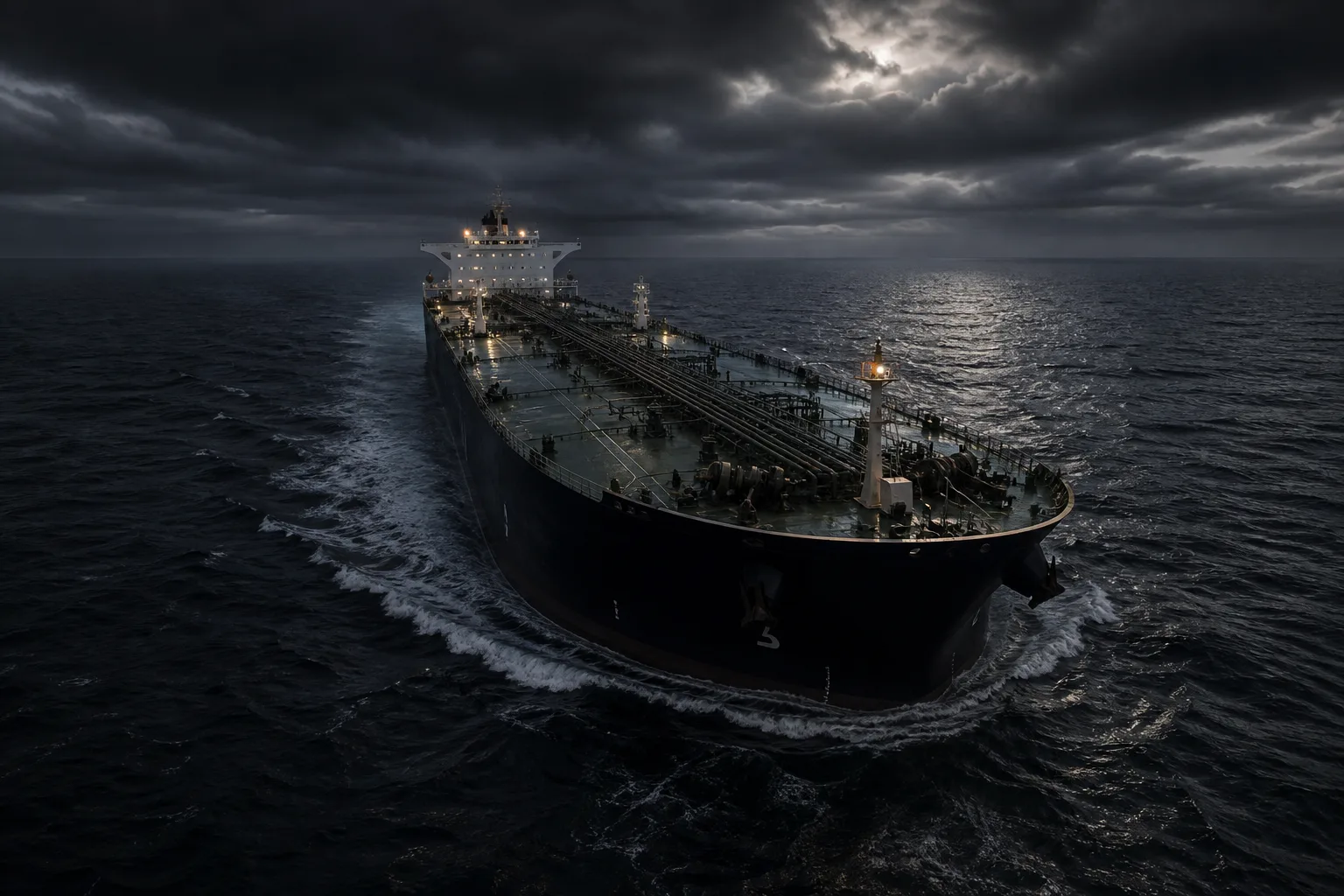
A product cargo mid-ocean is the real unit of ANZ fuel security — not a crude print on a screen.
How the Ledger Recalibrates
Three stock lines reopen now:
Stock days, not headlines. Australia operates at Level 2 of the National Fuel Security Plan — “keeping Australia moving” — meaning supply continues under system pressure. New Zealand’s Fuel Response Plan sits in Phase 1 monitoring. Escalation matrices already name higher phases that would ration, change fuel specifications, or prioritize critical services. That ladder is itself a mark-to-market: policy admitting the buffer is finite.
Freight and insurance as primary variables. Gulf chaos previously revoked or repriced coverage hard enough to idle hulls even when a paper corridor existed. The same insurance architecture that turned Hormuz into a cloud and P&I problem still prices Pacific product legs. A VLCC or product tanker that must pay transit, wait, or detour adds landed cost faster than retail politics can absorb.
Inflation, then terms of trade. Westpac’s earlier scenario work showed a Hormuz shock lifting Australian petrol by a quarter to a full Australian dollar per litre depending on the dollar and margins, with CPI and consumption drag larger in New Zealand because there is no LNG/coal export offset. Australia partially insulates national income with energy exports; households still pay at the pump. That asymmetry is the political fuse under every “temporary” price spike.
What Importers Will Not Assume
They will not assume peace is a free floating market, again — the market priced peace more than once and got stuck with a closed or half-open strait. They will not assume IEA emergency releases can be repeated at prior scale after prior draws. They will not treat Singapore, Korea, and Japan as fully diversified suppliers when all three sit inside the same Asia refining basin.
Forced conservation under price pain is a climate lever nobody planned — demand destruction as residual, not strategy.
The Binding Constraint Remains State Power at the Water
Capital can hedge futures; households cannot. Iranian, Omani, and U.S. state rules still decide whether product reaches Asia. Exclusion drafts, sanctions sequencing, and Houthi pressure on secondary lanes moved the state layer first; ANZ stockpiles were always the soft spot.
Rewrite the fuel book for days of cover. A corridor that is not free is still a tax — paid at the import berth before the domestic receipt.
Continue reading


Sources
Aug 7 Hormuz exclusion-draft / transit counts tape; IEEFA and government fuel-security frameworks; Westpac ANZ scenario work; prior Culled Hormuz MOU and sanctions coverage


