

Between March 1 and September 7, only 240 container ships entered the Gulf through Hormuz, against 4,198 a year earlier. Oil tankers have partly returned under escort. Washington's $40 billion insurance facility did not restore the liner schedule. Money met a risk it cannot transfer.
Between March 1 and September 7, Xeneta counted 240 container ships entering the Gulf through the Strait of Hormuz. A year earlier the same window held 4,198. The Financial Times put that 94 percent hole on the record Sunday, in a season when oil tankers have partly resumed under American escort. Washington spent the spring building a $40 billion answer. The boxes did not take it.
The answer was insurance, scaled until it resembled policy. In March the U.S. International Development Finance Corporation pledged $20 billion of maritime reinsurance. On April 3 the book doubled to $40 billion — half sovereign, half from seven U.S. carriers, Chubb in the lead, with AIG, Berkshire Hathaway, Travelers, Liberty Mutual, Starr, and CNA beside it. Hull, cargo, and war liability were supposed to let a premium stand in for a safe passage. By May the DFC still reported no active policies. The cover had been drawn around naval escorts that never became a schedule.
A quote is not a rotation
Private underwriters did not go silent. A spring survey of the Lloyd’s marine war market found most of them still willing to write hull and cargo. A 40-foot box from China to the UAE now carries marine insurance near $1,000, up from about $120, and the freight itself has run from roughly $1,250 toward $10,000. The price moved. Eleven of the 99 container services that used to call the Gulf are still running, most of them intra-Gulf or Iran–China. Transit times have doubled, to about 60 days, and cargo stalls at Mundra or Colombo on the way. Jebel Ali, near 40,000 TEU a day before the war by Lloyd’s List, lost more than 90 percent of that volume early and has barely climbed back.
A check can compensate a shipowner for a lost hull. It cannot compensate a captain for the chance of not coming home, a crew for months of exposure, or a sanctions desk for a legal theory that shifts between Bandar Abbas and a compliance call. It cannot compensate a liner for a missed rotation, a shipper for a delivery date that has become a rumor, or a free zone for a map of calls that assumed Jebel Ali was first.
The price of risk runs away before the market clears, because the network stops behaving like a market first.
Finance spent decades on the other assumption: name the premium, transfer the risk, let the ship sail. Hormuz is the counterexample in public. Seven P&I clubs had already closed the strait with cancellation notices before anyone assembled $40 billion to reopen it. The facility proved the second clause. Quoting the risk does not restore the network that used the risk as a route.
Oil is the exception that states the rule. Tankers earn enough, and draw enough escort, to move. A limestone cargo cannot bid against a supertanker day near $1 million, and corn and limestone shipments through the strait went to zero in August. The escort ledger and the commercial ledger were never the same book.
The bid moves to the other coast
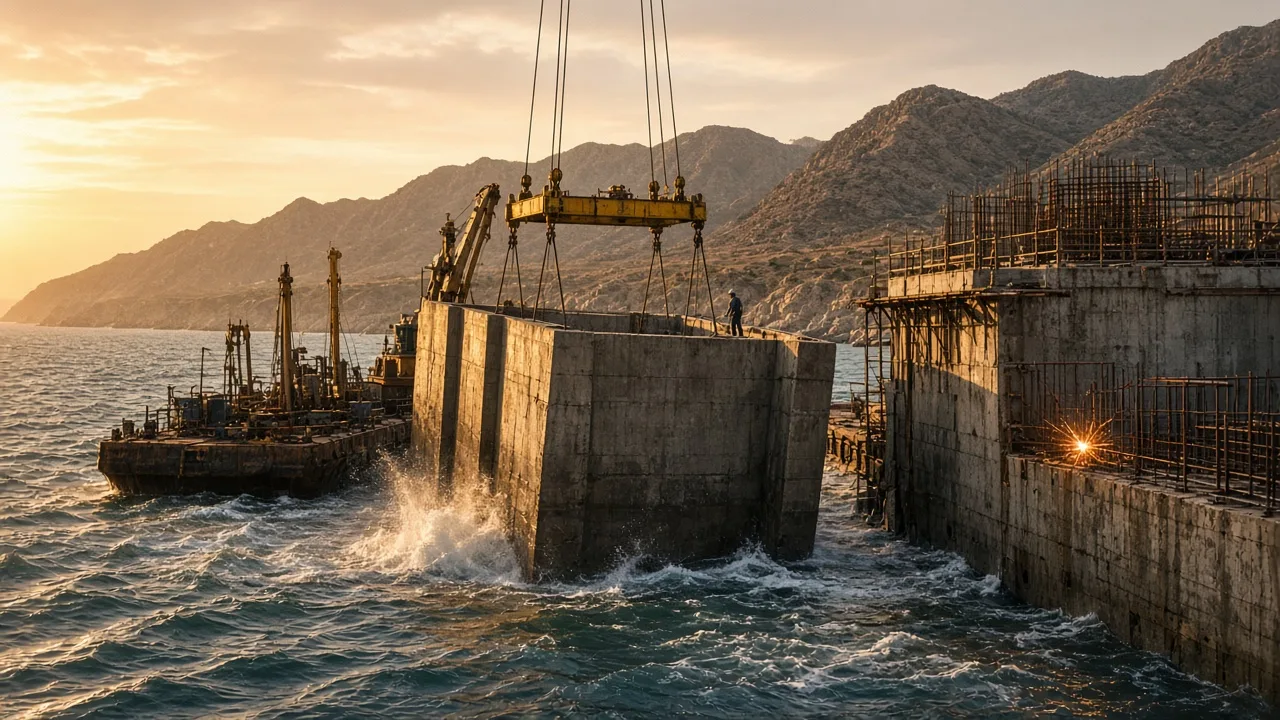
When a chokepoint cannot be insured back into ordinary use, capital stops pricing the passage and starts pouring concrete around it. DP World is planning two terminals on the Fujairah coast, on the Gulf of Oman, so a ship can reach the UAE without Hormuz. Khor Fakkan and Oman’s Sohar are the valves already taking the strain. The east-coast relief is real, and it is smaller than the machine it is replacing. Jebel Ali and its free zone — 12,000 firms, more than a fifth of Dubai’s GDP — do not relocate because a term sheet prefers the other shoreline.
This is the boundary on a habit the decade has been learning elsewhere. Scarcity becomes a reservation, the reservation becomes collateral, the collateral becomes an asset class. Buyers will pay to hold a gas-turbine slot years ahead because the slot still behaves. A strait that deletes 94 percent of container entries does not. You cannot reserve a rotation the lines have already struck. You build another door.
The same week, on land, cheap precision was writing a security premium onto factories that cannot move. At sea the premium failed from the other side. The ship can be rerouted. The network cannot be paid, at any quote now on offer, to pretend the old map is still there.
The test is narrow. If Xeneta’s container count through Hormuz climbs toward the old run-rate while Fujairah is still a plan, the insurance theory was only early. If east-coast calls and Omani relays keep rising while Gulf liner services stay near eleven, the experiment has already returned its result. Money met a risk that does not transfer. Capital is building the bypass.
Continue reading


Sources
Financial Times reporting (Sept. 20, 2026) via Xeneta on container entries through Hormuz, March 1–September 7; FT on Jebel Ali volumes, Fujairah terminal plans, and east-coast diversion; DFC announcements and congressional reporting on the $40 billion maritime reinsurance facility; Lloyd's marine-market surveys on war-risk appetite


