

Andrea Kimi Antonelli won Sunday's Italian Grand Prix from 19th, passing Mercedes teammate George Russell at Monza. The same weekend, the paddock's valuation case still holds: Formula 1 teams average about eight times trailing revenue, versus 12.9 times for NBA franchises. Scarcity and story density have not yet closed the gap.
MONZA — Andrea Kimi Antonelli started Sunday’s Italian Grand Prix nineteenth, a power-unit penalty that should have made him a spectator to his own home race. Fifty-three laps later he passed Mercedes teammate George Russell for the win, the first Italian to take the Italian Grand Prix since 1966. Charles Leclerc had already put a Ferrari in the Parabolica wall and brought out a red flag. A virtual safety car later split Mercedes’ strategy: Antonelli onto fresh mediums, Russell left to nurse worn hards. Russell, who needed the points, finished second. Antonelli’s championship lead moved to 66.
That is the product. Eleven constructors. A calendar Liberty Media sells as a global series. A single afternoon that compressed a title fight, a national myth, and a Scuderia humiliation into one park outside Milan.
Forbes still prices the grid at eight times revenue
Capital has noticed the shape of the asset, if not yet the American multiple. Forbes’ latest team valuations put Formula 1 at about eight times trailing revenue, up from 2.3 times in 2019 and 4.9 times in 2023. The NFL still averages 10.7 times. The NBA averages 12.9. Toto Wolff’s Mercedes stake sale printed about $6 billion, a new high, above McLaren Racing’s reported $4.06 billion buyout last September. Ferrari, on Forbes’ books, sits at $6.5 billion. The average team is now worth $3.6 billion. None of that is a distressed toy. All of it still trades cheaper than a closed North American league with thirty-odd clubs.
Zak Brown has been saying the quiet part in public. Formula 1 has no promotion and relegation. Cadillac is paying more than $1 billion — startup costs plus a $450 million anti-dilution fee — to become the eleventh team. The Concorde machinery is built to keep a twelfth from arriving on a bargain ticket. The Race’s business desk asked the question the paddock already had: why an NBA franchise can clear twelve times revenue when an F1 team, scarcer and now profitable at the sharp end, clears six to eight.
The residual haircut is not a mystery. Team owners do not own the championship. Liberty does. The calendar has 24 grands prix, not 1,230 NBA games. U.S. audiences remain a fraction of NASCAR’s even after Drive to Survive and Apple TV’s rights check. The cost cap is climbing toward $215 million. Lower-grid teams still need another sponsor or three to get into the black. Those constraints are real. They do not erase the other ledger: inventory is tiny.
Eleven slots cannot be cloned after a home win
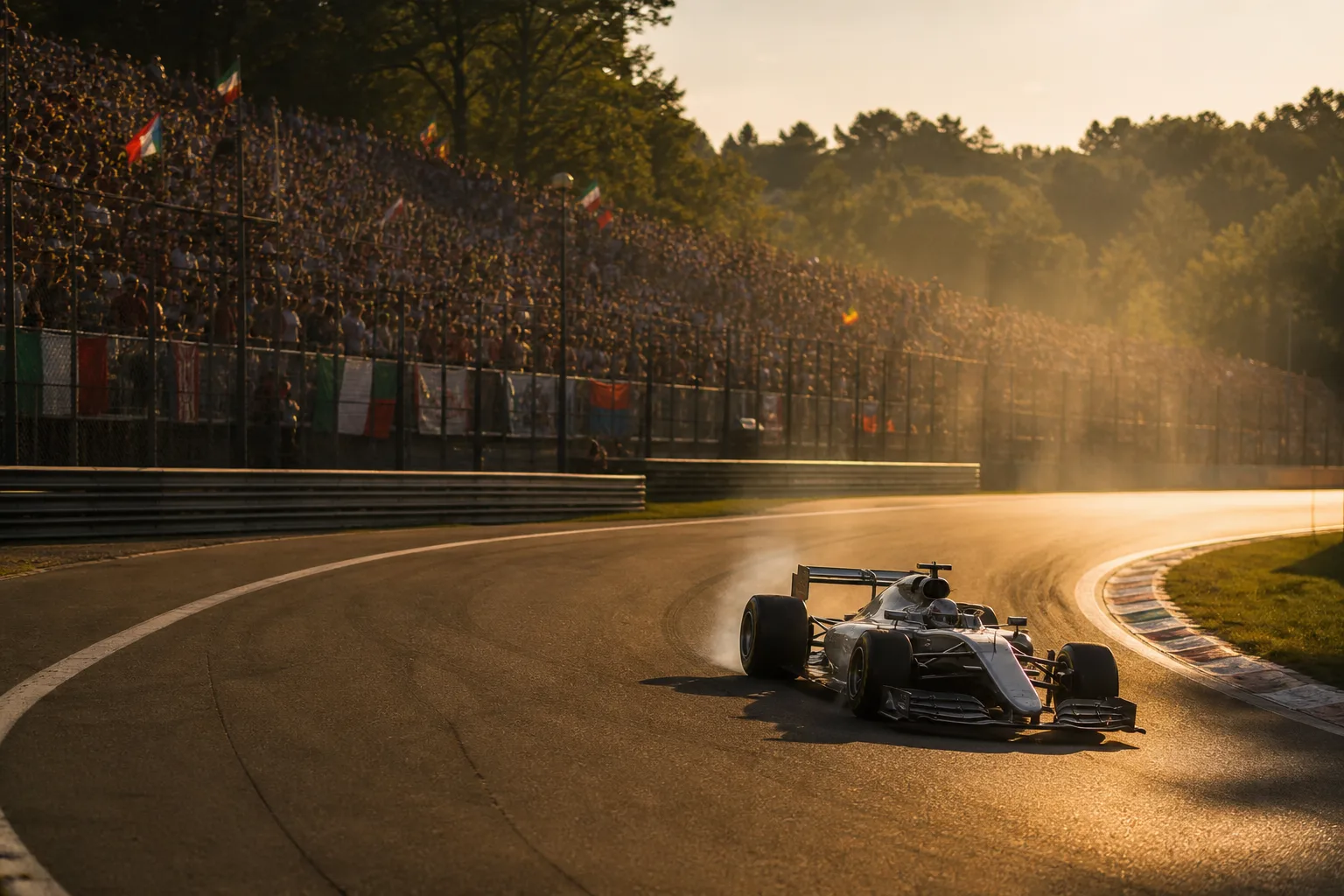
Sunday was the argument in motion. An Italian in silver climbing from the back on home asphalt. A teammate title rival left on the wrong tire. Ferrari in the wall before the race had a plot. Investors who just paid $12.5 billion for the Lakers bought a city and a floor that cannot be copied. An F1 team is a rolling factory that only eleven people get to park — the same scarcity logic that now sends AI labs shopping for cricket’s crowd rather than inventing a new sport.
There are eleven of these things, and the story they sell is not a regional Tuesday night.
If the multiple is going to close, it will close on weekends like Monza — unpredictable results, a breakout on home soil, a championship squeezed tighter — not on a slide that treats FWONK as a basketball cap table with extra carbon fiber. The race already did the marketing. The print has not yet followed.
Continue reading


Sources
Formula 1, BBC Sport, Sky Sports, and PlanetF1 race reports on the 2026 Italian Grand Prix; Forbes SportsMoney team valuations and trailing-revenue multiples versus NFL and NBA; The Race on F1-versus-U.S. franchise multiples; reporting on Toto Wolff's Mercedes stake sale near $6 billion and McLaren Racing's September 2025 buyout at about $4.06 billion


