

India will charge merchants 0.4% on most UPI payments above ₹2,000 from October 15, while consumers and most low-value transactions remain free. The change monetizes a mature payment rail; claims that it will push users toward the e-rupee remain plausible but unproven.
India has finally put a price on part of UPI.
From October 15, person-to-merchant UPI payments above ₹2,000 will carry a 0.4% merchant discount rate, capped at ₹300 for transactions of ₹75,000 or more. Consumers will not be charged directly. Person-to-person transfers remain free, as do small-merchant QR payments within the protected category. NPCI says more than 95% of merchant-payment volume sits below the ₹2,000 threshold.
That makes the change narrower than the headline suggests. India is not abandoning free UPI. It is asking whether the network can begin earning from the slice of commerce where a percentage fee produces meaningful revenue without disturbing the daily payments that built the network.
The fee monetizes scale without charging the payer
UPI processed 24.5 billion transactions worth ₹29.82 lakh crore in August 2026, according to NPCI. At that scale, zero merchant pricing stops looking like a promotional decision and starts looking like an allocation question: who pays for acquiring, switching, fraud controls, settlement and continued infrastructure?
The new framework answers only part of it. Larger person-to-merchant transactions become a source of revenue for the institutions running and accepting UPI, while the consumer-facing price remains zero. Certain thin-margin or essential categories receive different treatment, including flat-fee structures rather than the standard percentage charge.
The distinction matters because merchant fees rarely stay confined to an accounting line forever. A retailer can absorb them, raise prices, favor another payment method or redesign discounts around cheaper rails. The buyer may never see an explicit UPI surcharge and still pay for acceptance indirectly.
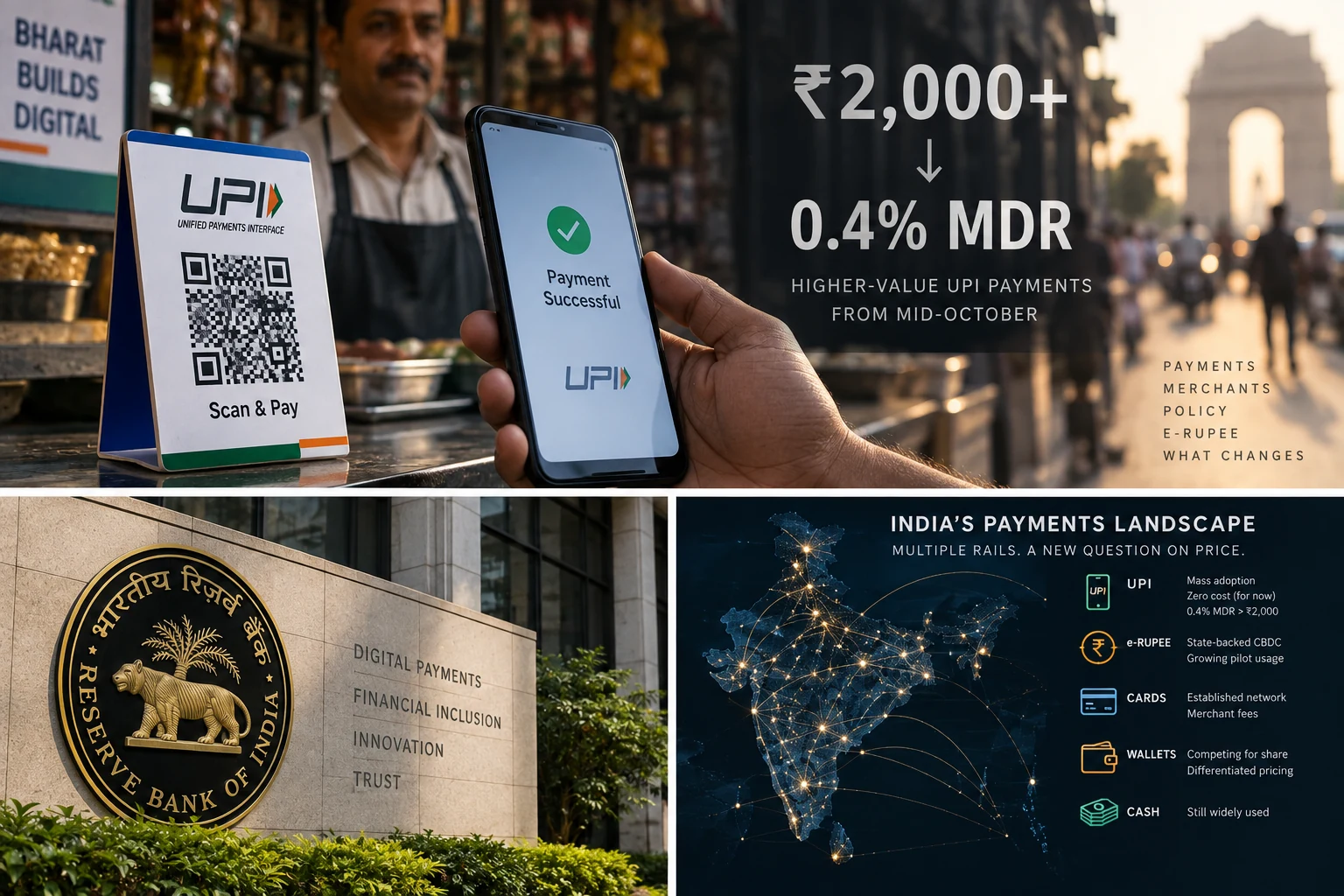
The e-rupee can use the same QR code. That is not the same as a pricing advantage
The more ambitious interpretation is that priced UPI creates an opening for the Reserve Bank of India’s digital rupee.
Technically, the substitution is no longer fanciful. RBI says e-rupee wallets can scan existing UPI QR codes. NPCI’s interoperability rules were designed so merchants already accepting UPI could receive digital-rupee payments without installing a second acceptance network.
That solves one difficult problem: merchant reach.
It does not solve the economic one. Public RBI and NPCI material does not establish that a merchant facing the new 0.4% UPI MDR will receive an equivalent e-rupee payment at a systematically lower all-in cost. NPCI’s interoperability circular says existing switching fees and UPI settlement processes apply when digital-rupee users transact through UPI QR infrastructure. The digital rupee also remains a pilot rather than a mass-market rail with UPI’s usage.
Mint reports that officials and industry participants expect the MDR change could encourage some merchants or users toward the CBDC. That is a reasonable hypothesis. It is not yet a documented migration policy.
Shared acceptance gives the e-rupee a doorway into UPI commerce. It does not prove that merchants save money by walking through it.
This is the same distinction that matters in other payment systems: the asset, the settlement rail and the price of using the rail are different things. Our earlier look at Iranian trade settlement made the same separation between the currency in which commerce is priced and the infrastructure through which it ultimately clears.
The real experiment is whether merchants steer behavior
The first observable effect should appear on the merchant side, not in CBDC wallet downloads.
A ₹2,500 payment now creates a ₹10 MDR at the headline rate. A ₹20,000 transaction creates ₹80. At ₹75,000, the ₹300 cap stops the charge from scaling further. Those amounts are small against some merchant margins and material against others.
That is why the threshold matters. NPCI preserves the zero-price habit for low-value daily purchases while charging the higher-value transactions that can produce revenue. If merchants absorb the cost, consumer behavior may barely move. If they begin offering cash discounts, card incentives, wallet promotions or e-rupee preferences, the new price becomes visible through steering rather than a checkout surcharge.
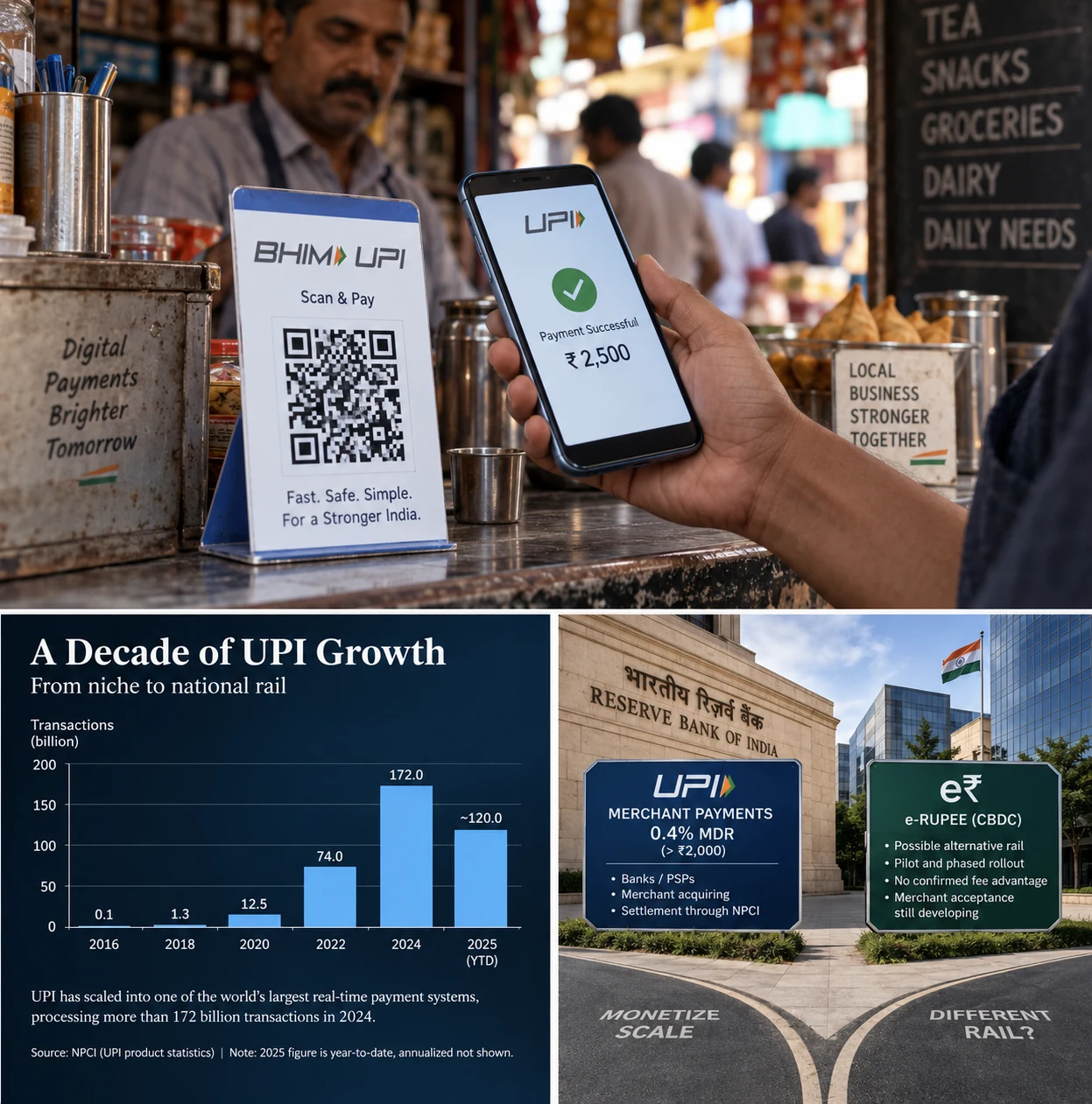
Repricing UPI does not yet make the e-rupee its replacement
India has already solved the hardest problem in retail payments: getting millions of merchants and consumers onto one interoperable habit. Repricing that habit is therefore a more consequential experiment than launching another payment app.
The e-rupee has useful architecture. It is central-bank money rather than a bank-account transfer, can be held in a wallet and can use UPI QR acceptance. But a technically compatible rail becomes a commercial substitute only when users and merchants have a reason to prefer it.
That reason has not yet been demonstrated. The strongest evidence today supports a simpler claim: India is beginning to monetize selected UPI merchant payments while protecting the low-value transactions that made UPI ubiquitous.
The next test is measurable. Watch merchant acceptance data, payment-method steering and e-rupee wallet activity after October 15. If merchants facing the MDR begin shifting meaningful transaction volume toward the CBDC, repricing UPI will have created a second rail. If they simply absorb the fee, India will have monetized the first one without changing the map.
The distinction between a workaround and a new system is one we have seen elsewhere in alternative payment rails: usage has to move, not merely become technically possible.
Sources
National Payments Corporation of India, UPI product statistics and Digital Rupee interoperability circular; Reserve Bank of India, Digital Rupee FAQs; Mint reporting on the September 2026 UPI MDR framework and possible CBDC effects; Times of India and Indian Express reporting on scope, thresholds, caps and implementation date.
More in Markets & Finance


Sources
NPCI UPI statistics and interoperability circulars; RBI Digital Rupee FAQs; reporting from Mint, Times of India and Indian Express on the September 2026 MDR framework.
