

The United States has publicly acknowledged operational weapons in orbit for the first time, just as its decade-long effort to move civilian collision warnings away from the Pentagon remains unfinished. The juxtaposition matters: orbit is becoming a warfighting domain before America has settled who should manage ordinary traffic through it.
Space has always been militarily important. The language changed this week. America now openly says it has weapons in orbit while the civilian traffic-control system designed to free the Pentagon from collision warnings is still stuck between pilot program and cancellation.
The euphemism finally became a weapon
For decades, Washington carefully distinguished military satellites from weapons in space. That rhetorical buffer narrowed sharply Monday.
Air Force Secretary Troy Meink told the Air, Space and Cyber Conference that the Space Force now has “on-orbit space control weapons” capable of defending U.S. forces against hostile action. The service declined to describe the systems. Air & Space Forces Magazine called the statement the Pentagon’s most direct acknowledgement to date that the United States is operating offensive capabilities in orbit.
The disclosure follows years of warnings about Chinese and Russian counterspace systems. It also follows the U.S. military’s first live-fly orbital warfare exercise, Apollo Maneuvers 2026, in which spacecraft practiced operations in a contested environment.
Those facts belong naturally in a defense story. The stranger companion story is bureaucratic.
America is clarifying how it may fight in orbit before clarifying who runs the traffic desk.
The civilian traffic system is still a pilot
Almost eight years after the first Trump administration ordered civilian space-traffic responsibilities shifted away from the Pentagon, the Commerce Department’s Traffic Coordination System for Space remains incomplete.
Breaking Defense reported Monday that nearly $200 million and almost a decade into the effort, officials and industry are debating whether TraCSS should be scrapped, preserved or rebuilt under a different model. The White House has repeatedly sought deep cuts; Congress has repeatedly restored funding.
The original logic was clean. Civilian and commercial satellite operators need warnings when spacecraft or debris may collide. The military needs to know when another spacecraft’s maneuver is not accidental. Moving routine safety work to Commerce would free Space Command to concentrate on hostile behavior.
That separation becomes more valuable precisely as orbital behavior becomes more ambiguous.
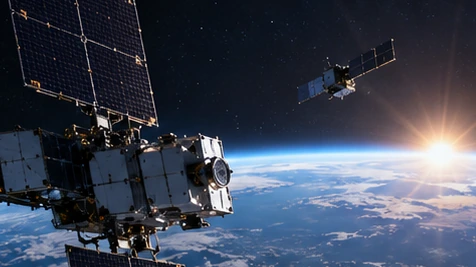
A satellite approaching another satellite may be inspecting it, servicing it, threatening it or merely passing through a crowded orbital shell. The same positional data can describe ordinary traffic and military intent. The institution interpreting that movement therefore matters.
Weapons make traffic management a security problem
Low Earth orbit is filling with commercial constellations, debris, maneuvering spacecraft and increasingly sophisticated military systems. At orbital velocities, even an unintentional collision can destroy hardware and create fragments that threaten unrelated satellites. A hostile maneuver may initially look very similar to a safety problem.
TraCSS was meant to create a civilian baseline: reliable public collision services drawing on government, operator and commercial tracking data. Critics say the current pilot still relies too heavily on Defense Department information and has not integrated commercial capabilities quickly enough. Supporters argue inconsistent funding prevented the architecture from maturing.
Either way, the timing has become awkward.
The United States has now chosen to disclose that it possesses operational space-control weapons because officials believe openness strengthens deterrence. At the same moment, it has not finished building the civilian institution meant to keep ordinary orbital coordination from consuming military attention.
That is not simply administrative untidiness. It is an architectural choice about how a crowded domain distinguishes accident from aggression.
Air traffic control became mundane because aviation built institutions around predictable movement. Maritime powers separate harbor masters, commercial navigation and naval command for similar reasons.
Orbit is heading in the opposite order. The weapons are arriving while the traffic rules are still under construction.
More in Geopolitics


Sources
Air & Space Forces Magazine, Breaking Defense and space-policy reporting on orbital weapons, Apollo Maneuvers and TraCSS.
