

The World Food Programme said prolonged closures of major crossings with Pakistan since late 2025 have forced traders onto longer routes through Iran and Central Asia, raising transport costs even as global markets debate dollar debasement and gold's rally. In its September 2026 countrywide market report, WFP pegged diesel at an average 80.3 Afghanis per litre, up 4.7 percent in the month and 14 percent year on year, while food inflation reached 8.0 percent. An unskilled laborer working two days a week at 300 Afghanis could afford only 47 percent of WFP's in-kind food basket on average. Kabul's problem is not whether the afghani tracks a weaker dollar; it is whether imports can reach markets before winter road closures and Hormuz-linked fuel shocks add another layer to the bill.
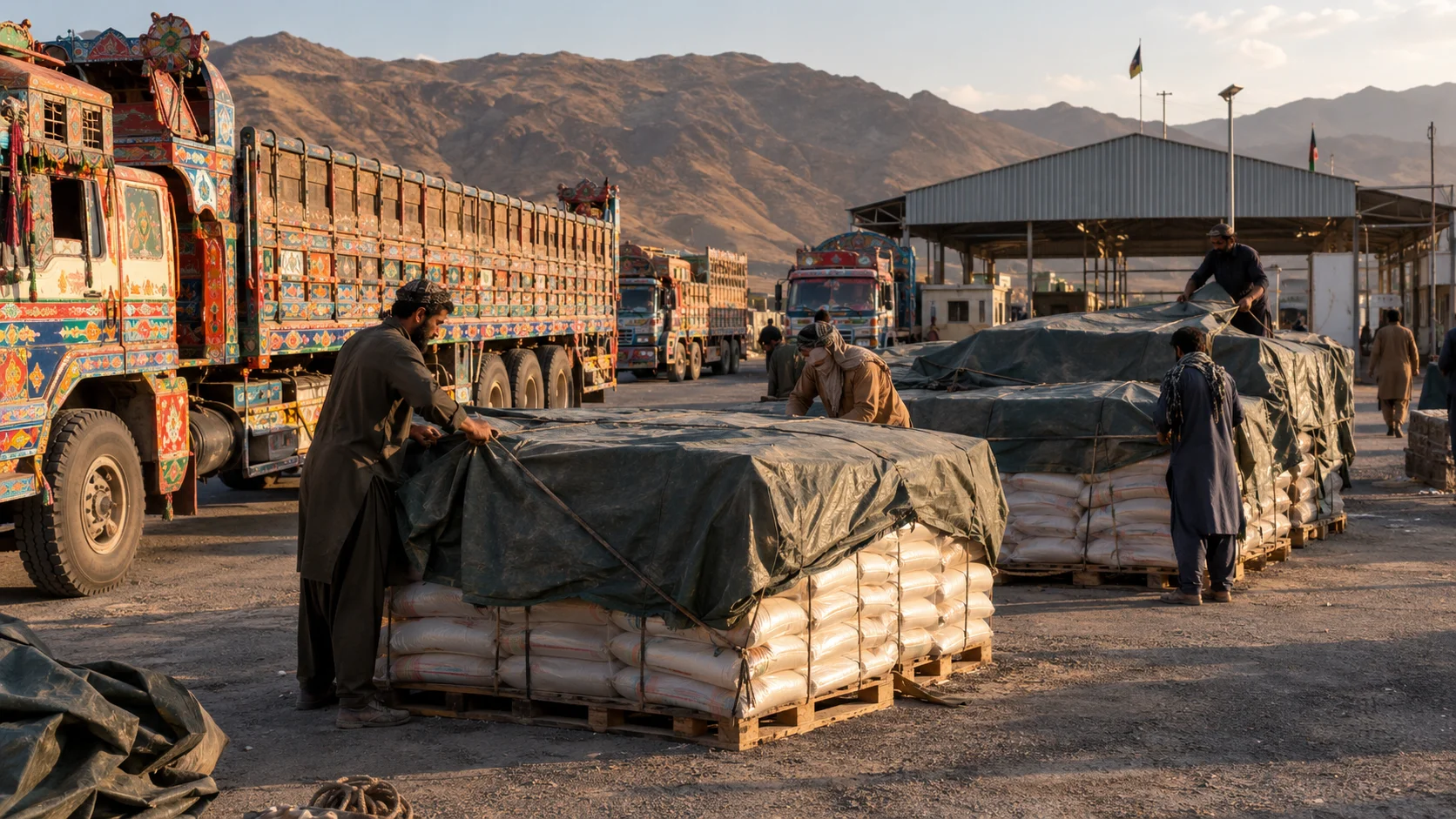
Global desks on 20 October were still trading the reflation bundle — gold firm, the dollar softer, long bonds under pressure — while KabulNow’s summary of the World Food Programme’s September countrywide market report described a different transmission mechanism. Afghanistan has become more dependent on Iranian and Central Asian corridors after prolonged closures of eastern and southern crossings with Pakistan, including Torkham and Chaman, following late-2025 clashes and Islamabad’s disputes with the Taliban over Tehreek-e-Taliban Pakistan sanctuaries. The reroute adds time and freight; it does not pass through a weaker dollar as a discount.
A landlocked economy does not import through FX screens. It imports through whichever gate is open — and pays the diesel to get there.
Border Closed, Bill Open
Pakistan closed the major gates after a year of intermittent fighting; humanitarian analysts including ACAPS have estimated cross-border trade through the Durand Line fell by more than 90 percent by mid-2026, stranding trucks and breaking routes that once carried Pakistani flour, fuel, and consumer goods into Afghan cities. WFP said the Middle East conflict since late February further disrupted Hormuz shipping, lifting Brent to about $102 per barrel in September — nearly 16 percent above August — and feeding through to diesel at 80.3 Afghanis per litre on average, up 4.7 percent in the month and 14 percent year on year.
Headline inflation was 7.8 percent year on year in August, with food at 8.0 percent — modest by Tehran’s standards, but paired with collapsed labor income. WFP put the national average in-kind food basket at 5,438 Afghanis in September, up 0.5 percent month on month and 4 percent year on year. An unskilled laborer averaged only two working days per week at 300 Afghanis per day, enough to cover 47 percent of that basket nationwide; affordability fell to 16 percent in Nuristan and peaked near 62 percent in Baghlan. Culled’s Monday world briefs noted rice and cooking oil still double-digit above year-ago levels in early October even as petrol eased toward AFN 85 per litre — a split that shows fuel and staples do not move in lockstep when corridors change.
Humanitarian Logistics as Price Discovery
The same border shock is visible in aid supply chains, not only bazaars. WFP’s September country brief, summarized on ReliefWeb, describes airlifts of super cereal into Kabul and a multimodal corridor through Iran’s Bandar Abbas port — more than 1,000 metric tons in 41 containers toward Islam Qala in Herat, with the first tranches delivered and the balance due in October. That is price discovery by logistics: when Pakistan is shut, Dubai and Bandar Abbas become the marginal port, and the import bill includes container hire, insurance, and war-risk premia Culled has tracked on Hormuz lanes and Iran’s parallel FX stress.
Official Kabul still signals transit ambition — a six-day trade fair with 323 domestic and foreign exhibitors, per desk reporting — but WFP warns that seasonal agriculture slowdown, winter road access, and restricted women’s workforce participation cap how much domestic demand can offset external shocks. More than 1.2 million returnees from Iran and Pakistan this year, in WFP’s October messaging, add mouths without matching wage days.
What Would Ease the Arithmetic
A durable reopening of Torkham and Chaman with cleared backlogs would reprice wheat and cooking oil faster than any G-10 dollar move. Short of that, watch diesel at the pump, WFP basket affordability by province, and container arrivals at Islam Qala against Bandar Abbas sailing delays. Diplomatic pauses that calm oil markets trim the fuel leg; they do not replace Pakistani overland capacity.
The falsifier for “dollar weakness helps Kabul” is not the AFN/USD print near 64.9 in recent desk data. It is sustained narrowing of year-on-year food inflation and rising labor days while borders stay shut. Until those series turn together, STATE border policy — not CAPITAL’s macro narrative — owns the import bill.
Continue reading


Sources
KabulNow on WFP September 2026 countrywide market report; WFP Afghanistan country briefs and September ReliefWeb logistics on Dubai airlift and Bandar Abbas corridor; Culled world briefs on AFN 64.9 and October food prices; ACAPS on Durand Line trade collapse; prior Culled on Hormuz and Iran FX stress


