

Iran's Statistical Center reported September point-to-point inflation of 89.8 percent and an annual rate of 73.6 percent as households wrestle with a collapsing rial and surging food costs. On the same diplomatic calendar, Central Bank Governor Abdolnaser Hemmati met Algeria's Mohand Bouri in Bangkok to discuss expanded banking and economic cooperation. The juxtaposition tests whether corridor diplomacy can deliver usable relief or only political alignment while prices outrun policy at home.
Iran’s Statistical Center reported that September point-to-point inflation reached 89.8 percent, with the annual rate at 73.6 percent, according to IranWire’s summary of the official release. The print lands after months in which a weak rial, imported input costs, and wartime logistics have fed through to food and household goods — a domestic price spiral that markets have often treated as background to Hormuz and sanctions headlines rather than the lead indicator.
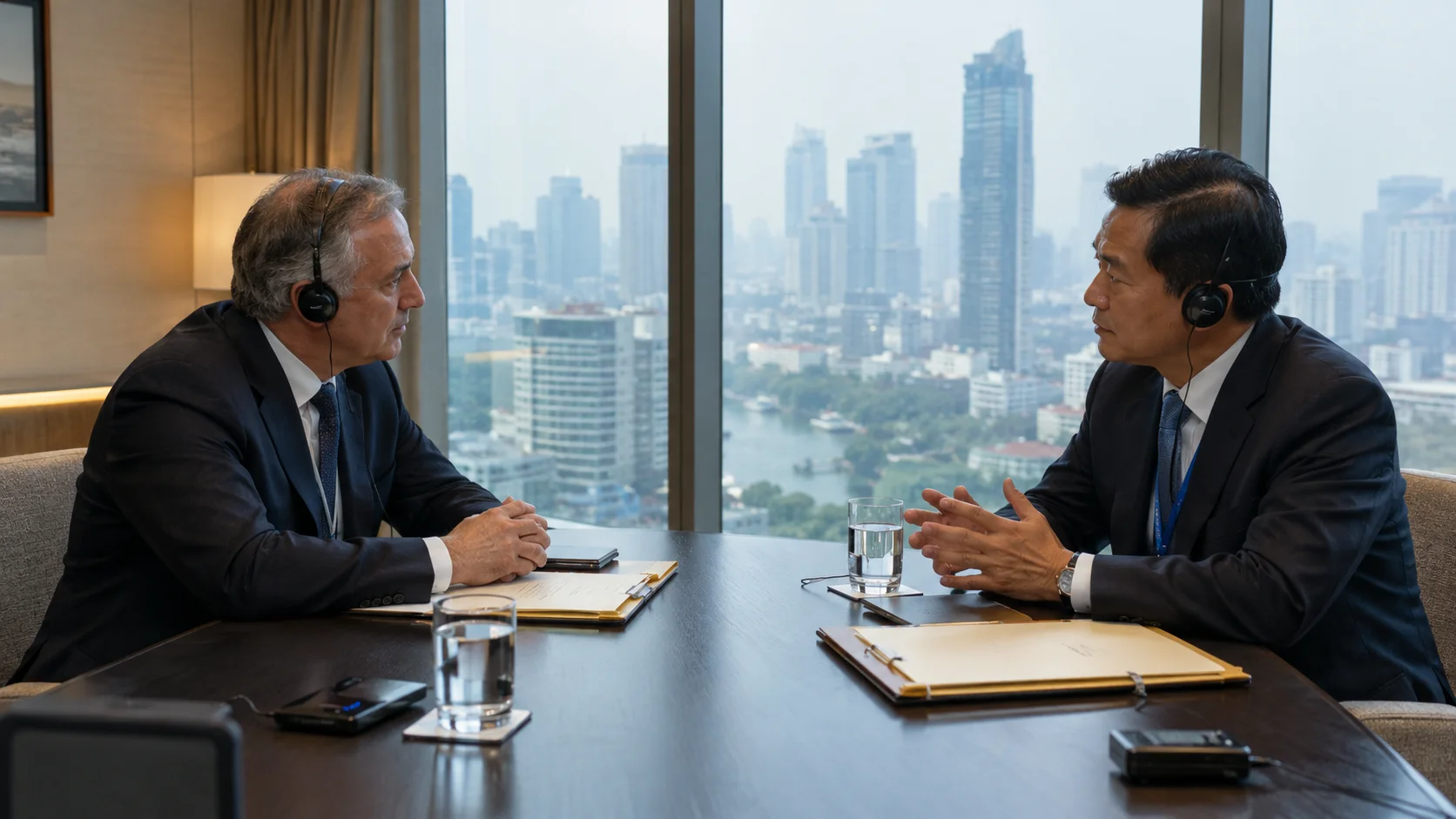
On the same week’s calendar, Central Bank Governor Abdolnaser Hemmati met Algeria’s central-bank governor, Mohand Bouri, on the sidelines of the IMF and World Bank annual meetings in Bangkok to discuss expanded banking and economic cooperation, Tehran Times reported. The readout is diplomatic boilerplate — deeper ties, mutual support, financial-sector coordination — but the venue matters: Iran is actively courting partners who can settle trade and extend credit outside the dollar channels Washington polices.
Corridor diplomacy widens options at the margin; it does not, by itself, retire a near-90 percent inflation print attributed to the Statistical Center.
Two Clocks
The household clock is what the Statistical Center measures: shelf prices repricing faster than wages, currency substitution in everyday trade, and political pressure on a government already managing external conflict. Culled has tracked how Hormuz corridor claims and permission-based shipping markets shape oil risk; this peg is different — inflation as the binding domestic constraint on legitimacy and stability, not another tanker headline.
The diplomatic clock is what Hemmati and Bouri advanced in Bangkok. Algeria sits in the same sanctions-adjacent geography as other non-dollar trade experiments Iran has pursued with neighbors and BRICS-aligned partners. U.S. secondary pressure on oil buyers remains the outer fence; banking outreach to Algiers is an attempt to punch smaller, bilateral holes in that fence — correspondent relationships, settlement workarounds, and trade finance that do not require reopening SWIFT for the whole economy.
Neither clock automatically resets the other. The public meeting summary does not claim that Algerian cooperation will lower Tehran food inflation next month — and the inflation print offers no evidence that it already has.
What the IMF Room Acknowledged
The International Monetary and Financial Committee briefing that framed the week’s multilateral agenda treated war spillovers, inflation, and financial stability as active, concurrent risks — not a menu where policymakers pick one. CNBC’s coverage of member calls for support amid shocks sits in the same Bangkok news cycle as Hemmati’s bilateral. Iran’s delegation is arguing for relief and connectivity; the IMFC text reminds readers that many economies are still absorbing energy and conflict pass-through.
For investors, the split screen clarifies what to watch. External channels — Hormuz insurance, sanctions enforcement, Brent premia — still dominate cross-border capital flows. Internal inflation near 90 percent point-to-point is the stress test for whether any corridor produces imported goods at stable prices or only political cover for trade that was already happening at the margin.
Evidence That Would Change the Story
Usable economic relief would show up in observable series, not communiqués alone. Watch whether official inflation decelerates in October and November prints from the Statistical Center — especially food and housing components that drive household anger. Watch rial parallel-market gaps and whether import volumes of staples recover without another subsidy blowout. On the corridor side, look for announced correspondent-banking agreements, documented settlement currencies, and trade flows with Algeria that move beyond hydrocarbon barter.
If inflation stays near 90 percent while Bangkok produces only handshake headlines, corridor diplomacy is alignment theater — important for geopolitics, thin for household budgets. If bilateral banking ties coincide with moderating food inflation and narrower currency spreads, Hemmati’s outreach becomes a policy instrument worth pricing. Until one of those paths hardens, domestic price pressure remains the story that outruns the diplomacy — and the falsifier is the next Statistical Center release, not the next MOU.
Continue reading


Sources
IranWire on Statistical Center September 2026 inflation; Tehran Times on Hemmati–Bouri central-bank meeting at IMF annual meetings; CNBC on IMFC war-spillover and inflation risks; prior Culled on Hormuz corridors and U.S. secondary sanctions


