

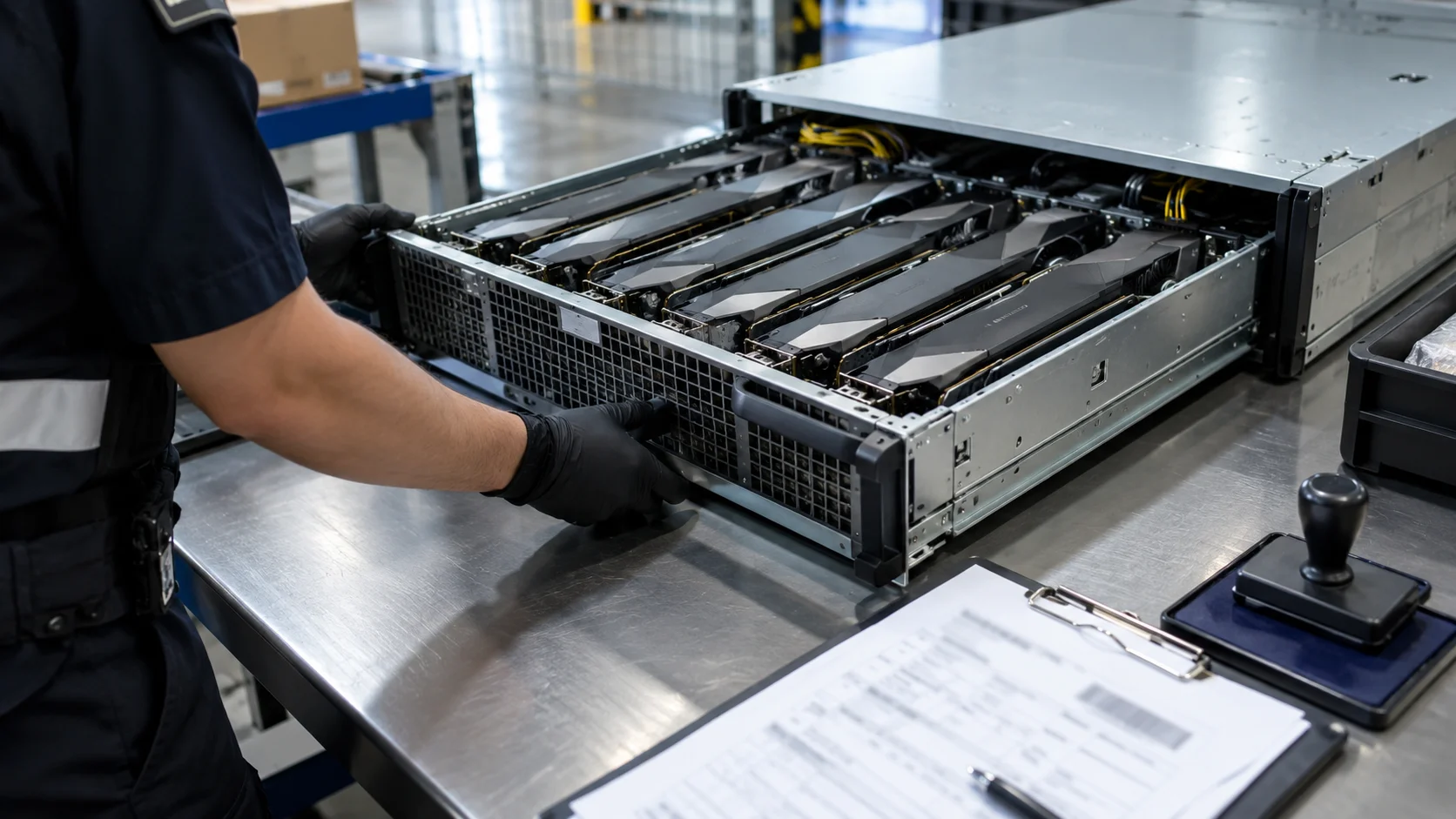
Malaysian customs seized about RM49.5 million ($12.1 million) in advanced AI chips at Kuala Lumpur International Airport on Oct. 15, officials said Oct. 28. Thirty server units entered under false component declarations and were headed for re-export without the permit Kuala Lumpur now requires on high-performance U.S.-origin silicon in transit.
Kuala Lumpur, Oct. 28 — Malaysia’s customs department said Wednesday it seized 30 server units containing advanced AI chips worth about 49.5 million ringgit ($12.11 million) after an inspection in the Kuala Lumpur International Airport free-trade zone on Oct. 15. Wire services including Reuters and AP carried the announcement from a press briefing in Sepang.
KLIA Customs director Aspalila Ag Tuah said the shipment arrived from an Asian country under a single air waybill, was misdeclared as generic electronic components, and was slated for re-export to another Asian destination — a path that requires a trade permit under rules Malaysia tightened last year on U.S.-origin high-performance chips. Investigators suspect the same syndicate behind a June seizure of 72 server units and at least five cases this year totaling more than RM100 million in seized silicon, Aspalila said. A Malaysian logistics firm is assisting the probe; officials reported no arrests yet.
Permits Where the Border Looks Open
The enforcement frame is Strategic Trade Act 2010 and MITI’s Strategic Trade Controller’s Directive No. 1/2025, which regulates export, transit, and transshipment of advanced AI chips. Masyita Ismail, a senior official at the Investment, Trade and Industry Ministry’s Strategic Trade Secretariat, told reporters the hardware is dual-use — controllable because it can feed weapons-of-mass-destruction programs — and that chips above 4,800 total processing performance, or 1,600 TPP with performance density of 3.2 or higher, need a permit filed 30 days before entry.
Malaysia adopted the regime under U.S. pressure to keep cutting-edge accelerators from being re-routed to China through connector economies — the same geoeconomic lane described in broader patchwork-bloc coverage, where Kuala Lumpur complies sector by sector even while preaching nonalignment. Officials declined to name chip brands, origin countries, or final destinations, citing an open investigation.
Aspalila said syndicate tactics mirror earlier cases: use Malaysia as a transit hub so the next leg faces fewer visible restrictions. That logic collides with parallel enforcement elsewhere — including Taiwan’s criminal GB300 diversion probes — but the Malaysian case highlights documentation fraud rather than serial-number tampering on the loading dock.
Why a $12 Million Seizure Still Matters
$12 million is small against global AI capex, but the operational signal is large. Server-form factor smuggling bundles compute density with freight-forwarder opacity: thirty units can represent many GPU sockets, not loose trays. Each foiled transit attempt confirms that export controls now chase logistics chains, not only end-user consignees.
Penalties under Section 12 of the Strategic Trade Act reach RM20 million for corporations and up to 10 years imprisonment for individuals if prosecutors prove willful violations. The open question is whether syndicate cases graduate from customs holds to criminal convictions — and whether Washington treats Malaysian enforcement as sufficient proof that third-country transit rules are biting.
What would change the verdict: named destinations tied to sanctioned entities; corporate indictments; or a drop in seizure frequency that would suggest rerouting away from KLIA rather than better concealment.
Until then, Malaysia’s message at the podium was procedural: the airport free-trade zone is not a neutral corridor for mislabeled AI servers.
Continue reading


Sources
Reuters, CNA, AP, Malay Mail/Bernama, Malaysia MITI Strategic Trade Secretariat


