

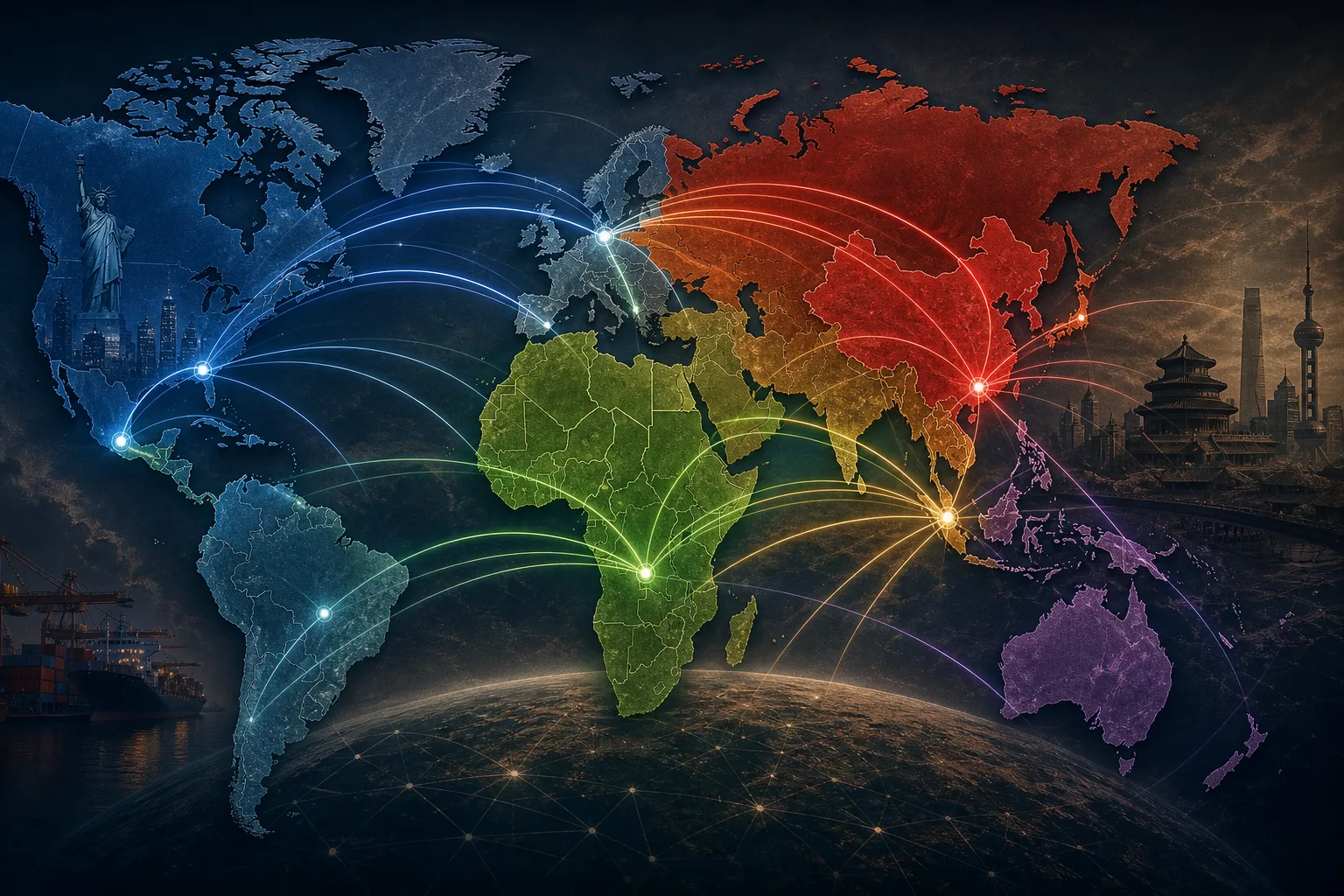
Global trade is not collapsing; it is being rewired. The world is sorting into overlapping economic patches — U.S.-led, China-centered, BRICS+, and a plurilateral trade web — while middle powers hedge, connector economies absorb diverted flows, and military redlines harden from Hormuz to Guyana. The result is not deglobalization but a messier, more expensive form of integration shaped by geopolitical sentiment as much as by geography.
The question is no longer whether the post-Cold War order survives. It does not. The better question is what replaces it — and whether the replacement looks like closed empires or overlapping patches stitched together by fear, profit, and the stubborn physics of shipping lanes.
The Patchwork, Not the Breakup
Headline writers say deglobalization. Economists who read the freight data say something subtler. Global trade and foreign investment have not retreated to autarky; they have lengthened, rerouted, and clustered. Direct U.S.–China trade in sensitive sectors fell sharply in 2025, yet total world trade kept growing — much of it flowing through connector economies that import Chinese components, assemble them, and export finished goods westward. Mexico, Vietnam, and Malaysia are not neutral ground. They are switchyards.
Boston Consulting Group calls the emerging shape a multi-nodal patchwork: four gravitational fields rather than two Cold War poles. The United States anchors one. China anchors another. BRICS+ — Brazil, Russia, India, the Gulf entrants, Indonesia, and others — forms a third, prioritizing sovereignty and parallel financial plumbing over deep legal integration. A fourth bloc, the plurilateralists, clusters around CPTPP members, the European Union, South Korea, and Britain — nations still committed to rules-based trade but increasingly building structures that do not require Washington’s permission.
This is reglobalization: more integration, worse plumbing. Flows between rival camps grow more slowly than flows within them. Investment follows sentiment. The WTO fades; CPTPP, RCEP, and bilateral side-deals multiply. The world is not segmenting into self-contained regions so much as into sentiment groupings — who you trust when the strait closes, whose chips you can run, whose insurance will cover the hull.
The Western Hemisphere Redline
If any theater has graduated from nuisance to redline, it is the arc from the Caribbean lanes through Venezuela to Guyana’s Essequibo frontier. Washington’s January 2026 intervention — the capture of Nicolás Maduro and the sustained U.S. military presence in the southern Caribbean — did not resolve the triangle. It froze one vertex while hardening another.
Guyana, sitting atop the decade’s largest offshore oil discovery, now carries the most expansive defense partnerships in Caribbean history. President Irfaan Ali has been explicit: Maduro’s removal did not retire Venezuela’s territorial claim over the Essequibo, and Guyanese sovereignty cannot be outsourced. ExxonMobil’s Stabroek Block makes the dispute a energy-security problem for the hemisphere, not a border skirmish. Secretary of State Marco Rubio warned Caracas in 2025 that aggression against Guyana or U.S. operators would invite consequences — language that reads, in 2026, as doctrine rather than rhetoric.
The Caribbean is not free of eastern influence, whatever that phrase is taken to mean. Cuba remains under intensifying U.S. pressure as Venezuelan oil flows falter. Chinese infrastructure lending and diplomatic presence persist across the region, though not at the scale of Beijing’s African portfolio. What has changed is the American perimeter: the southern Caribbean is now treated as a security space where narcotics interdiction, regime change, and energy access overlap. Venezuela–Guyana is less a Venezuelan ambition than a test of whether the United States will treat the northern tier of South America as a managed zone the way it once treated the Persian Gulf.

Singapore and Malaysia: Quiet Alignment by Sector
Southeast Asia’s two most consequential hedgers do not shout. They calculate.
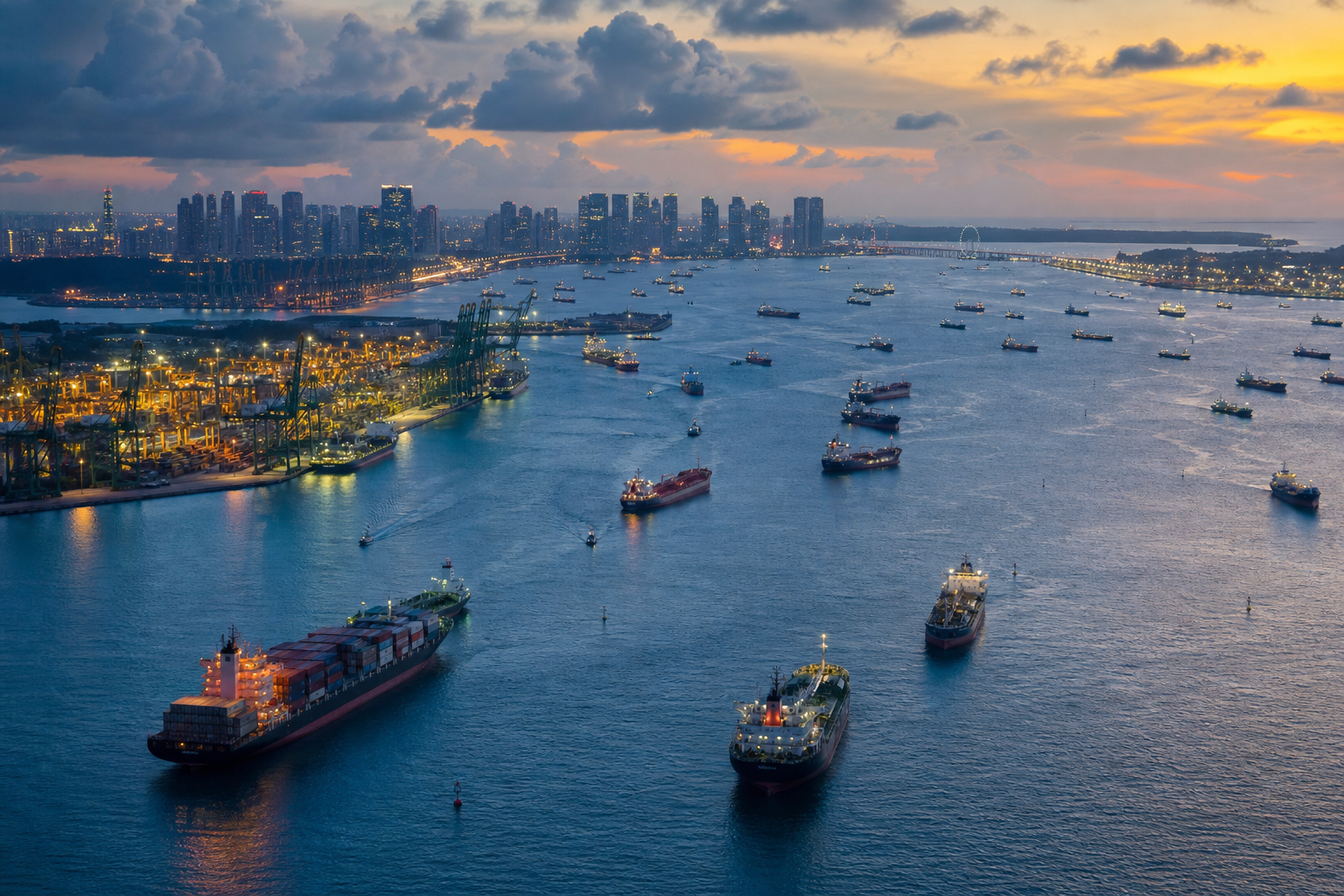
Singapore remains the republic of “no” — refusing to choose between Washington and Beijing while hosting both. Foreign Minister Vivian Balakrishnan has framed the Malacca Strait as a littoral commons: Singapore, Malaysia, and Indonesia share an interest in keeping it open, untolled, and governed by UNCLOS transit rights. That position looks almost quaint when Hormuz is mined and Iran demands route fees, which is precisely why it matters. Singapore’s nightmare is contagion — a world where chokepoint politics becomes normal, where every strait has a toll collector and insurance underwriters price navigation out of existence.
Malaysia still speaks the language of nonalignment, ASEAN centrality, and an open trading system. Under Prime Minister Anwar Ibrahim, Putrajaya brokered a Thailand–Cambodia ceasefire and convened an ASEAN–Gulf–China summit that showcased convening power without formal allegiance. But ISEAS research captures the drift beneath the rhetoric: neutrality by sector. Malaysia’s semiconductor industry sits inside a U.S.-led technical architecture. When Washington demanded mirrored export controls in the America–Malaysia trade framework, Kuala Lumpur complied — not because it chose a side in public, but because its most valuable exports already lived on the American side of the fence.
Both states belong to the plurilateral patch in trade ambition and the hedging patch in security. Both worry about the same thing: being forced to declare before they are ready.
Northeast Asia: Alignment, Armament, and the CRINK Edge
Japan and South Korea are moving the opposite direction — toward visible alignment. Rare-earth coercion from Beijing, North Korea’s nuclear expansion, and doubt about America’s staying power have pushed Tokyo and Seoul into semiconductor cooperation, critical-minerals diversification, and tighter trilateral coordination with Washington. The historical grievances remain; the structural pressures are stronger.
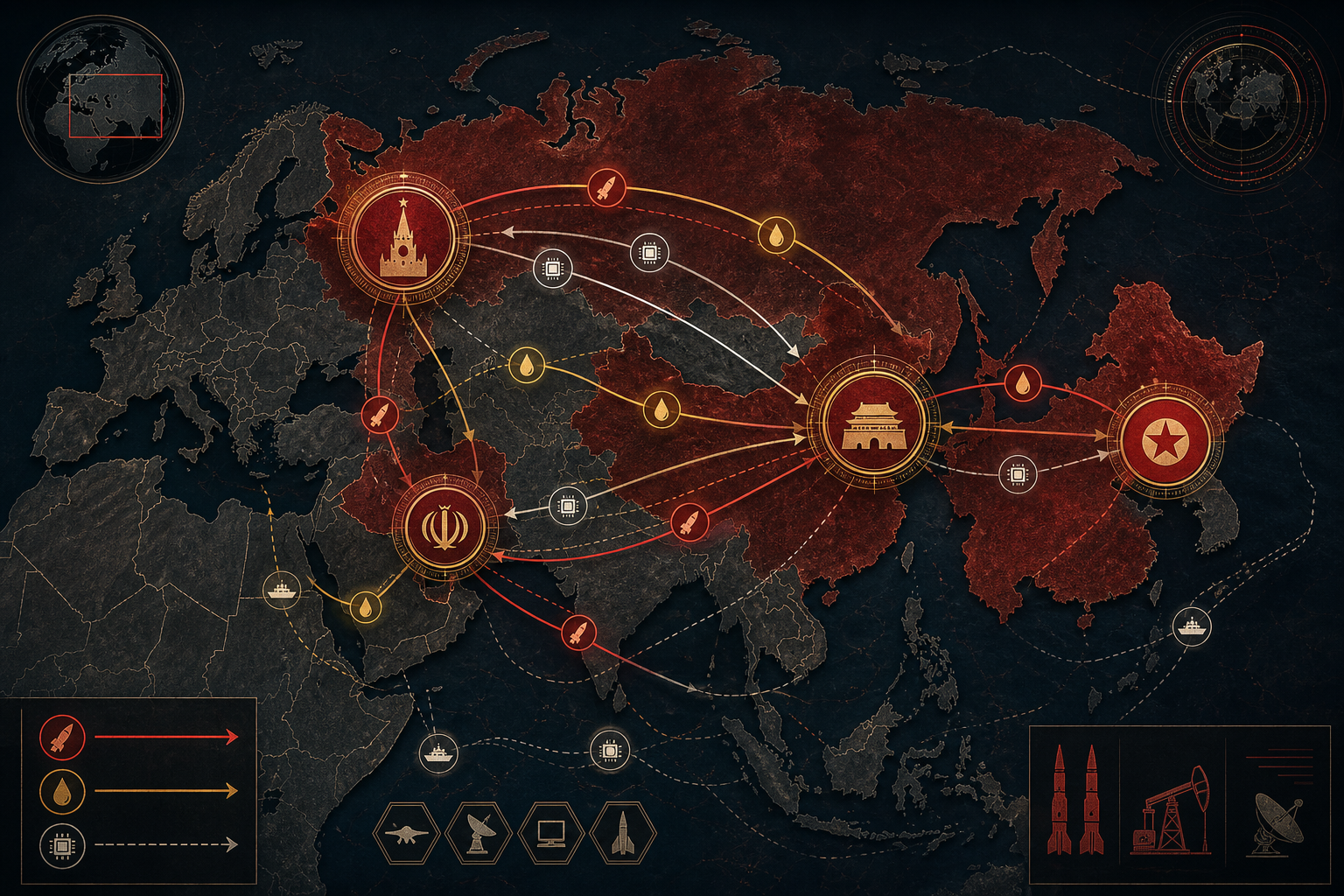
North Korea occupies a different node entirely. Ammunition, missiles, and reportedly troops for Russia’s Ukraine war have bought Pyongyang diplomatic oxygen and hard currency. The mutual-defense treaty with Moscow formalizes what was already a wartime supply chain. North Korea is not hedging. It has picked the revisionist patch.
What Russia Wants — and Who Shares the Dream
Russia’s war aim is larger than Donbas. Vladimir Putin has spent two decades campaigning for a post-West order: multipolar, sphere-based, and institutionally hostile to NATO’s border creep. The February 2026 consultations on a Eurasian security architecture — launched as Ukraine negotiations intensified — are Moscow’s bid to codify that vision: a continental framework where security decisions are made in Moscow and Beijing, not Brussels, open to European states that accept the new perimeter on Russian terms.
Russia does not lead a unified bloc. It leads a grievance network sometimes called CRINK — China, Russia, Iran, North Korea — that CSIS and the Atlantic Council treat as coordination without alliance. China buys Russian oil and signs technology deals but will not subordinate its commercial interests to Putin’s timetable. Iran trades drones and doctrine for sanctions relief and strait leverage. North Korea trades metal and men for cash and cover.
Who shares the dream? In full, almost no one. In part, much of the global south that resents dollar weaponization, IMF conditionality, and Western double standards on territorial integrity. BRICS+ expansion — Egypt, Ethiopia, the UAE, Indonesia — reflects appetite for alternative platforms, not appetite for Russian military leadership. Brazil and India still trade with everyone. The shared dream is strategic autonomy, not Muscovite empire. Russia offers the vocabulary; China offers the capital; Iran and North Korea offer the willingness to fight asymmetrically.
Reading the Map
Deglobalization is the wrong word. The world is re-globalizing along faction lines — patches of trust, patches of denial, connector economies profiting from the friction. The Caribbean and the Guiana Shield are now inside an American security perimeter whether Caracas accepts it or not. Singapore and Malaysia preserve optionality until sectoral dependence chooses for them. Japan and South Korea align upward. North Korea and Iran align downward into Russia’s wartime orbit.
The actionable principle is blunt: follow the binding constraint, not the press release. Whichever power can close the strait, deny the chip license, or set the insurance premium is the power that sorts the blocs — regardless of what any foreign minister says about neutrality over espresso in Davos.
Continue reading


Sources
BCG multi-nodal trade patchwork analysis, World Economic Forum reglobalization framing, Bank for International Settlements bloc-trade data, ISEAS Malaysia geoeconomic alignment research, Belfer Center Singapore middle-power report, Bernama Balakrishnan Malacca remarks, Atlantic Council and CSIS CRINK analysis, KIEP Eurasian security architecture assessment, Guyanese and Bloomberg reporting on Essequibo and U.S. intervention, IMF July 2026 World Economic Outlook.


