

A new U.S. order on foreign-made grid equipment and a Senate proposal targeting Chinese optical transceivers extend the AI rivalry beyond chips. The policy shift puts power hardware, data-center networking, and technical talent at the center of a supply-chain contest once defined mainly by advanced processors.
The U.S.-China technology contest has moved from the chip into the room around it. Washington’s August executive order on foreign-made transformers, high-voltage circuit breakers, and related grid equipment creates a route to restrict components linked to China and 23 other countries. A separate Senate proposal would bar federal national-security systems from buying Chinese optical transceivers.
Neither measure bans every component immediately. The Energy Department must first identify risky equipment and issue implementing rules. But the direction is clear: an AI data center is no longer treated as a stack of servers. It is a strategic assembly of power conversion, cooling, cables, switching, and skilled operators.
The optical module is now a national-security object
The issue is less glamorous than a GPU, but it is central to an AI cluster. Optical transceivers convert electrical signals into light and move data between servers. At scale, a modern data center requires an enormous number of those links. Asia Times reports that the Coalition for a Prosperous America estimates Chinese firms control roughly 70% of the global optical-module market.
That creates an uncomfortable mismatch for policymakers. The United States can constrain the most advanced processors while leaving a substantial part of the network fabric exposed to Chinese supply. A procurement restriction would not solve the manufacturing challenge overnight. It would instead force operators and suppliers to map components, validate substitutes, and accept that hardware origin can become a deployment constraint.
The transformer order works on the same logic. A data center cannot turn a shipped accelerator into usable compute without a powered site. Equipment that once looked like ordinary industrial procurement can become an intelligence concern when it sits at the junction of high-voltage infrastructure and a sensitive computing workload.
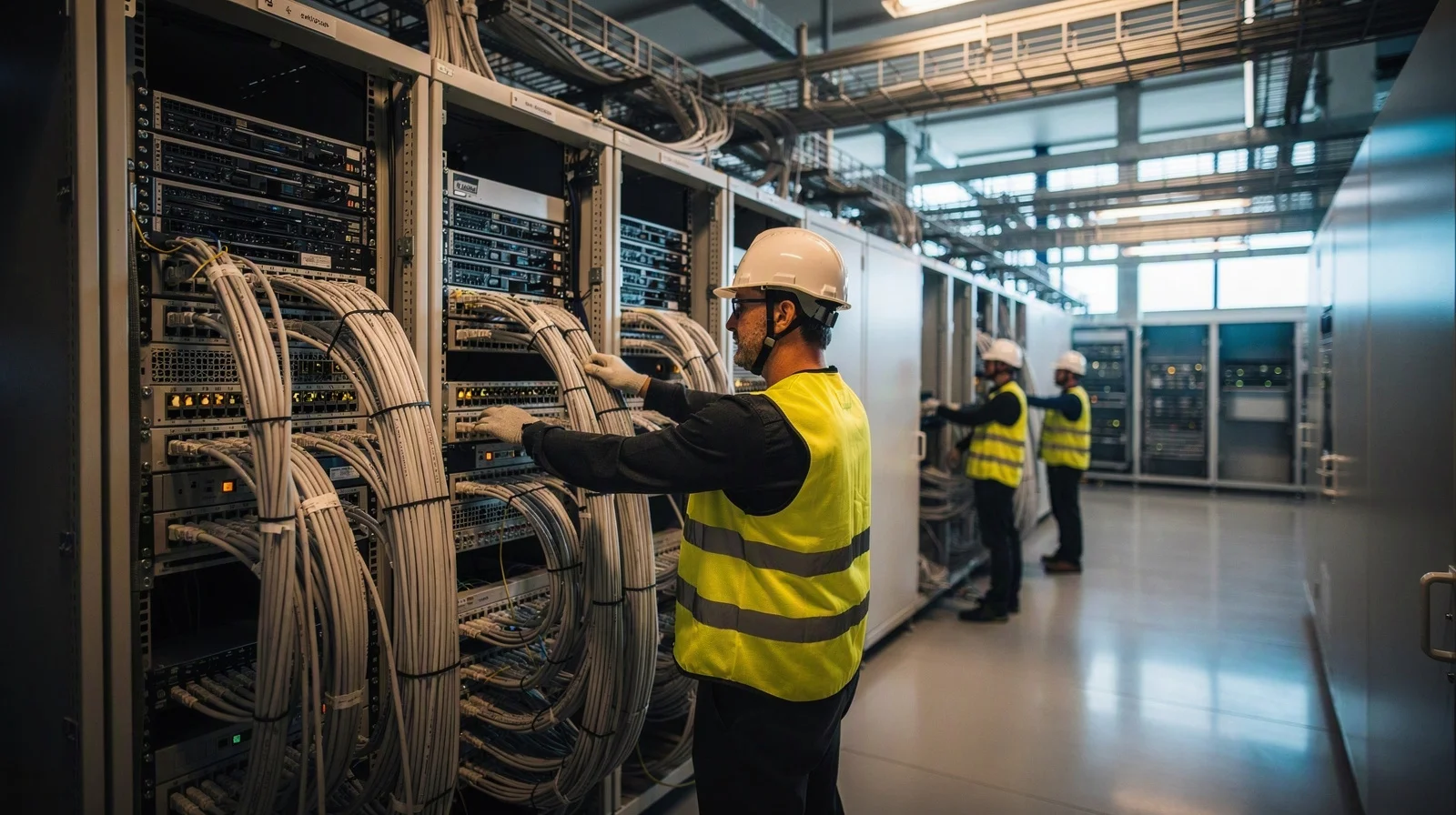
Supply-chain security meets a capacity shortage
The policy arrives when the U.S. is trying to build more data centers, not fewer. That makes it a harder form of restriction than a simple import ban. Replacement equipment must be available on a construction schedule; the testing burden lands on customers already waiting for interconnection, switchgear, and cooling capacity.
European suppliers are already reorganizing around that reality. Legrand’s acquisitions of U.S., European, and Chinese equipment companies show how the market is becoming regional even before final U.S. rules arrive. The competitive question is no longer merely who makes the best component. It is who can deliver compliant capacity in the geography where a tenant needs it.
That is why the fight over AI power costs and supply-chain security are becoming one story. A campus must now secure electricity, transmission upgrades, approved equipment, and finance at once. A delay in any one layer can idle the entire investment.
Talent controls mirror the hardware contest
Asia Times also reports that China has tightened travel approvals for relatives of key AI personnel, following new rules that allow authorities to halt overseas travel on national-technological-security grounds. The reporting is difficult to independently verify, but the strategic logic is familiar: knowledge moves through people as well as equipment.
The AI rivalry is becoming a contest over the full operating system of compute, not just the processor at its center.
Washington still permits some advanced-chip exports to China, and both governments have discussed an AI dialogue. That coexistence is not a contradiction so much as a reminder that the relationship now has several gears. Commercial access, safety talks, export controls, equipment screening, and talent policy can all move in different directions.
For data-center developers and investors, the practical implication is direct. Procurement risk now sits beside power risk and credit risk. The next constraint may not be the chip a customer wants. It may be the transformer, optical module, or compliance approval needed to make that chip useful.
More in Geopolitics


Sources
Asia Times reporting on U.S. equipment restrictions, optical-transceiver proposals, and China’s technology-security measures; prior Culled reporting on data-center grid costs.
