

Saudi Aramco reported third-quarter 2026 adjusted net income of $31.2 billion on Nov. 3 and maintained a $21.9 billion base dividend, while chief executive Amin Nasser said preliminary engineering had started to expand the East-West pipeline from about seven million toward ten million barrels per day—the new material is scale, not another repair headline, and the binding constraint is STATE export insurance against Hormuz exposure funded by PLATFORM cash flow that also backs Aramco’s $2.6 billion Humain AI stake.
Culled’s September reporting tracked a bypass around the bypass—Oman transfers and half-capacity **Petroline** flows while the strait stayed hot. **Nasser’s** earnings-call language points past restoration toward a wider pipe that can carry more barrels west when gulf terminals wobble—the geopolitical read is insurance priced in steel, not rhetoric.
Riyadh, Nov. 8 — Saudi Aramco closed the third quarter with adjusted net income of 117 billion riyals ($31.2 billion), up 9 percent year on year and slightly ahead of consensus, according to the company’s results release and earnings-call coverage. The $21.9 billion base dividend framework held, signaling that export-disruption arithmetic has not yet forced a payout retreat even as regional conflict keeps Brent sensitive to every drone headline.
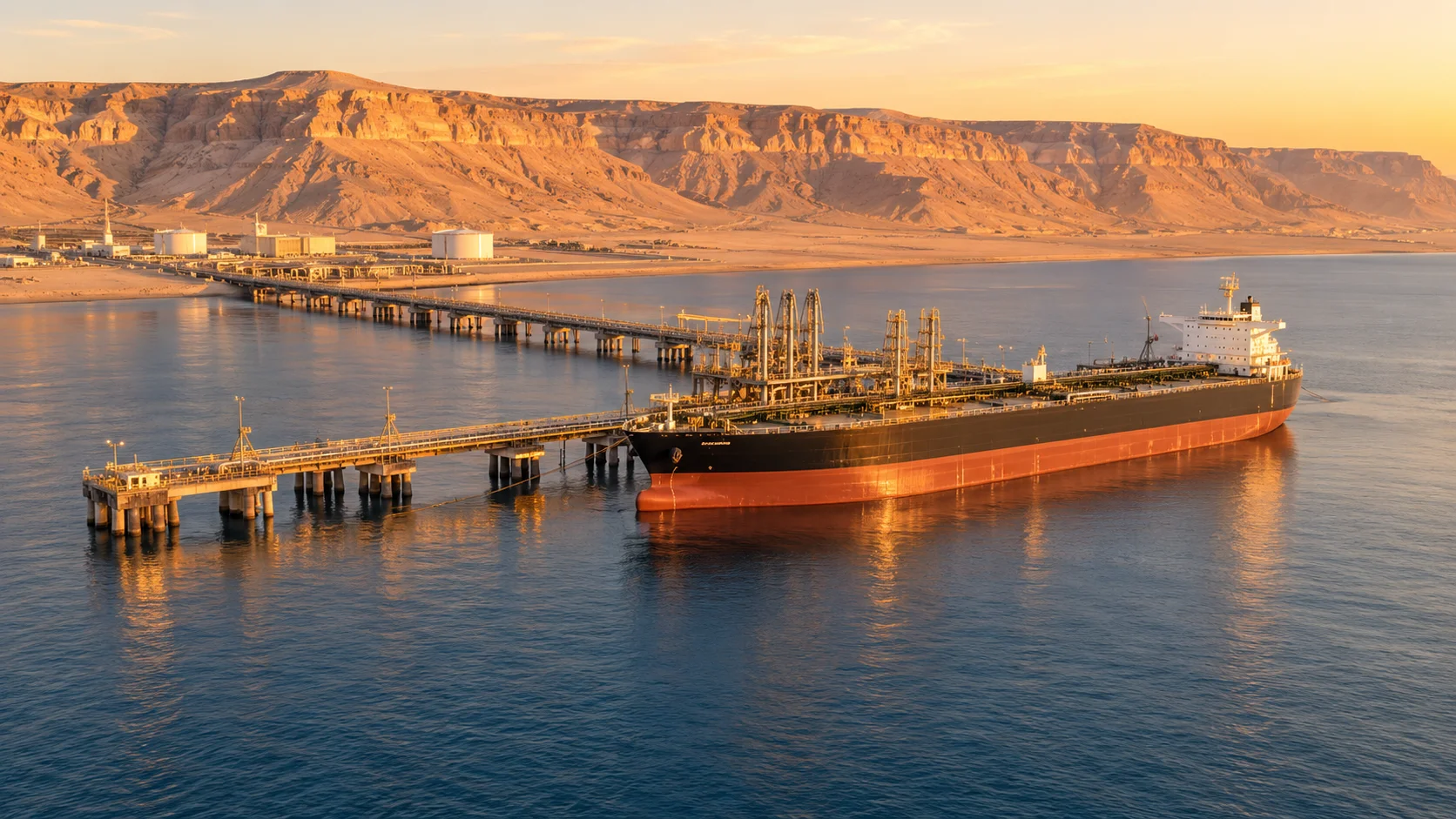
The strategic line item is infrastructure, not the beat itself. Chief executive Amin Nasser told analysts that preliminary engineering is underway to expand the kingdom’s East-West pipeline—the Petroline spine that moves crude from eastern fields toward Yanbu on the Red Sea—from about seven million barrels per day toward ten million, Asharq Al-Awsat reported Nov. 3. That is a step change from September, when Culled tracked repairs and Oman ship-to-ship work as improvised redundancy. Expansion talks convert improvisation into capital spending with a published throughput target, albeit still preliminary on schedule and cost.
Wartime payback in days, capex in decades
Nasser framed the pipe as already paying for itself: amid the current disruption, he said Aramco recovered the line’s entire construction cost in about 15 days of wartime throughput—a rhetorical bridge between emergency rerouting and a permanent wider corridor. The company continues Gulf terminal lifts, ship-to-ship transfers, and storage options at demand centers while restoring damaged assets; more than 90 percent of restart materials were sourced domestically, he added, with drone surveys and rapid-repair crews cited as reasons emergency fixes cleared benchmarks six times faster than industry averages.
The downstream segment’s adjusted EBIT rose more than $4 billion quarter on quarter, per the call recap, while upstream earnings reflected lower prices versus the prior quarter but still-strong realizations. Aramco maintained 2026 capital spending guidance at $50 billion–$55 billion, including restoration costs—discipline that still accommodates a $2.6 billion cash injection into Humain, its 49 percent AI infrastructure joint venture targeting 3 gigawatts of data-center capacity by 2030.
Export insurance and compute export ambition now share one balance sheet.
That juxtaposition matters for readers who treat Riyadh as only an oil bidder. STATE redundancy on crude routes and PLATFORM bets on AI hosting are not trade-offs in the earnings narrative; both are billed as competitive advantage funded by the same dividend-supported equity story.
Red Sea outlets and the insurance wall
Culled’s insurance constraint piece documented how Red Sea war risk repriced tanker cover even when barrels could move. A wider East-West system does not erase maritime peril at Yanbu, but it increases the share of volume that can avoid Hormuz chokepoint politics without depending on every VLCC accepting a quoted premium. The falsifier is effective throughput: preliminary engineering is not installed capacity. Until commissioning dates and pumping tariffs land, traders should treat ten million barrels per day as directional intent, not spare capacity on a balance sheet.
The company also reiterated optional upside to maximum sustainable capacity above 12 million barrels per day if Riyadh orders it—a reminder that spare production and spare pipe are different levers. Zuluf field expansion toward 600,000 barrels per day by year-end continues on schedule, Nasser said, linking upstream additions to the same resilience story.
Strait politics versus pipe politics
Hormuz remains the world’s most quoted risk factor in crude, and Culled’s permission-market framing still applies: the strait is not binary open-or-closed, but a curve of delays, escorts, and insurance spreads. Aramco’s response is to stack options—Gulf lifts, Oman transfers, Red Sea pipes, floating storage—so customers see continuity even when any one node fails.
For sovereign investors, the lesson of this quarter is continuity of payouts plus escalation of physical hedges. For oil consumers, the lesson is that Saudi redundancy projects are accelerating while the conflict Nasser called the energy industry’s largest supply shock is still live. Brent may ease on logistics success, as in September, without geopolitical risk disappearing from the term structure.
Yanbu can take more barrels when the desert pipe widens; Hormuz still sets the price of everything that must pass it.
Continue reading


Sources
Aramco third-quarter 2026 results release; Asharq Al-Awsat Nov. 3 on pipeline engineering and earnings call; Culled September East-West bypass coverage.


