

Afghanistan’s Government Media and Information Center said Afghan and Russian private-sector representatives signed fifteen memorandums valued at $103 million in Kabul on Nov. 12, covering medicine, wheat, flour, cooking oil and fresh-produce exports including pomegranates. Deputy Prime Minister Alexei Overchuk led a Russian economic mission the same week; Interfax quoted him putting January–August 2026 bilateral turnover above $349 million. Kabul also approved a foreign-investment policy and a fixed-tax regime for commercial imports. Memoranda are not shipments or settled payments—the test is whether Moscow’s diplomatic access becomes usable commercial infrastructure while Pakistan-border reroutes and rising staple prices raise the payoff for alternative supply lines.
Culled’s October peg on Russia–Afghanistan trade left dates, agreements and payment rails open. The Nov. 12 memorandum package is the first batch of named commercial commitments on the tape—still not audited flows. This update tracks policy support, Overchuk’s visit, and what customs and Kabul wholesale prices would have to show before the corridor story graduates from diplomacy to infrastructure.
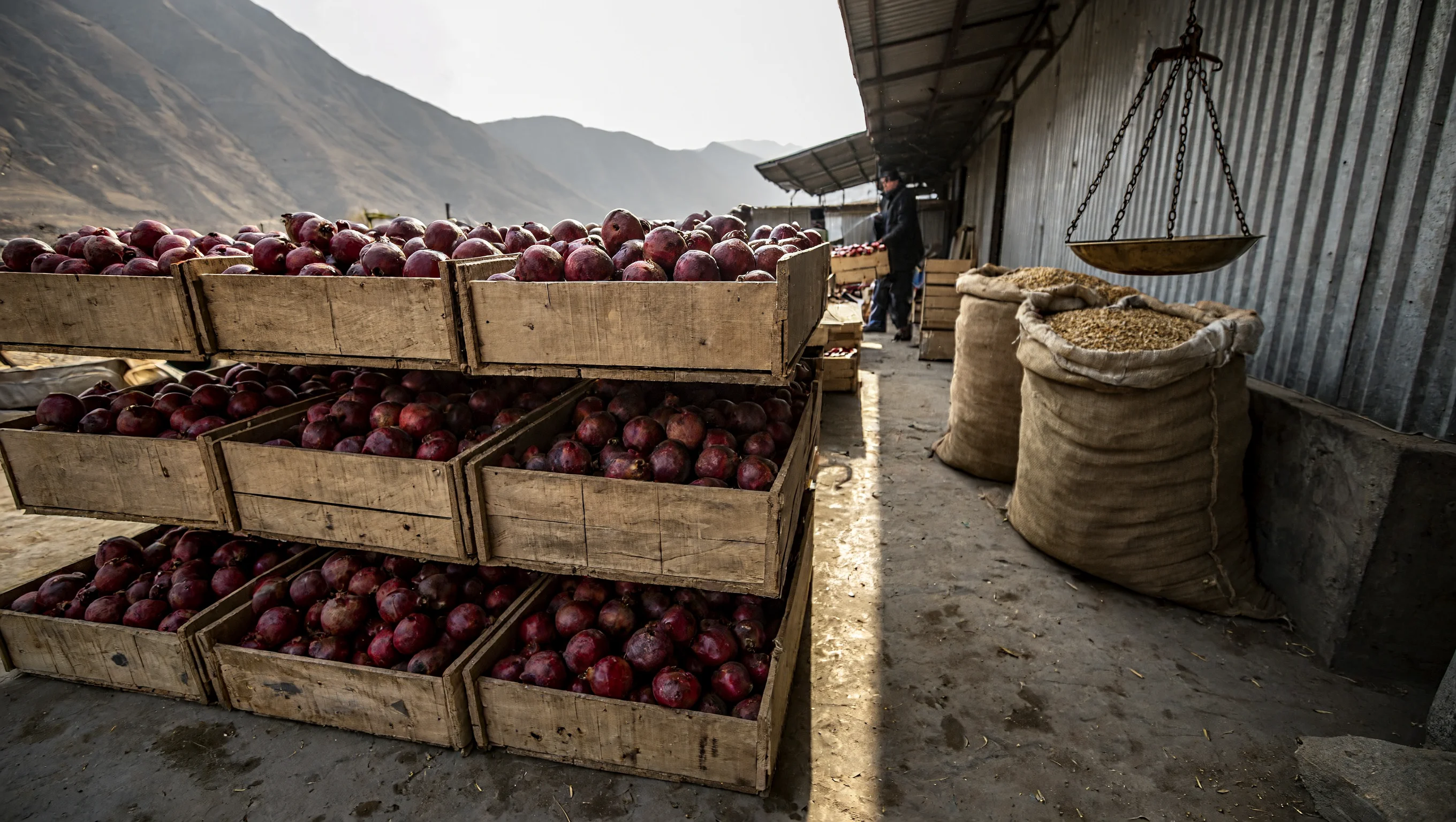
Kabul’s Saturday-to-Thursday news week opened with diplomacy and staples on the same tape. Afghanistan’s Government Media and Information Center said Afghan and Russian private-sector representatives signed fifteen memorandums valued at $103 million on 12 November, according to EconoTimes’ summary of the announcement. The package spans medicine, wheat, flour, cooking oil and fresh-produce sales toward Russia, with pomegranates singled out. Officials did not name signing companies, split values by deal or attach delivery schedules—readers should treat the figure as an announced aggregate, not cleared customs revenue.
The same visit cycle put Russian Deputy Prime Minister Alexei Overchuk in the room with Mullah Abdul Ghani Baradar Akhund, Afghanistan’s deputy prime minister for economic affairs. Baradar’s office asked for easier Russian market access, lower transit costs, simpler customs steps and longer visa treatment for Afghan traders, and invited Russian capital across health care, telecoms, agriculture, energy, mining and infrastructure, per the GMIC account. ACCI reported a chamber-level economic memorandum on 13 November and a Grand Hotel business session attended by roughly one hundred investors and traders from both sides—separate paperwork from the fifteen private memorandums, but part of the same corridor push.
A memorandum is a commitment to negotiate terms—not a wagon count, a letter of credit, or a paid invoice.
From Preview to Paper
Culled’s October reporting framed Russia’s Afghanistan bet as measurable corridor economics, not another recognition headline. That article tracked Overchuk’s mission before dates firmed and asked whether diplomatic access would produce signed trade architecture, border throughput and settlement paths. 12 November supplies the first large bundle of private memorandums on the record. Interfax, cited in the same GMIC reporting chain, quoted Overchuk putting January–August 2026 bilateral turnover above $349 million, with Russian exports up 2.1× and Afghan exports to Russia up 2.2× versus the year-earlier period—growth claims that still need independent customs confirmation.
Parallel policy moves matter because corridors fail in licensing and tax treatment, not only in handshake counts. The Kabul Tribune reported that Afghanistan’s Economic Commission, chaired by Baradar, approved a foreign-investment policy aimed at investor security and growth, alongside a fixed-tax payment system for commercial import companies working through customs offices. Those are rule changes, not foreign capital landed. They nonetheless lower friction if Russian grain, medicine and machinery volumes rise along Central Asian overland routes—the same geography Culled tied to import stress when Pakistan border closures pushed Kabul toward costlier reroutes.
Staples, Prices and What Would Falsify the Story
Afghan consumers price the corridor story at the wholesale stall, not the palace press room. Pajhwok on 14 November quoted market sources saying a 24-kg sack of Indian rice rose from 2,500 to 2,600 afghanis and sugar nudged higher, while Kazakh flour held near 1,600–1,650 afghanis for a 49-kg sack and diesel ticked up to 86 afghanis per litre. Traders attributed some moves to higher import volumes in Kabul markets—a reminder that memorandums on Russian wheat and oil must show up as competing supply and stable wholesale quotes, not only as bulletin text.
Do not collapse every November memorandum into one Russia narrative. During Afghanistan Energy Week on 9–10 November, UNDP reported an Afghanistan International Bank memorandum with 77 Construction Group on a Herat wind project—40 MW initially, with statements citing 200 MW scale-up plans and an Afghanistan Credit Guarantee Foundation guarantee under a de-risking facility. That is domestic bank paperwork for renewables, not a Russian export line item. Treat it as evidence Kabul is shopping parallel financing rails, not proof the $103 million Russian package is already funded.
Scorecard for the Next Print
The honest posture after 12 November is announced commercial architecture plus policy support, not completed trade flows. Watch four channels Culled flagged in October, now with names attached.
Contract annexes and counterparties. Fifteen memorandums without company lists cannot be reconciled to shipments. Public signatory names, Incoterms and payment currency would convert rhetoric into audit trails.
Customs and corridor throughput. Hairatan rail links and overland legs into Kabul should echo in cargo dwell, wagon counts and Afghan import revenue if Russian grain and medicine volumes scale.
Banking and settlement. Large bilateral trade needs correspondent paths, trade-house clearing or triangulated currencies. Central-bank notices and documented letters of credit matter more than turnover multiples in a deputy prime minister’s speech.
Staple-market behavior. If Russian supply is real, wholesale flour, oil and rice should eventually compete with Central Asian and Pakistani-routed stock without relying on border shocks alone—while import-route stress still sets the baseline.
Moscow already holds the political door in Kabul. 12 November suggests that access is producing usable commercial paper and domestic rule tweaks Kabul traders can cite at customs. The falsifier is unchanged: flat border statistics, anonymous memorandums and staple prices that ignore the new supply story would mean the corridor remains diplomacy dressed as trade. The next hard prints are company-level deal text, September-forward trade releases both capitals publish, and Kabul wholesale panels that move when Russian cargoes actually land.
Continue reading


Sources
EconoTimes and GMIC on fifteen Nov. 12 memorandums; Kabul Tribune on foreign-investment and fixed-tax import policy; Pajhwok on Kabul staple prices Nov. 14; ACCI on Overchuk visit; UNDP on separate Herat wind MoU via Afghanistan International Bank


